
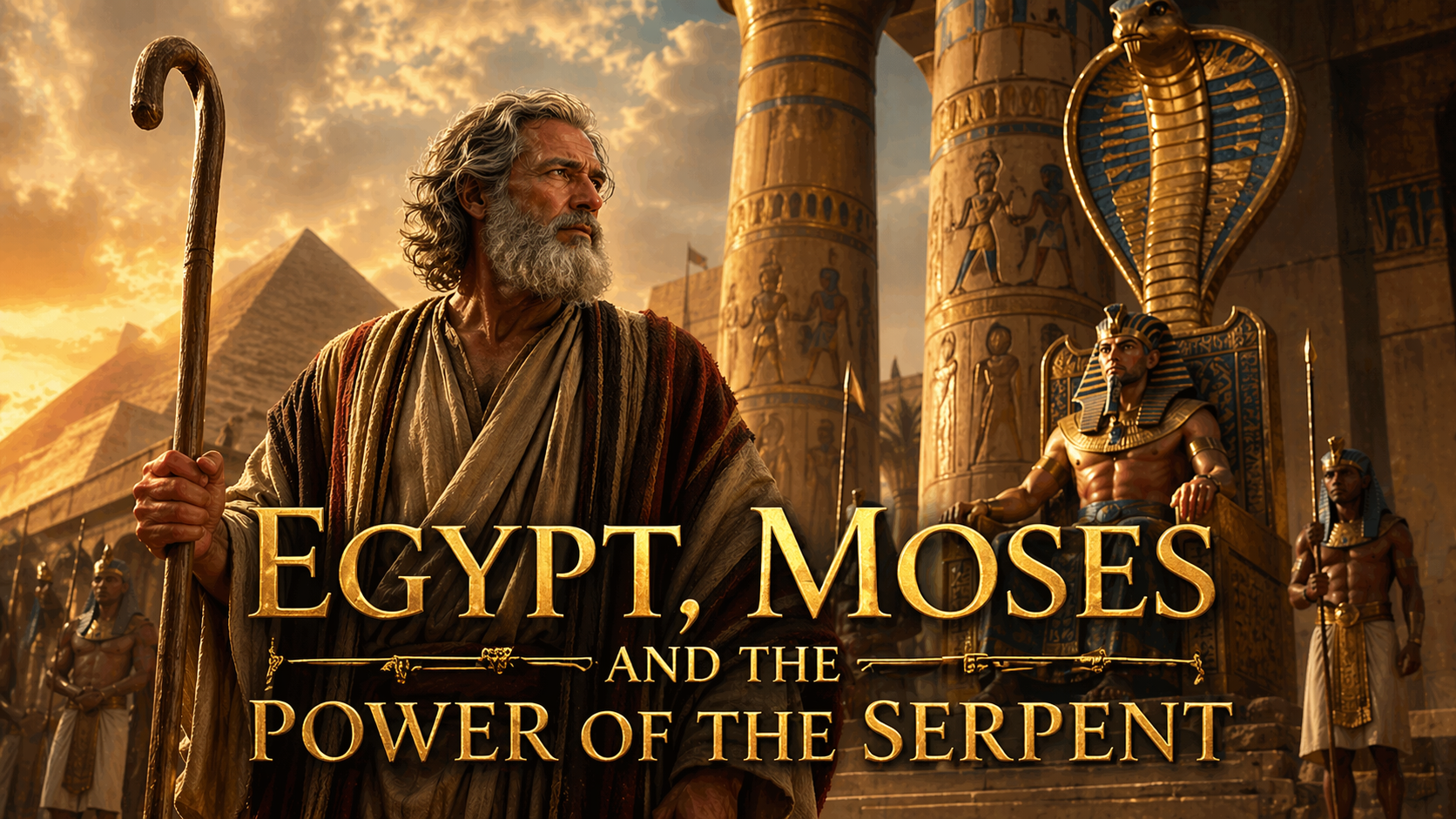
Egypt, Moses, and the Power of the Serpent
Ancient Egypt is one of the most fascinating civilizations in world history. Its pyramids, temples, royal tombs, and towering monuments still capture the imagination of millions. Yet behind all of Egypt’s splendor stood a spiritual system deeply shaped by ideas about death, power, and the afterlife. In the Bible, Moses enters that world not merely as a former prince of Egypt, but as God’s chosen messenger sent to confront one of the most powerful empires on earth.
In this presentation, Dr. Michael Hasel explores the biblical story of Moses against the archaeological and historical backdrop of ancient Egypt. His focus is not just on kings and monuments, but on a deeper conflict, the clash between the God of heaven and the serpent-centered religious ideology of Egypt. The result is a compelling look at how archaeology, Egyptian texts, and Scripture together illuminate one of the Bible’s most dramatic accounts.
The Bible Stands in History
One of the major themes presented is that the Bible is unique among the world’s religious books because it is grounded in real history. From Genesis to the Gospels, Scripture places its message in actual lands, among actual nations, and in the lives of real rulers and real people. This means the Bible invites investigation. It mentions events, cities, kings, and conflicts that can be studied against the material remains of the ancient world.
That is one reason archaeology matters so much. It helps us understand the historical setting in which God worked. Rather than existing in some vague spiritual realm removed from reality, the Bible presents God as acting in time and space. He creates, calls, speaks, judges, delivers, and saves within the very flow of human history.
Egypt and the Nile
Egypt owed its very existence to the Nile River. The annual flooding of the Nile made agriculture possible and sustained the kingdom for thousands of years. Ancient writers like Herodotus famously described Egypt as the gift of the Nile, and archaeology confirms how central the river was to every part of Egyptian life.
That dependence also shaped Egyptian religion. The Nile was not simply a river. It was tied to divine power. The land, the crops, the kingship, and the hope of life after death were all connected to a worldview in which nature and the gods operated together. In such a culture, the king was not merely a political leader. He was deeply woven into the religious life of the nation.
Egypt’s Obsession with the Afterlife
The pyramids, royal tombs, funerary shrines, and burial treasures of Egypt reveal a civilization consumed with the question of what comes after death. Their monuments were built not only to honor kings, but to secure their future in the next life. Huge efforts were made to preserve the dead body, protect the king’s name, and prepare him for existence beyond the grave.
What stands out in Dr. Hasel’s presentation is how often the serpent appears in this setting. Serpents show up in Egyptian tomb art, royal iconography, and afterlife texts. They are connected with protection, guidance, divine power, and even the journey into eternal existence. The serpent was not a minor symbol. It was central.
This creates a striking contrast with the Bible. In Genesis 3, the serpent is the deceiver, the one who twists the truth about God and death. In Egypt, however, serpent symbolism became deeply embedded in royal and religious ideology. That tension becomes especially important in the story of Moses.
The Power of the Serpent in Egyptian Religion
Egyptian texts and artwork frequently present the serpent as a guardian and a symbol of divine authority. Royal thrones, shrines, death masks, and tomb walls often include serpent imagery. In some depictions, serpents are associated with eternal life. In others, they protect the king as he journeys through the afterlife.
Dr. Hasel highlights how dramatically different this is from the biblical worldview. In Scripture, death is an intruder, an enemy, not a creative force. God created humanity for life, not for death. Yet Egyptian religion came to see death as part of the fabric of cosmic existence, something navigated through ritual, magic, and divine protection.
That helps explain why the confrontation between Moses and Pharaoh is so much more than a political standoff. It is a direct challenge to the spiritual foundations of Egypt itself.
The Princess, the Palace, and the Child from the Nile
The story of Moses’ early life takes on even more meaning when placed beside the dynastic tensions of Egypt’s 18th Dynasty. Dr. Hasel points to a period of royal instability in which succession was a major issue. Several generations struggled with producing strong male heirs through the chief royal line. In that context, the adoption of a Hebrew baby boy by an Egyptian princess becomes especially interesting.
Moses, drawn from the Nile, was raised in the palace and educated in the highest levels of Egyptian culture. He would have known the language, the court system, the military structure, and the religious symbols of Egypt. He grew up with access to privilege, power, and the possibility of becoming deeply embedded in the ruling system of the empire.
And yet the Bible says that when he came of age, he refused that identity. He chose instead to suffer with the people of God rather than enjoy the fleeting pleasures of sin. That decision was not small. It meant turning away from status, wealth, and perhaps even a path toward power in Egypt itself.
The Name of Moses
Even Moses’ name fits naturally into the Egyptian setting. As Dr. Hasel explains, the name is Egyptian in form and resembles names associated with royal identity. That detail supports the authenticity of the Exodus narrative rather than weakening it. Moses truly belongs in Egypt’s world, even though he ultimately rejects Egypt’s gods and Egypt’s vision of power.
This also reminds us that God often works within real cultures and real histories. He does not save people in a vacuum. He calls them out of the systems they know and leads them into truth.
Bricks, Straw, and the Historical Setting of Exodus
One of the classic details in Exodus is the making of bricks with straw. For a long time, some critics treated this as unrealistic or legendary. Yet archaeology and Egyptian texts have shown otherwise. Egyptian tomb scenes depict brickmaking, and ancient records complain about a lack of straw for making bricks. Even in more recent centuries, similar building methods have remained in use in parts of Egypt.
This is a good example of how archaeology does not prove every spiritual truth of Scripture, but it often confirms the realism of the world the Bible describes. Exodus does not read like fantasy because it was not written as fantasy. It belongs in the setting of ancient Egypt.
Hatshepsut, Thutmose III, and the Question of Moses
A major part of Dr. Hasel’s presentation considers the pharaohs who may fit the timeline of Moses’ life. He examines the 18th Dynasty, including Hatshepsut, Thutmose III, and Amenhotep II. Hatshepsut is especially significant because of her unusual role as a female ruler and because of the political tensions surrounding royal succession.
Her story includes attempts to secure legitimacy, monumental building projects, and later the erasure of her image from public memory. Dr. Hasel suggests that the larger dynastic tensions of this period may shed light on why Moses’ place in the royal court would have mattered so much and why his return later in life would have been such a serious challenge.
Whether or not one agrees with every identification, the broader point remains strong. The biblical story of Moses fits naturally into a very real historical period in Egyptian history marked by instability, royal ambition, and the struggle for succession.
Moses, Aaron, and the Serpent Before Pharaoh
One of the most dramatic moments in the Exodus account comes when Moses and Aaron stand before Pharaoh and Aaron’s rod becomes a serpent. Pharaoh’s magicians do the same, but Aaron’s rod swallows theirs. In the biblical story, this is a sign of God’s superiority. In the Egyptian context, it becomes even more powerful.
Why? Because the serpent was one of Egypt’s own symbols of royal and divine power. Pharaoh wore it on his crown. It represented protection, authority, and the strength of Egypt’s gods. So when the rod of God swallows the serpents of Pharaoh’s magicians, the message is unmistakable. The God of Israel is greater than Egypt’s entire religious system.
This is not just a miracle. It is a theological confrontation. The symbol Egypt trusted becomes the very symbol through which Egypt is humbled.
Why Egypt Never Recorded the Exodus Like the Bible Does
A common question is why Egypt did not leave behind a straightforward record of the Exodus. Dr. Hasel offers an important historical observation. Ancient empires did not normally record their defeats honestly. Their inscriptions celebrated victories, strength, and divine favor. Public admissions of humiliation were rare to nonexistent.
That makes the silence of Egypt less surprising, not more. In fact, if the plagues and Exodus truly struck at the heart of Egyptian religion and kingship, they would have represented a devastating ideological collapse. Such a defeat would be precisely the kind of event an empire would avoid commemorating in its official records.
By contrast, the Bible regularly records the failures, sins, defeats, and humiliation of God’s own people. That honesty sets Scripture apart from the boastful style of royal propaganda found in the surrounding world.
Ruins, Judgment, and the God of History
The presentation closes by reflecting on the ruins of Egypt itself. The temples, tombs, and monuments remain impressive, but they are ruins nonetheless. The once-mighty empire that seemed invincible has long since passed. This reality echoes the biblical prophets, who warned of judgment and desolation.
What remains today is not Egypt’s eternal power, but the evidence that earthly empires rise and fall while God remains sovereign over history. He is the one who sets up kings and removes them. He is the one who calls Moses out of the Nile and later sends him back to confront Pharaoh. He is the one who delivers His people and keeps His promises.
Final Thoughts
Egypt, Moses, and the Power of the Serpent is more than a lecture on archaeology. It is a reminder that the Bible’s great themes, creation, deception, death, deliverance, and judgment, unfold in the real world. The symbols of Egypt, the history of its rulers, and the remains of its monuments all help us see the Exodus story with greater depth.
Moses did not confront a vague spiritual darkness. He stood against a powerful empire saturated with serpent symbolism, afterlife obsession, and royal self-exaltation. And in that conflict, the God of heaven made His power known.
For believers today, that same God still rules over history. Kingdoms rise and kingdoms fall, but His word stands. The ruins of Egypt are silent now, but Scripture still speaks, and its message remains clear: the Lord alone is God, and He is able to save.
Discover more from Fannin County Seventh-day Adventist Church
Subscribe to get the latest posts sent to your email.


