
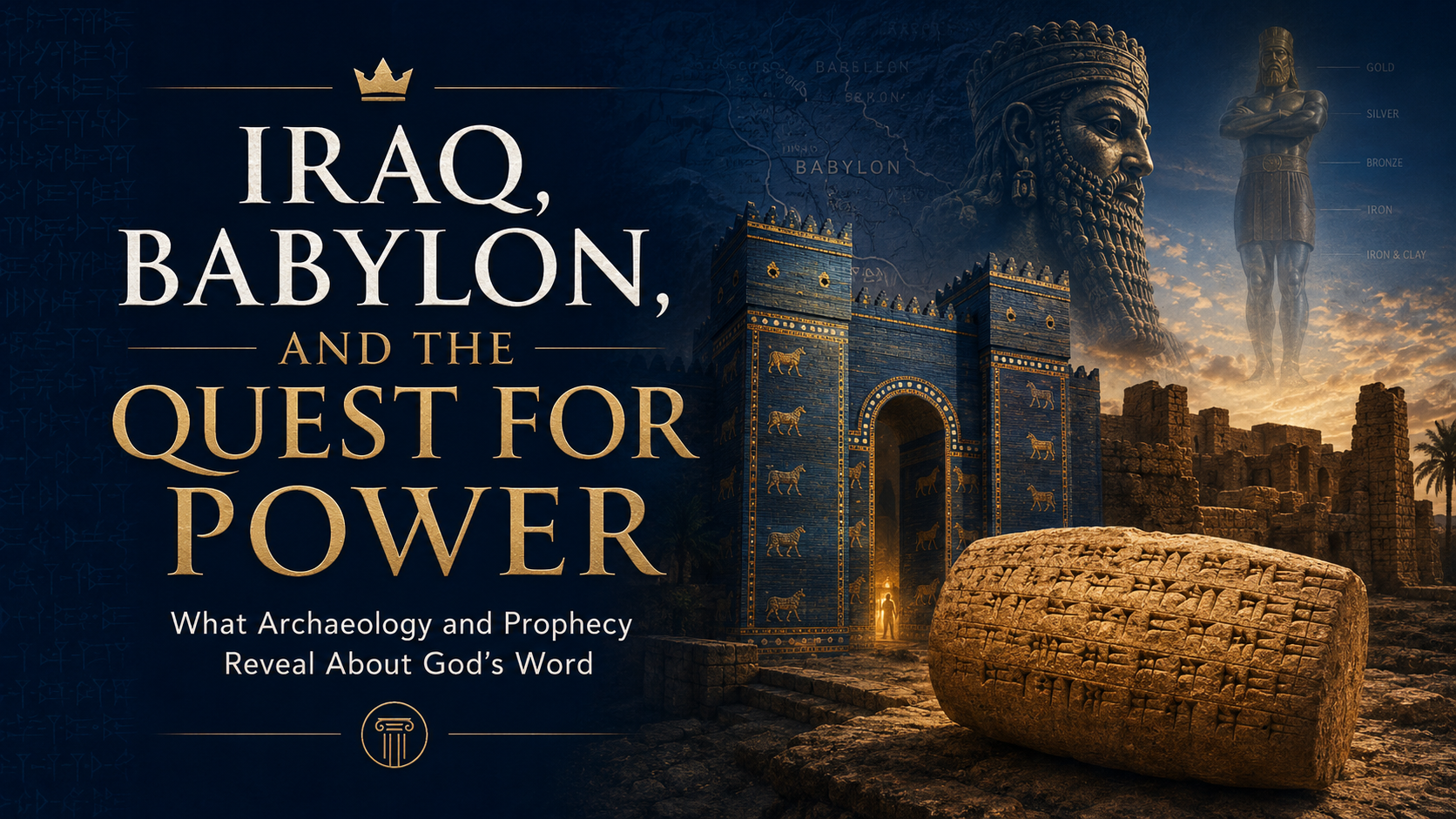
Iraq, Babylon, and the Quest for Power: What Archaeology and Prophecy Reveal About God’s Word
Few cities in history carry the weight of Babylon.
Babylon was more than an ancient city. It became a symbol of power, pride, human ambition, false worship, political greatness, and final judgment. Its ruins still speak today. Its name still appears in conversations about empire, prophecy, and the conflict between human pride and the kingdom of God.
In Part 4 of Greatest Discoveries in the Land of Israel, Dr. Michael G. Hasel takes us into the world of Iraq, Babylon, Nebuchadnezzar, Daniel, and the quest for power. The lecture connects ancient history with modern events. It also reminds us that the Bible is not disconnected from the real world. Scripture speaks into history, archaeology, prophecy, and the deepest questions of the human heart.
At the center of it all is one powerful truth:
The kingdoms of this world rise and fall, but the Word of God stands forever.
Babylon and the Human Desire for Power
The lecture begins by connecting ancient Babylon with modern Iraq. Babylon is located in present-day Iraq, south of Baghdad. For thousands of years, this region has been connected with civilization, empire, and political power.
Dr. Hasel explains how Saddam Hussein saw himself in connection with Nebuchadnezzar. He tried to rebuild parts of Babylon and present himself as a modern successor to the ancient Babylonian king. He sponsored festivals, restored buildings, and used imagery that connected his rule with the glory of ancient Babylon.
That connection is important because it shows something that repeats throughout history.
Human rulers often want more than leadership. They want legacy. They want greatness. They want their names carved into stone, stamped on bricks, printed on coins, or remembered in monuments.
Babylon represents this desire in a powerful way.
It was a city of walls, gates, temples, processions, and royal pride. It was a city that seemed impossible to defeat. It stood as one of the greatest symbols of human strength in the ancient world.
But the Bible tells us that no kingdom is beyond the reach of God.
The Land Between the Rivers
The region of Babylon belonged to ancient Mesopotamia. The word Mesopotamia means “the land between the rivers,” referring to the Tigris and Euphrates rivers. This area became one of the earliest centers of civilization.
Many of the first great cities of human history developed there. The lecture mentions places like Ur, Uruk, and Kish. These were not small villages. They were early centers of government, religion, trade, education, and culture.
This is also the world connected to Abraham.
Genesis tells us that Abraham came from Ur of the Chaldeans. That means Abraham was not called out of a simple or primitive place. He was called out of one of the most advanced cities of his time.
Ur was wealthy. It had impressive buildings. It had beautiful craftsmanship. It had religious centers, royal tombs, and objects of gold, silver, lapis lazuli, and ivory. Archaeology has shown that Ur was a place of great sophistication.
That gives Hebrews 11:8 even more meaning:
“By faith Abraham obeyed when he was called to go out to the place which he would receive as an inheritance. And he went out, not knowing where he was going.”
Abraham did not leave comfort because he had a better earthly city already waiting. He left because God called him.
That is faith.
Abraham’s Call Out of Ur
When we understand Ur, we better understand the faith of Abraham.
God called Abraham away from wealth, security, culture, and familiarity. He called him to go to a land he did not know. Abraham could not search for travel options. He could not look up hotels. He could not review maps in the way we do today. He simply had the command of God.
And he obeyed.
This is one of the first major lessons of the lecture. Archaeology helps us see that Abraham’s obedience was not small. He was leaving behind a great center of civilization to follow the voice of God into the unknown.
That speaks to every believer today.
Sometimes God calls us away from what looks safe. Sometimes He leads us into a future we cannot fully see. Sometimes faith means leaving behind what is familiar because God has spoken.
Abraham’s life teaches us that God’s call is worth more than human security.
The Rise of Babylon
Over time, Babylon became one of the great powers of the ancient world. Long before Nebuchadnezzar, rulers like Hammurabi helped make Babylon famous.
Hammurabi is known for his law code, one of the most famous legal collections from the ancient world. Some of its laws have similarities to laws found in the Old Testament, though the biblical law is distinct in its theology, purpose, and view of human life.
This shows again that the Bible speaks into a real ancient context. The world of Genesis, Exodus, Daniel, and the prophets was not empty. It was filled with kingdoms, legal systems, temples, armies, rulers, and written records.
By the time we reach Nebuchadnezzar, Babylon had become a city with a long history behind it.
That raises an important question from the book of Daniel.
Did Nebuchadnezzar Really Build Babylon?
In Daniel 4:30, Nebuchadnezzar says:
“Is not this great Babylon, that I have built for a royal dwelling by my mighty power and for the honor of my majesty?”
Some have wondered how Nebuchadnezzar could say this. Babylon existed long before him. How could he claim to have built it?
Archaeology helps answer that question.
Dr. Hasel explains that thousands of bricks have been found stamped with Nebuchadnezzar’s name. These bricks identify him as king of Babylon and builder of major temples. The evidence shows that Nebuchadnezzar was not claiming to have created Babylon from nothing. He was the great rebuilder and restorer of the city.
This matters because it supports the historical setting of Daniel 4. Nebuchadnezzar’s pride was connected to real building projects, real monuments, and real royal ambition.
He looked at the greatness of Babylon and gave glory to himself.
That was his mistake.
The Pride of Nebuchadnezzar
Nebuchadnezzar’s words in Daniel 4 reveal the danger of pride.
He looked at Babylon and said, in effect, “I built this. I did this. This is my power. This is my majesty.”
That spirit is not limited to ancient kings. It appears in every human heart.
We may not rule an empire, but we can still fall into the same trap. We can look at our work, our success, our intelligence, our money, our influence, or our accomplishments and forget that every breath comes from God.
The Bible says that while the words were still in Nebuchadnezzar’s mouth, judgment came. He lost his reason and lived like a beast of the field until he learned that “the Most High rules in the kingdom of men.”
This is the central lesson of Daniel 4:
God rules over kings, nations, history, and human pride.
Nebuchadnezzar had to learn that the hard way.
The Mercy of God Toward a Pagan King
One of the most beautiful parts of Nebuchadnezzar’s story is that God did not simply destroy him.
God humbled him.
That is different.
God’s purpose was not only punishment. His purpose was redemption. Nebuchadnezzar was brought low so that he could finally look up. At the end of the chapter, he praises and honors the God of heaven.
Daniel 4 ends with Nebuchadnezzar saying that God is able to humble those who walk in pride.
That is an amazing testimony. This is the same king who conquered nations, destroyed Jerusalem, and carried captives away to Babylon. Yet God was still reaching for him.
This gives us hope.
If God could reach Nebuchadnezzar, He can reach anyone.
- He can reach the proud.
- He can reach the powerful.
- He can reach the skeptical.
- He can reach the wounded.
- He can reach the person who seems far from Him.
No one is beyond the reach of God’s grace.
Daniel 2 and the Kingdoms of History
The lecture also focuses on Daniel 2. In that chapter, Nebuchadnezzar has a dream of a great image made of different metals. Daniel, through God’s revelation, explains the dream and its meaning.
The image represents a sequence of kingdoms:
- The head of gold represents Babylon.
- The chest and arms of silver represent Medo-Persia.
- The belly and thighs of bronze represent Greece.
- The legs of iron represent Rome.
- The feet of iron mixed with clay represent divided powers that do not fully unite.
This prophecy has been deeply important to believers because it shows that God knows history before it unfolds. Kingdoms rise and fall, but God is never surprised.
Daniel 2 does not end with human kingdoms. It ends with a stone cut out without hands. That stone strikes the image and becomes a great mountain filling the whole earth.
This points to the kingdom of God.
Human kingdoms are temporary. God’s kingdom is eternal.
A Bible Study in World War II
One of the most powerful moments in the lecture is Dr. Hasel’s story about his grandfather during World War II.
His grandfather was a Seventh-day Adventist pastor in Germany who was drafted into the army. Because of his faith, he refused to take life. He asked to serve as a medic. He carried a wooden replica of a pistol instead of a real weapon because he did not want to be tempted to use violence in the heat of battle.
He also kept the Sabbath, even under extremely difficult conditions.
During the war, his commanding officer asked him whether Germany would win. That was a dangerous question. A patriotic answer would have been expected. But Dr. Hasel’s grandfather knew the prophecy of Daniel 2. He believed that no final united European empire would arise in the way Hitler imagined.
So he opened his Bible and gave his commanding officer a Bible study on Daniel 2.
Later, he was asked to repeat the same study to other officers, including men trained in history. They confirmed the historical sequence. His commanding officer then began preparing his unit for retreat, believing that Germany would not win the war.
This story is remarkable because it shows that Bible prophecy is not just theory. It gave courage, clarity, and direction in one of the darkest periods of modern history.
God’s Word was a light in the middle of war.
The Fall of Babylon
Babylon seemed impossible to conquer.
Its walls were massive. The Euphrates River flowed through the city. Ancient sources describe its defenses as extraordinary. It had food supplies and confidence. The people inside believed they were safe.
But the prophets had already spoken.
Isaiah named Cyrus long before the fall of Babylon. Isaiah 44 and 45 describe God using Cyrus to subdue nations, open gates, and allow Jerusalem to be rebuilt.
That is stunning.
The Bible does not only describe Babylon’s fall after the fact. It points forward to it in prophecy.
According to the lecture, Babylon fell on October 12, 539 BC. The Persians entered the city, and the kingdom passed from Babylon to Medo-Persia, just as Daniel had interpreted in the dream of Daniel 2.
Daniel 5 describes the final night of Babylon’s kingdom. Belshazzar held a feast. The sacred vessels from the temple in Jerusalem were brought out and dishonored. Then the writing appeared on the wall:
Mene, Mene, Tekel, Upharsin.
Daniel interpreted the message. Babylon had been weighed and found wanting. Its kingdom was divided and given to the Medes and Persians.
That very night, Babylon fell.
Belshazzar and the Accuracy of Daniel
For a long time, some questioned the Bible’s mention of Belshazzar as king of Babylon. Historical records named Nabonidus as the last king. Critics used this as an argument against the book of Daniel.
But later discoveries helped clarify the situation.
Records show that Nabonidus was away from Babylon for a period of time and entrusted kingship to his son, Belshazzar. This helps explain why Daniel 5 presents Belshazzar as ruling in Babylon and why Daniel was offered the position of third ruler in the kingdom.
That detail makes perfect sense if Nabonidus was first, Belshazzar was second, and Daniel was being offered the third position.
Once again, archaeology and ancient records helped answer a criticism that had been raised against Scripture.
This reminds us to be patient. Sometimes critics speak too quickly. Sometimes evidence comes later. Sometimes the Bible is questioned because the full historical picture has not yet been uncovered.
The Prophecies Against Babylon
The prophets Isaiah and Jeremiah spoke strongly about Babylon’s future. They described its judgment, its fall, and its eventual desolation.
Babylon did not disappear immediately after Cyrus conquered it. It continued for a time. Even Alexander the Great wanted to restore it. But eventually, the city faded into ruins.
The lecture describes how the sounds of owls and jackals in Babylon reminded one soldier of the prophecies of Isaiah and Jeremiah. What had once been a city of glory became a place of ruins.
That contrast is sobering.
Babylon claimed permanence. God declared judgment.
God was right.
Two Men and Two Responses
Near the end of the lecture, Dr. Hasel compares Nebuchadnezzar and Saddam Hussein.
Both were connected with Babylon. Both were associated with power, ambition, and empire. Both wanted greatness. Both were eventually humbled.
But their stories remind us that being humbled is not the same as being converted.
Nebuchadnezzar finally acknowledged the God of heaven. His testimony in Daniel 4 is one of the most surprising statements of praise in the Old Testament. A pagan king came to recognize the sovereignty of the true God.
The question is not only what happens to a person externally. The deeper question is what happens in the heart.
Power can be taken away. Pride can be exposed. A kingdom can fall. But will the heart surrender to God?
That is the question for every person.
The Word of God Stands Forever
The lecture closes with Isaiah 40:8:
“The grass withers, the flower fades, but the word of our God stands forever.”
This verse beautifully summarizes the message of Babylon.
Babylon withered.
Nebuchadnezzar’s empire faded.
Medo-Persia rose and fell.
Greece rose and fell.
Rome rose and fell.
Modern rulers have tried to rebuild old glory, but they too fade.
Yet the Word of God remains.
This is why the study of Daniel is so important. It does not merely give us history. It gives us confidence. It reminds us that God sees the end from the beginning. He is not guessing. He is not reacting. He is ruling.
What Babylon Teaches Us Today
The story of Babylon is not just ancient history. It speaks directly to us.
1. Human pride always falls
Nebuchadnezzar learned that the Most High rules. Every person must learn the same lesson. Pride may build monuments, but it cannot build eternity.
2. God can reach anyone
Nebuchadnezzar’s conversion reminds us not to give up on people. God can reach the person we think is too proud, too far away, or too hardened.
3. Prophecy gives confidence
Daniel 2 shows that God knows history before it happens. This gives believers courage in uncertain times.
4. Archaeology can strengthen faith
Ancient bricks, cylinders, inscriptions, and ruins do not replace Scripture. But they can help us see the historical world of the Bible more clearly.
5. God’s kingdom is the only kingdom that lasts
Every human empire is temporary. God’s kingdom alone will stand forever.
A Call to Surrender
The message of Babylon ends with a personal call.
It is easy to look at Nebuchadnezzar and see pride. It is harder to look at ourselves.
But all of us must ask:
- Am I giving glory to God, or to myself?
- Am I trusting human power, or the kingdom of God?
- Am I listening to the Word of God, or ignoring it?
- Am I willing to surrender fully to Christ?
Nebuchadnezzar had to be humbled before he looked to heaven. We do not need to wait for that kind of crisis. We can surrender now.
The God who ruled over Babylon still rules today. The God who gave Daniel wisdom still gives wisdom today. The God who humbled Nebuchadnezzar still calls proud hearts to repentance today. The God who guided history still holds the future.
Babylon is gone.
The Word of God remains.
And the kingdom of Christ is coming.
May we be ready to stand, not with the kingdoms that fade, but with the God whose Word stands forever.
Discover more from Fannin County Seventh-day Adventist Church
Subscribe to get the latest posts sent to your email.


