
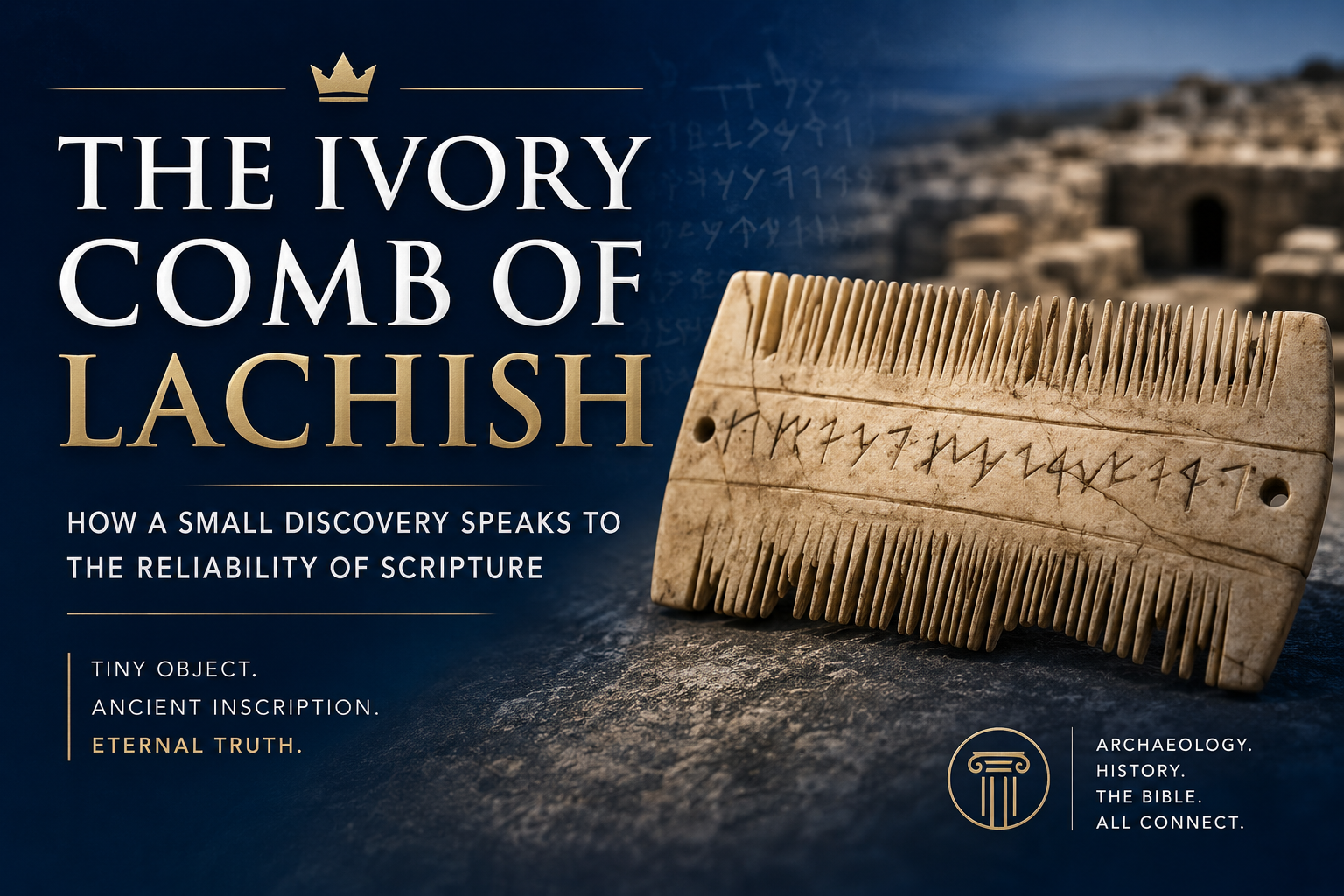
The Ivory Comb of Lachish: How a Small Discovery Speaks to the Reliability of Scripture
Sometimes the most powerful evidence comes in the smallest form.
In Part 3 of Greatest Discoveries in the Land of Israel, Dr. Michael G. Hasel shares the story of one of the most remarkable archaeological discoveries connected to the biblical world: a tiny ivory comb found at Lachish. At first glance, it looked like a small, ordinary object. It was not gold. It was not a royal monument. It was not a massive temple inscription carved into stone.
It was a comb.
Yet this small object carried something extraordinary. Scratched into its surface was an early alphabetic sentence, a sentence that may take us back to a time long before Moses. For believers, this discovery is not just about archaeology. It is a reminder that God is able to preserve witnesses in the dust of history, even when the world doubts His Word.
A World Forgetting the Word of God
Dr. Hasel begins the lecture by reflecting on William Tyndale, the man who gave his life so that the Bible could be read in the English language. Tyndale lived in a time when many people did not have access to Scripture in their own tongue. His work was opposed, his Bibles were burned, and eventually he was executed for translating the Word of God.
That story should make us pause.
Today, many of us have Bibles everywhere. We have printed Bibles, Bible apps, audio Bibles, study Bibles, and online commentaries. Yet we also live in a time when many people rarely read Scripture. The Bible is available, but it is often ignored.
This creates a serious question for the church:
Do we truly value the Word of God, or have we simply become used to having it nearby?
Dr. Hasel warns that we may be living in a new kind of dark age. Not because the Bible has disappeared, but because biblical literacy is fading. Many people know the names of Bible characters, but not the stories. They may have heard of Moses, David, Joshua, or Esther, but they do not know how those lives fit into God’s plan of redemption.
That is why biblical archaeology matters. It does not replace faith. It does not become the foundation of our belief. But it can remind us that the Bible speaks within real history, real places, real kingdoms, real people, and real events.
When Scholars Doubt the Bible
A major theme in the lecture is the long history of skepticism toward the Old Testament. Many modern scholars have questioned whether Moses could have written the first five books of the Bible. Some have argued that writing was not developed enough in Moses’ day. Others have suggested that the stories of the Old Testament were written much later, during the monarchy, after the exile, or even in the Hellenistic period.
In simple terms, some scholars have said:
- Moses could not have written the Pentateuch.
- The early Israelites may not have had enough literacy.
- David and Solomon may not have ruled as the Bible describes.
- Much of the Old Testament may have been written much later than believers have traditionally understood.
One of the repeated arguments is based on the phrase, “there is no evidence.”
There is no evidence for this. There is no evidence for that. There is no evidence for a kingdom. There is no evidence for literacy. There is no evidence for David. There is no evidence for writing.
But as Dr. Hasel points out, an argument from silence is not the same as proof.
Just because something has not yet been found does not mean it never existed. Archaeology is always incomplete. Every year, new discoveries are made. Every excavation uncovers only a small portion of what once existed. Much has been destroyed. Much remains buried. Much may never be found.
This is important for Christians to remember. Our faith is not built on what archaeologists have or have not discovered this year. Our faith is built on God and His Word. Still, when discoveries do appear, they often remind us that many confident objections against the Bible were made too soon.
The House of David Inscription
One example Dr. Hasel gives is the House of David inscription. For many years, some scholars claimed there was no extra-biblical evidence for King David. Because David’s name had not been found outside the Bible, some argued that he may have been more like a legend than a historical king.
Then, in 1993, the Tel Dan inscription was discovered. It included the phrase “House of David.”
This was a major discovery. It showed that an ancient neighboring kingdom referred to Judah by the dynasty of David. In other words, David was not just a character remembered by later biblical writers. His name was known in the ancient world.
This did not convince everyone. Some still resisted the evidence. But the discovery changed the discussion.
That is often how archaeology works. A theory may stand for many years until one discovery forces people to rethink it. A small piece of stone, a broken jar, a seal impression, or a tiny inscription can challenge decades of assumptions.
Why Lachish Matters
The central location in this lecture is Lachish.
Lachish was one of the most important cities in ancient Judah. After Jerusalem, it was one of the major centers of power in the kingdom. It appears in the Bible and in the history of major empires that attacked Judah.
The city was destroyed by the Assyrians under Sennacherib and later by the Babylonians during the time of Nebuchadnezzar. Because of this, Lachish has become one of the most important archaeological sites for understanding the biblical world.
Dr. Hasel and his team excavated at Lachish from 2013 to 2017. During those years, they worked through layers of history. Like many ancient cities, Lachish was built and rebuilt over time. One city would be destroyed, and another would be built on top of it. These layers help archaeologists study different periods of occupation.
But the discovery that became most famous was not a wall, a gate, or a palace.
It was a tiny comb.
The Discovery of the Ivory Comb
The comb was discovered by a student named Katherine during the 2016 excavation season. At first, it did not seem very important. It looked like a small piece of bone. It was placed in a bone bag and recorded carefully, as archaeological items must be.
Later, a specialist examined it and realized it was not ordinary bone. It was ivory, likely from an elephant tusk. This meant it was a luxury object. It had been shaped by human hands and used as a comb.
The comb had teeth on both sides. One side had wider teeth, and the other had smaller teeth. The smaller teeth were likely used to remove lice from hair or a beard.
That detail may sound ordinary, but it is actually part of what makes the discovery so human. People in the ancient world had many of the same daily concerns that people have today. They cared for their hair. They used tools. They dealt with discomfort. They created objects for personal care.
The Bible world was not imaginary. It was filled with real people living real lives.
The Inscription No One Expected
For a long time, the comb sat among the many objects recovered from the excavation. Archaeology does not end when the digging stops. In many ways, the real work begins afterward. Objects must be cleaned, studied, categorized, photographed, compared, and published.
Years later, while examining the comb, researcher Dr. Meline Mamugloo noticed scratches on its surface. At first, they may have looked like random marks. But under closer examination, they appeared to be letters.
The comb was sent to an expert in ancient inscriptions, Dr. Daniel Vainstub. He confirmed that the marks formed an inscription.
This was the turning point.
The tiny ivory comb was not only an artifact. It carried a complete sentence written in an early alphabetic script.
The sentence has been translated along these lines:
May this ivory tusk root out the lice of the hair and the beard.
That sentence is simple. It is not a royal decree. It is not a theological sermon. It is not a temple prayer. It is a practical statement written on the very object it describes.
And that is what makes it so fascinating.
The Earliest Complete Alphabetic Sentence
According to the lecture, this inscription became significant because it may be the earliest complete sentence ever found written in an alphabetic script.
That matters because the alphabet changed human history.
Before alphabetic writing, many writing systems were extremely complex. Egyptian hieroglyphics used many signs. Cuneiform systems also required years of training. In those cultures, scribes were an elite class because literacy was difficult and specialized.
But alphabetic writing was different. It used a smaller set of signs. Over time, this made writing more accessible. The alphabet became the ancestor of writing systems used by much of the world today.
So when an early alphabetic sentence appears at Lachish, it raises important questions.
- How early was alphabetic writing being used?
- Who was using it?
- Was it limited to remote mining areas, or was it used in major cities?
- Could writing have existed earlier than many scholars assumed?
The Lachish comb suggests that alphabetic writing was not only scratched in isolated desert places. It was present in a major Canaanite city, on a luxury item, in a context connected to high culture.
Why This Matters for Moses
One of the biggest questions raised by the lecture is this:
Could Moses have written the first five books of the Bible?
Skeptics have often argued that Moses could not have written Scripture because writing was not developed enough in his time or environment. But the evidence of early alphabetic writing makes that objection weaker.
The Bible says Moses was raised in Egypt. Acts 7:22 says, “And Moses was learned in all the wisdom of the Egyptians, and was mighty in words and in deeds.”
If Moses was educated in Egypt, he would have been familiar with a highly literate culture. Egypt had scribes, records, inscriptions, administration, and written communication. If alphabetic writing was already developing in the region before or around the time of Moses, then the idea that Moses could write becomes far more reasonable.
The Lachish comb does not prove every detail about Moses. It does not need to. What it does is challenge the claim that alphabetic writing was impossible or unavailable in the ancient world of the patriarchs and Moses.
That is why this discovery matters.
A Small Object with a Big Message
There is something deeply meaningful about the kind of object God allowed to be found.
It was not a throne.
It was not a golden crown.
It was not a massive victory monument.
It was a small comb used for removing lice.
That almost feels surprising. Yet the Bible often shows us that God works through small things. A shepherd’s sling. A boy’s lunch. A widow’s oil. A manger in Bethlehem. A cross outside Jerusalem.
God does not need large things to make a large point.
The comb reminds us that the ancient world was literate earlier than many assumed. It reminds us that ordinary objects can carry extraordinary meaning. It reminds us that God can preserve evidence in ways no one expects.
And it reminds us that the stones still cry out.
Faith Before Evidence
One of the strongest spiritual points in the lecture comes near the end. Dr. Hasel asks whether we are willing to stand for the Bible even when the evidence has not yet appeared.
This is important.
Christians should not be afraid of evidence. We should welcome honest study. We should care about history, archaeology, language, and truth. But our faith should not rise and fall with every new discovery or every academic theory.
There will always be unanswered questions. There will always be places where the evidence is incomplete. There will always be critics who say, “Nothing has been found.”
But absence of evidence is not evidence of absence.
Sometimes the evidence is still buried. Sometimes it is sitting in a box waiting to be studied. Sometimes it is already found, but not yet understood. Sometimes it takes years for the significance of a discovery to become clear.
That is exactly what happened with the ivory comb.
The Hand of God in the Details
One of the most moving moments in the lecture is when Dr. Hasel describes Dr. Mamugloo’s reaction to the discovery. She said that she felt the hand of God in it.
That statement matters because it came from a serious scientist. She was not speaking carelessly. She had spent her life in research, science, and careful study. Yet when she saw how this discovery unfolded, she recognized something beyond herself.
For believers, that is not hard to understand.
We believe in a God who works through history. We believe in a God who guides, preserves, reveals, and calls. We believe in a God who can use a tiny object from an ancient city to encourage faith thousands of years later.
That does not mean every discovery must be exaggerated. It does not mean we should force archaeology to say more than it says. But it does mean we can receive these moments with gratitude.
God is not silent.
The Story in the Air Raid Shelter
Near the end of the lecture, Dr. Hasel shares a powerful personal story from Israel. While visiting the home of the Kasuto family during Purim, the conversation turned to biblical interpretation, Moses, and the reliability of Scripture.
Dr. Hasel told them about the ivory comb and its possible date near the time of the patriarchs. The family immediately understood the significance. If alphabetic writing existed that early, then one of the major objections against Mosaic authorship loses much of its force.
Then, suddenly, air raid sirens went off.
The group moved into a shelter with other families. In that tense moment, surrounded by uncertainty and fear, the story of the ivory comb was retold in Hebrew to the people in the shelter.
Think about that scene.
A tiny artifact from ancient Lachish became a witness to families sitting in a shelter during war. A discovery buried for thousands of years became a word of encouragement in a moment of danger. A comb that could have been missed by a few inches became part of a testimony to God’s faithfulness.
That is more than interesting history. That is a reminder that God knows how to reach people in the exact place where they are.
What This Discovery Teaches the Church
The ivory comb of Lachish teaches several lessons that are important for believers today.
1. The Bible is rooted in real history
The events of Scripture happened in real places. Lachish, Jerusalem, Egypt, Babylon, and other biblical locations are not fictional settings. They belong to the world of history.
2. Archaeology often confirms what critics once doubted
Many objections against the Bible have been based on missing evidence. But discoveries continue to challenge those objections.
3. Small discoveries can have great importance
A tiny comb may not look impressive, but its inscription has major implications for the history of writing.
4. Faith should not depend on archaeology
Archaeology can encourage us, but it is not the foundation of our faith. The foundation is God Himself.
5. Christians must stand for Scripture
In every generation, believers are called to trust God’s Word. That call remains the same whether the world accepts it or rejects it.
When the Stones Cry Out
In Luke 19:40, Jesus said, “I tell you that, if these should hold their peace, the stones would immediately cry out.”
That verse is often quoted when speaking about archaeology, and for good reason. The land of the Bible continues to produce discoveries that speak into modern questions. Stones, inscriptions, seals, tablets, and fragments all bear witness to the world of Scripture.
The ivory comb is not a stone, but it joins that chorus of witnesses.
It tells us that writing existed earlier than many believed. It tells us that ancient Canaan had more literacy than some expected. It tells us that ordinary objects can preserve extraordinary testimony.
Most of all, it reminds us that God is able to defend His Word.
A Call to Trust the Word of God
The final challenge of the lecture is simple and direct:
Are we willing to stand up for the Bible?
Not only when archaeology supports it. Not only when scholars agree with it. Not only when culture respects it. But because God has spoken.
Evidence is valuable. Discoveries are exciting. Archaeology can strengthen our understanding. But the believer’s confidence rests in the character of God.
If God has spoken, His Word is trustworthy.
The ivory comb of Lachish is a wonderful discovery. It is small, fragile, and easy to overlook. Yet through it, we are reminded of a great truth: God can use even the smallest witness to point people back to His Word.
In a time when many are forgetting Scripture, the church must return to it. We must read it, teach it, believe it, and live by it.
The world may question. Scholars may debate. Evidence may come slowly. But God’s Word remains.
And sometimes, from the dust of the ancient world, even a little comb can remind us that the Bible can be trusted.
Discover more from Fannin County Seventh-day Adventist Church
Subscribe to get the latest posts sent to your email.


