
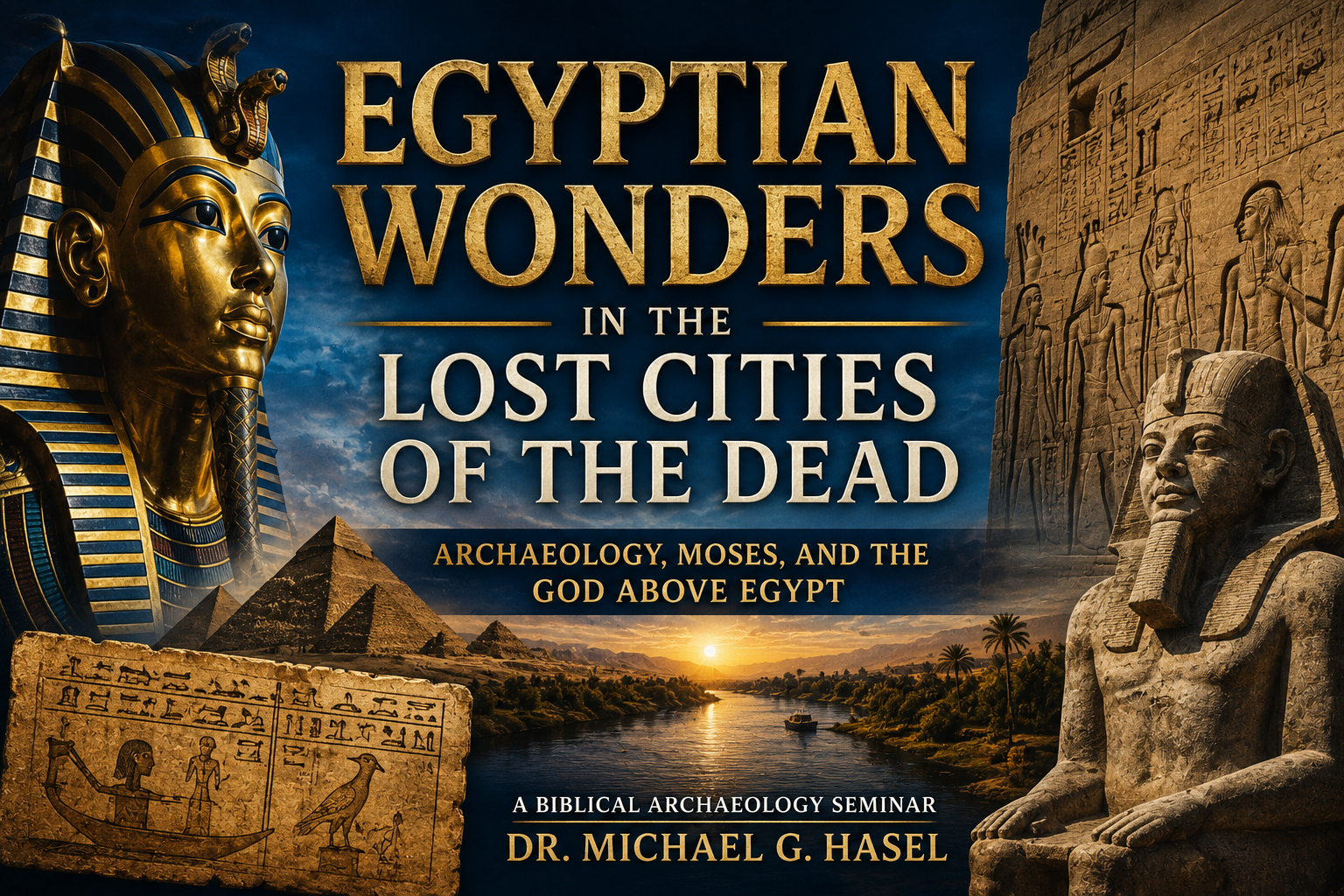
Egyptian Wonders in the Lost Cities of the Dead: Archaeology, Moses, and the God Above Egypt
Disclaimer: The video shared in this post was produced by a third party. We may not endorse every view, belief, or conclusion of the creator, but we are sharing it because we believe it contains material that may be helpful and encouraging to our visitors.
Egypt has fascinated the world for centuries. Its pyramids, temples, tombs, mummies, and inscriptions continue to stir the imagination of anyone interested in ancient history. Yet for Bible readers, Egypt is more than a place of monuments and mystery. Egypt is one of the great settings of Scripture. It is the land where Abraham once traveled, where Joseph rose to power, where Israel multiplied into a nation, and where Moses confronted Pharaoh in the name of the living God.
That is why archaeology in Egypt matters so much. It helps us understand the world of the Bible in a fuller way. It gives background, context, and historical texture to the people and events described in Scripture. It does not replace faith, and it does not stand above the Word of God. But it often confirms that the Bible speaks about real places, real cultures, real rulers, and real struggles in history.
In this article, we will look at some of the major ideas presented in the seminar on Egyptian wonders and lost cities of the dead. We will consider the pyramids, Egyptian beliefs about life after death, the discovery of the Rosetta Stone, the rise of Egyptology, the place of Moses in Egyptian history, and the contrast between the gods of Egypt and the God of the Bible. Along the way, we will see that archaeology can deepen our confidence in Scripture and remind us of a far greater truth: all earthly empires fade, but the Lord still stands.
Why Egypt Continues to Capture Attention
Ancient Egypt was one of the longest-lasting civilizations in human history. Its life centered on the Nile River, which provided water, fertile land, transportation, and stability. Historians have often said that Egypt was the gift of the Nile, and that description is not far off. Without the Nile, Egypt as we know it would never have existed.
Because of this unique environment, Egypt developed monumental architecture early in its history. The civilization produced:
- Huge temples built for kings and gods
- Elaborate tombs filled with treasures
- Pyramids that still dominate the landscape
- Written records that preserve religion, politics, and warfare
- A complex system of beliefs about death and the afterlife
For many people, Egypt feels almost timeless. But the Bible reminds us that even the greatest human civilization is still subject to the purposes of God. Egypt rose, flourished, oppressed, and declined. Its monuments remain, but its power is gone.
The Pyramids and Egypt’s Obsession with the Afterlife
When most people think of Egypt, they think first of the pyramids. These structures still inspire awe because of their size, precision, and age. The Great Pyramid alone was built with millions of stone blocks and stood as the tallest building in the world for thousands of years.
But the question is not only how the pyramids were built. The deeper question is why they were built.
The answer lies in Egypt’s obsession with life after death. The pyramids were not simply displays of national pride. They were tombs. They were part of a system designed to carry the king safely into the next world. Egyptian rulers wanted their bodies preserved, their names remembered, and their souls protected beyond death.
This helps explain why so much effort went into tombs, burial chambers, funerary texts, masks, coffins, and grave goods. For the Egyptians, death was not the end. It was a transition that required elaborate preparation.
Yet their vision of the afterlife was uncertain, fearful, and ritual-heavy. Their hope rested in magic, preservation, protective deities, and successful passage through the unseen world. That is very different from the biblical hope, which rests not in tombs, spells, or symbols, but in the power of God and the promise of resurrection.
The Judgment Scene and the Egyptian View of the Soul
One of the most striking features of Egyptian religion is the famous judgment scene found in tombs and funerary texts. In this scene, the heart of the deceased is weighed against the feather of truth. If the heart proves too heavy, the person is condemned. If it balances rightly, the person may enter the blessed afterlife.
This image reveals several things about Egyptian belief:
- Life after death was deeply important to them
- Judgment was part of their religious outlook
- Moral order mattered in their thinking
- Fear accompanied the journey beyond death
Yet for all its impressive imagery, this system could never provide true assurance. It offered a burdened soul a process, but not peace. It presented judgment, but not grace. It pointed to eternity, but not to a Savior.
By contrast, the Bible teaches that eternal life is not achieved through ritual skill or mythological navigation. Eternal life is found in the Lord. The God of Scripture does not merely weigh the human heart. He can cleanse it, renew it, and redeem it.
Serpents, Death, and False Hope in Egyptian Religion
Egyptian tombs and temples are filled with serpent imagery. The serpent appears as protector, guide, and symbol of royal power. In some contexts, it is connected with the king’s journey through death into renewed life. This is important because it reveals a profound spiritual contrast between Egyptian religion and biblical revelation.
In Scripture, the serpent is connected with deception, rebellion, and the fall. In Genesis 3, the serpent tells Eve, “You will not surely die,” and introduces distrust toward God. The serpent offers a false promise of wisdom, freedom, and life. In reality, it brings sin and death.
That makes Egyptian symbolism all the more striking. What God’s Word identifies as a deceiver, Egyptian religion often presents as guide and protector. What Scripture treats as an enemy, Egyptian thought weaves into its sacred imagery.
This is more than an interesting cultural difference. It is a reminder that false religion often takes what is dark and presents it as light. It offers spiritual language, sacred beauty, and ancient tradition, yet leads away from the truth of God.
King Tut and the Treasures of Death
The discovery of Tutankhamun’s tomb remains one of the greatest archaeological moments in modern history. When Howard Carter opened the burial chamber and saw its treasures, he famously described “wonderful things.” And indeed, the tomb contained stunning artifacts: shrines, coffins, statues, gold furnishings, and the famous burial mask known around the world.
Yet the splendor of the tomb tells a sobering story. All that wealth was gathered for a dead king. All that craftsmanship was devoted to preserving a body. All that gold could not stop death from coming. It could only decorate the chamber that death had entered.
Tutankhamun’s tomb reveals the brilliance of Egyptian art, but also the limits of Egyptian hope. No treasure could conquer the grave. No shrine could guarantee victory over death. No mask, no mummy, no burial ritual could do what only God can do.
This is where archaeology becomes a witness not only to history but also to theology. Egypt’s tombs show humanity longing for eternity, yet unable to secure it. They reflect Ecclesiastes in an unexpected way. God has set eternity in the human heart, but human systems cannot satisfy that longing.
The Rosetta Stone and the Unlocking of Ancient Egypt
For centuries, the language of ancient Egypt was unreadable. The temples stood, the carvings remained, the monuments survived, but their message was locked away. That changed with the discovery of the Rosetta Stone during Napoleon’s Egyptian campaign.
The stone contained the same decree written in multiple scripts, including Greek. Because Greek could still be read, scholars were finally given the key to begin unlocking Egyptian hieroglyphs. This eventually led to the work of Jean-François Champollion, whose decipherment of the language opened the doors to Egyptian history.
This breakthrough matters enormously for biblical studies. Once Egyptian inscriptions could be read, archaeology entered a new era. Now scholars could compare biblical history with Egyptian records. Place names, kings, cities, campaigns, and cultural patterns could all be examined with greater clarity.
The result has been significant. Egyptian texts have illuminated the world in which many biblical events took place. While the Bible was never dependent on archaeology to become true, archaeology has repeatedly shown that Scripture speaks in the language of real history.
The Earliest Mention of Israel Outside the Bible
One of the most important discoveries in Egyptology is the Merneptah Stele, which contains the earliest widely accepted mention of Israel outside the Bible. This inscription dates to the late thirteenth century BC and refers to a campaign in Canaan.
Why does that matter? Because it shows that Israel was already known as a people in the land by that time. That means the Exodus and wilderness journey must have occurred before then. This has major implications for the chronology of the Old Testament and reminds us that Israel was not invented late in imagination or legend. Israel existed in history.
Archaeological evidence like this does not tell the whole biblical story by itself. But it does anchor the conversation in the real world. It shows that the Bible is talking about actual historical entities, not purely symbolic ones.
Moses in the World of Egypt
Perhaps the most compelling part of the seminar is the discussion of Moses and the Egyptian court. The Bible does not give the names of the pharaoh or the princess involved in Moses’ early life, so scholars must work by chronology and historical context rather than by direct naming. Even so, the biblical timeline places Moses in a period of Egyptian history that fits remarkably well with what we know of the eighteenth dynasty.
The Bible tells us that Moses was drawn out of the Nile and adopted into Pharaoh’s household. He then grew up in Egypt’s highest circles of power, education, and privilege. Acts 7 says he was learned in all the wisdom of the Egyptians. That statement should not be taken lightly.
To be trained in Egypt at that level would have meant access to the best knowledge of the age, including writing, administration, religion, diplomacy, and military leadership. Moses did not grow up on the margins. He grew up at the center of empire.
And yet he had to answer a deeper question than education or status could settle: Who was he really?
Was he the son of Pharaoh’s daughter in identity and destiny? Or was he one of God’s covenant people? Would he embrace the throne of Egypt or the calling of the Lord?
Hebrews tells us the answer. By faith, Moses refused to be called the son of Pharaoh’s daughter, choosing rather to suffer affliction with the people of God than to enjoy the temporary pleasures of sin. That decision gives Moses one of the most powerful biographies in Scripture. He turned from earthly glory to identify with God’s people.
Bricks, Straw, and the Realism of Exodus
For a long time, some readers treated the biblical references to brickmaking with straw as if they were doubtful or symbolic. But archaeology and Egyptian texts have shown otherwise. Mud bricks mixed with straw were absolutely part of Egyptian construction practice. Tomb paintings, surviving bricks, and written texts all confirm this.
That may seem like a small detail, but it is actually important. It shows that Exodus describes labor conditions in a realistic Egyptian setting. The Bible is not inventing a vague picture of oppression. It is describing a world that fits the archaeological and textual evidence.
Small details matter. They often show whether a text knows the world it claims to describe. In this case, Exodus speaks with the marks of authenticity.
Why Egypt Does Not Preserve the Exodus Story Clearly
Some people ask why Egyptian records do not simply tell the Exodus story in the same way the Bible does. The answer is not difficult to understand. Ancient royal inscriptions were propaganda as much as history. Kings celebrated victories, magnified achievements, and concealed humiliation. Defeat was not the kind of thing rulers wanted carved permanently into stone.
This is not unique to Egypt, but Egypt is a strong example of it. Pharaohs regularly present themselves as triumphant, favored by the gods, and overwhelmingly successful. That means we should not expect a straightforward confession of disaster.
In that sense, the Bible’s candor stands out. Scripture does not hide the failures of its own people. It records disobedience, unbelief, defeat, and shame as well as faith and victory. That honesty is one of the reasons the Bible bears the marks of trustworthy history. It does not function like royal propaganda.
The Fall of Egypt and the End of Human Glory
The seminar closes with a sobering reminder: Egypt’s greatness is gone. Its temples lie in ruins. Its cities have faded. Its glory has been broken. The empire that once seemed unstoppable has become an archaeological memory.
This is exactly what Scripture teaches about every human kingdom. No matter how mighty a civilization becomes, it does not last forever. Its monuments may endure for a season, but its power does not. Egypt, Babylon, Assyria, Persia, Greece, and Rome all testify to this same truth.
Archaeology has a way of humbling human pride. It shows us broken statues, fallen capitals, emptied tombs, and forgotten names. It reminds us that human greatness is temporary. But it also does something more. It reminds us that God’s Word endures while empires collapse.
What Egypt’s Ruins Still Say to Us
So what does all this mean for us today?
It means that archaeology is not merely about stones and sand. It is about truth. It is about memory. It is about seeing that the world of the Bible was real, and that the God who acted in that world is still the true God today.
It also means that every person must answer the same kind of question Moses faced. Who will we serve? Will we live for passing glory, comfort, status, and power? Or will we identify ourselves with the Lord, even when obedience costs us something?
Egypt offered Moses privilege, education, and greatness. God offered him a mission. Egypt offered him a palace. God offered him a calling. Egypt offered him the crowns of this world. God offered him a place in redemptive history.
Moses chose wisely.
And that choice still matters. The gods of Egypt are gone. The pharaohs are dust. Their temples are ruins. But the God who called Moses is still alive. He still delivers. He still judges false powers. He still keeps His promises. And through Christ, He still offers something Egypt never could: not merely a dream of life after death, but true resurrection hope.
Conclusion
Egyptian archaeology continues to provide fascinating insight into the ancient world. The pyramids, tombs, inscriptions, burial customs, royal propaganda, and historical records all help us understand the setting in which biblical history unfolded. They also reveal the spiritual hunger of humanity, the fear of death, and the limits of false religion.
But above all, these discoveries point us back to Scripture. They remind us that the Bible does not float above history. It is rooted in real places and real events. And in the middle of those events stands the God of Abraham, Isaac, Jacob, Joseph, and Moses.
Egypt sought eternity through monuments. God gives eternal life through Himself.
Egypt trusted in tombs. God brings resurrection.
Egypt raised up kings who called themselves divine. God raised up Moses to confront them and lead His people out.
That is why the story still matters. Archaeology may uncover the lost cities of the dead, but the Bible reveals the living God.
Optional site disclaimer: Our church occasionally shares videos and resources created by others. While we value helpful teaching and thoughtful content wherever it may be found, sharing a resource does not mean we fully agree with or endorse all the theology, lifestyle, doctrine, or opinions of the content creators or their channels.
Discover more from Fannin County Seventh-day Adventist Church
Subscribe to get the latest posts sent to your email.


