
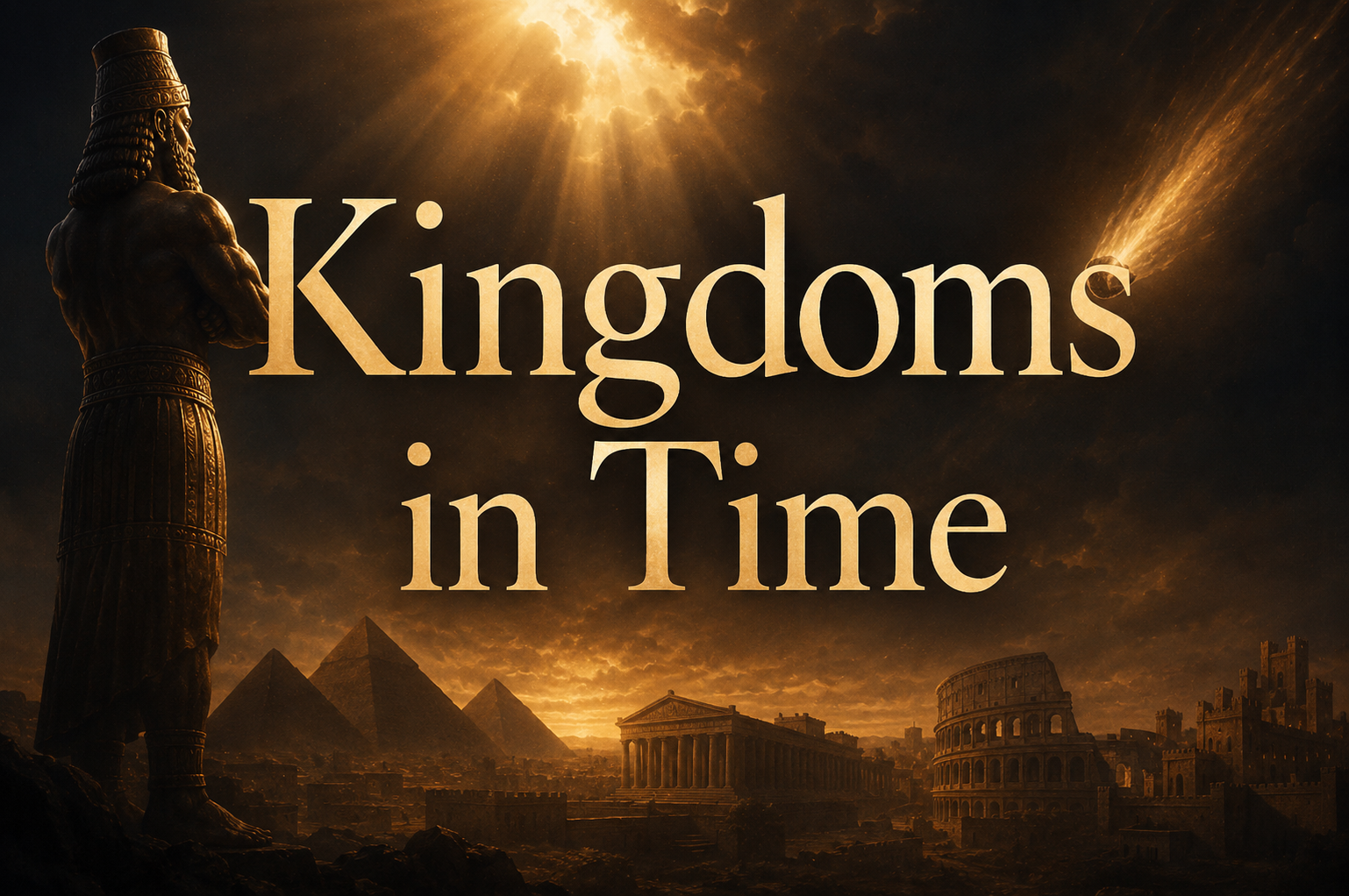
Kingdoms in Time: How Bible Prophecy Reveals God’s Hand in History
Time is one of the great mysteries of human life.
We remember the past. We live in the present. We wonder about the future. Every person moves forward through time, one moment at a time, unable to go back and unable to see clearly what is ahead.
But the Bible presents God as One who is not limited by time. He sees the end from the beginning. He knows what is coming before it happens. He raises up kings and removes kings. He rules over nations, empires, cities, and history itself.
That is the central message of Kingdoms in Time: History’s Greatest Bible Prophecies. The presentation takes us through some of the most remarkable prophecies in Scripture, showing how the Bible foretold events involving Jerusalem, Babylon, Medo-Persia, Greece, Rome, Tyre, Egypt, Nineveh, the Messiah, and the spread of the gospel to the world.
This is not prophecy for curiosity only. It is prophecy that builds confidence in the Word of God.
If God has accurately revealed the rise and fall of kingdoms, the coming of the Messiah, and the movement of history, then we can trust Him with the future. We can trust Him with our lives. And we can trust His promise that Jesus Christ will return.
The Bible and the God Who Knows the Future
The Bible is unlike any other book.
It was written by many different authors over many centuries. Its writers came from different backgrounds. Some were kings. Some were prophets. Some were shepherds. Some were fishermen. Some wrote from palaces, others from prisons, caves, or foreign lands.
Yet the Bible tells one unified story.
That story begins with creation. It continues through the fall of humanity, the calling of Abraham, the history of Israel, the coming of Christ, the spread of the gospel, and the promise of a new creation.
At the center of the story is Jesus.
Bible prophecy is one of the ways God shows that Scripture is not merely human wisdom. The Bible contains predictions that reach across centuries. Some deal with cities and nations. Others point to the Messiah. Others reach forward to the end of time.
Prophecy does not exist to satisfy curiosity. It exists to reveal God’s authority, His faithfulness, and His plan of salvation.
Jesus Predicted the Destruction of Jerusalem
One of the powerful examples in the presentation is Jesus’ prophecy about Jerusalem and the temple.
In Matthew 24, Jesus looked at the temple and told His disciples that not one stone would be left upon another. This would have been shocking. The temple was the pride of the Jewish nation. It was massive, beautiful, and deeply sacred to the people.
The disciples could hardly imagine its destruction.
Yet around AD 70, the Roman armies destroyed Jerusalem and the temple. The presentation explains that when the temple burned, the gold melted and ran into the cracks between the stones. Later, Roman soldiers pulled the stones apart to recover the precious metal.
What Jesus said came to pass.
The temple was destroyed. Jerusalem was devastated. The Jewish people were scattered. The event became one of the major turning points in biblical and world history.
This prophecy matters because Jesus did not speak vaguely. He spoke with clarity. He warned of a real event that took place within that generation.
The Scattering and Return of the Jewish People
The history of the Jewish people is one of the most remarkable stories in the world.
Many nations have been conquered and disappeared into history. Many peoples have been scattered and lost their identity. But the Jewish people survived exile, persecution, displacement, and repeated attempts to erase them.
The presentation points to biblical passages that speak of Israel being scattered among the nations and later gathered again.
This history is extraordinary. After nearly two thousand years of dispersion, the Jewish people maintained their identity, their Scriptures, their language, and their connection to Jerusalem. In 1948, the modern state of Israel was established.
Whatever one believes about modern political events, the survival of the Jewish people is historically remarkable. It reminds us that the Bible speaks about real nations, real places, and real historical movement.
The God of the Bible is not only the God of private faith. He is the Lord of history.
Jeremiah’s Prophecy of Seventy Years
Another major prophecy discussed is Jeremiah’s prediction that Judah would serve Babylon for seventy years.
The people of Judah had turned from God. They had ignored repeated warnings. Finally, Babylon came against Jerusalem. The city was conquered, the temple was destroyed, and many of the people were taken captive.
But God did not leave His people without hope.
Jeremiah said the captivity would last seventy years. After that, God would bring His people back.
That is exactly what happened. Babylon fell to Medo-Persia. Cyrus issued a decree allowing the Jewish people to return to Jerusalem and rebuild the temple. The exile did not last forever. God had set a limit, and His Word came true.
This tells us something important about God’s judgment.
God’s discipline is real. But His mercy is also real. He warned. He judged. He preserved. He restored.
The seventy-year prophecy shows both God’s justice and His faithfulness.
Cyrus and the Return From Exile
One of the most striking parts of Bible prophecy is the naming of Cyrus.
Long before Cyrus came to power, Isaiah spoke of him as the one God would use to accomplish His purpose. Cyrus would conquer Babylon and allow Jerusalem to be rebuilt.
That is a stunning detail.
The presentation explains that Cyrus conquered Babylon in 539 BC and later allowed conquered peoples, including the Jews, to return to their homelands. The Cyrus Cylinder, discovered in 1879, supports the historical reality of Cyrus’ policy of repatriating displaced peoples.
This does not make Cyrus a perfect man or a worshiper of God in the full biblical sense. But it does show that God can use even pagan kings to fulfill His purposes.
God is not limited by human politics. He can move through kings, nations, decrees, wars, and empires to accomplish what He has spoken.
Daniel 2 and the Statue of World Empires
The heart of the presentation is Daniel chapter 2.
About 2,500 years ago, King Nebuchadnezzar of Babylon had a troubling dream. In that dream, he saw a great image made of different materials:
- A head of gold
- Chest and arms of silver
- Belly and thighs of bronze
- Legs of iron
- Feet of iron mixed with clay
Then a stone cut out without hands struck the image on its feet. The whole image was destroyed, and the stone became a great mountain that filled the earth.
Daniel, through God’s revelation, explained the meaning of the dream. The different metals represented successive world empires. The final stone represented the kingdom of God, which would overthrow all earthly kingdoms and stand forever.
This prophecy gives a sweeping view of history from Babylon to the end of time.
The Head of Gold: Babylon
Daniel told Nebuchadnezzar that he was the head of gold.
Babylon was one of the most powerful and wealthy empires of the ancient world. It was known for its walls, gates, architecture, gold, temples, and military strength. Nebuchadnezzar rebuilt Babylon into a city of splendor.
Gold was a fitting symbol.
But Daniel also told the king that Babylon would not last forever. Another kingdom would arise after it.
This is one of the humbling lessons of Daniel 2. No earthly empire is permanent. No matter how powerful a kingdom looks, it stands only as long as God allows.
Babylon was great, but Babylon fell.
The Chest and Arms of Silver: Medo-Persia
After Babylon came Medo-Persia.
The presentation describes how Cyrus and the Medo-Persian forces conquered Babylon in a way that fulfilled prophecy. The Euphrates River was diverted, and soldiers entered the city through the riverbed while the gates were left open.
Isaiah had already spoken of Cyrus and of gates being opened before him.
Medo-Persia became the next major empire. The silver chest and arms represented this kingdom that followed Babylon. Silver also fits historically because silver became a dominant medium of exchange in the Persian world.
Once again, prophecy and history meet.
Babylon did not fall by accident. God had already revealed that another kingdom would arise.
The Belly and Thighs of Bronze: Greece
After Medo-Persia came Greece.
Alexander the Great led the Greek armies with incredible speed and power. He conquered the Persian Empire and expanded Greek influence across much of the ancient world.
When Daniel gave the prophecy, Greece was not yet the dominant power. It would have seemed unlikely that Greek power would one day reshape the world.
Yet the prophecy said another kingdom would arise, represented by bronze.
History confirms that Greece followed Medo-Persia as the next great world empire. Greek language, culture, philosophy, and influence spread widely. By the time of the New Testament, Greek had become one of the main languages of the Mediterranean world.
This prepared the way, in God’s providence, for the spread of the gospel.
The Legs of Iron: Rome
After Greece came Rome.
Daniel described the fourth kingdom as strong as iron. Rome fits this description with remarkable accuracy. It crushed, conquered, organized, and ruled with military force.
Rome dominated the Mediterranean world for centuries. It was the empire in power when Jesus was born, when He was crucified, and when the early church began spreading the gospel.
Roman roads, law, government, and military control shaped the world of the New Testament.
Iron is an appropriate symbol. Rome was strong, hard, and crushing.
Yet Rome, too, did not last forever.
The Feet of Iron and Clay: Divided Europe
Daniel’s prophecy did not say that another single empire would simply replace Rome. Instead, the feet and toes were made of iron mixed with clay.
This represented division.
When Rome weakened and fell, it was not replaced by one unified world empire. Instead, different tribes and kingdoms divided its territory. The presentation identifies groups such as the Franks, Anglo-Saxons, Alemanni, Lombards, Visigoths, Ostrogoths, Vandals, Heruli, Suevi, and Burgundians.
Some of these became connected to modern European nations.
Throughout history, rulers tried to reunite Europe under one power. Charlemagne tried. Napoleon tried. Kaiser Wilhelm tried. Mussolini tried. Hitler tried.
But Daniel’s words remained true:
“They shall not cleave one to another.”
The divided condition of Europe stands as one of the continuing witnesses to Daniel’s prophecy.
The Stone Cut Without Hands
The dream does not end with human kingdoms.
It ends with a stone cut out without hands. That stone strikes the image and becomes a great mountain filling the whole earth.
This stone represents the kingdom of God.
The phrase “without hands” is important. This is not a human kingdom built by human power. It does not arise through politics, armies, elections, or empire-building. It comes from God.
All earthly kingdoms rise and fall. God’s kingdom will stand forever.
This is the true hope of Daniel 2. The prophecy is not only about Babylon, Persia, Greece, Rome, and Europe. It is about Christ. It is about the final victory of God. It is about the coming kingdom that will never be destroyed.
The Dead Sea Scrolls and the Reliability of Scripture
Skeptics have often claimed that the prophecies of Daniel must have been written after the events because they are so accurate.
The presentation points to the discovery of the Dead Sea Scrolls as an important answer to that claim. Beginning in 1946, ancient manuscripts were discovered near Qumran. These included biblical texts and fragments dating before the time of Christ.
The Isaiah scroll is especially famous because it preserved the book of Isaiah with remarkable accuracy compared to later manuscripts.
The Dead Sea Scrolls showed that the Old Testament text had been carefully preserved. They also confirmed that prophetic writings existed before many of the events connected to the New Testament.
This matters because our confidence in Scripture is not based on blind belief. It is strengthened by history, archaeology, manuscript evidence, and fulfilled prophecy.
The Prophecy Against Babylon
Babylon was once considered one of the greatest cities in the world. It seemed indestructible. Yet the Bible predicted that Babylon would fall and never again be inhabited as a great city.
That prophecy has stood through history.
Even modern attempts to rebuild Babylon have failed to restore it to its former glory. The ruins remain a reminder that human pride cannot overturn the Word of God.
Babylon’s story is a warning.
Human greatness can look permanent. Cities can shine. Kings can boast. Nations can appear unstoppable. But if God has spoken judgment, no human hand can prevent it.
The Prophecy Against Egypt
Egypt was one of the greatest ancient civilizations. It had pyramids, temples, wealth, armies, and a long history of dominance.
Yet the Bible predicted that Egypt would never again rise to the same commanding position among the nations.
Egypt still exists today, but not as the world-ruling superpower it once was. Its ancient monuments remain as witnesses to former greatness, but its imperial dominance passed away long ago.
This is another example of prophecy dealing not only with destruction, but with the future status of a nation.
God’s Word does not speak carelessly. It has proved reliable through the passing of centuries.
The Prophecy Against Nineveh
Nineveh was the capital of the Assyrian Empire, located near modern Mosul in Iraq. It was powerful, violent, and feared.
The prophet Jonah once preached to Nineveh, and the city repented for a time. But later generations returned to violence and wickedness.
The prophet Nahum predicted Nineveh’s destruction in detail. The presentation notes that the city would be laid waste, affected by flooding, burned, and never rebuilt as before.
In 612 BC, Nineveh fell to the Babylonians and their allies.
Today, Nineveh’s ruins remind us that God sees the sins of nations. He may show mercy when people repent, but He also judges when violence and rebellion continue.
The Prophecy Against Tyre
Tyre was a powerful Phoenician city and a major force in ancient trade. Its location and naval strength made it difficult to conquer.
Ezekiel predicted that Tyre would be destroyed and that its stones, timber, and dust would be cast into the sea. This prophecy received a remarkable fulfillment when Alexander the Great attacked the island city of Tyre.
To reach the island, Alexander used material from the old mainland city to build a causeway into the sea. Stones from the ruins were literally thrown into the water.
What seemed like a strange detail in prophecy became history.
Tyre shows that God’s Word can be precise in ways people may not understand until after the event unfolds.
The Central Focus of Prophecy: Jesus Christ
As important as the prophecies about nations are, the central focus of Bible prophecy is Jesus.
The Old Testament contains many prophecies pointing forward to the Messiah. These were written centuries before Jesus was born.
The presentation highlights several of them:
- The Messiah would be born in Bethlehem.
- He would be born of a virgin.
- His ministry would begin at the appointed time.
- He would bring healing and light.
- He would enter Jerusalem riding on a donkey.
- He would be betrayed by a close friend.
- He would be sold for thirty pieces of silver.
- The money would be connected to the potter’s field.
- He would remain silent before His accusers.
- His hands and feet would be pierced.
- His garments would be divided.
- He would rise from the dead.
These prophecies do not point to an abstract idea. They point to a Person.
Jesus is the center of Scripture.
Bethlehem and the Birth of Christ
Micah prophesied that the ruler of Israel would come from Bethlehem. This was a small place, not the kind of city people would naturally choose for the birth of the Messiah.
Yet Jesus was born in Bethlehem.
Joseph and Mary lived in Nazareth, but a Roman census brought them to Bethlehem at the right time. Human politics and imperial administration became part of God’s providence.
This is another reminder that God can work through events that seem ordinary, inconvenient, or even oppressive. Rome issued a census. God fulfilled a prophecy.
The Timing of the Messiah
Daniel’s seventy-week prophecy pointed forward to the coming of the Messiah. The presentation explains the prophetic day-for-a-year principle and connects the 69 prophetic weeks to the time when Jesus began His ministry.
The word Messiah means “Anointed One.”
Jesus was anointed by the Holy Spirit at His baptism. He then began His public ministry, preaching the kingdom of God, healing the sick, and calling people to repentance.
This prophecy shows that the coming of Christ was not random. It was appointed. God had marked the time.
Jesus came exactly when heaven’s clock said He would come.
The Betrayal and Crucifixion of Jesus
The prophecies surrounding the death of Jesus are deeply moving.
The Old Testament foretold that the Messiah would be betrayed by a friend. Judas fulfilled this when he betrayed Jesus after sharing the Last Supper with Him.
Zechariah foretold the price of thirty pieces of silver and even connected the money with the potter. In the New Testament, Judas returned the money to the priests, and they used it to buy the potter’s field.
Isaiah foretold that the suffering servant would remain silent before His accusers. Jesus did this before Pilate.
Psalm 22 described details that fit crucifixion, including pierced hands and feet and the dividing of garments.
These details point us to one central truth:
Jesus did not die by accident.
He gave His life according to the plan of God.
The Resurrection of Christ
The story does not end at the cross.
The grave could not hold Jesus.
The presentation points to the testimony of the New Testament, where many witnesses saw Jesus alive after His resurrection. The disciples were not expecting it. They were fearful and confused. Yet after seeing the risen Christ, they became bold witnesses.
The resurrection is the foundation of Christian hope.
If Jesus is risen, then His promises are true. Death is defeated. Sin has been answered. The kingdom of God is coming.
Bible prophecy points not only to the suffering of Christ, but also to His victory.
Knowledge Shall Increase
Daniel also speaks of the time of the end, saying that many would run to and fro and knowledge would increase.
The presentation connects this with the remarkable explosion of knowledge, travel, communication, science, technology, medicine, and global movement in the modern world.
For thousands of years, travel was slow. Today, people cross oceans in hours. Information moves across the world instantly. A person can search vast libraries from a phone.
This does not mean every technological development is spiritually good. But it does remind us that we live in a time unlike any other in history.
The world is moving quickly. The gospel can now reach places once difficult to access. This connects directly with another prophecy of Jesus.
The Gospel to All the World
Jesus said that the gospel of the kingdom would be preached in all the world as a witness to all nations, and then the end would come.
At the time Jesus spoke those words, He was a poor teacher from a small nation under Roman rule. He had no army, no political office, no printing press, no internet, and no earthly organization that looked capable of reaching the world.
Yet today, the message of Jesus has gone around the globe.
Through missionaries, translations, radio, television, satellites, the internet, and personal witness, the gospel continues to spread to every nation.
This prophecy is still moving toward its final fulfillment.
And when the gospel has gone as God intends, the end will come.
History Is Moving Toward Christ
Daniel 2 shows that history is not random.
Babylon rose and fell. Medo-Persia rose and fell. Greece rose and fell. Rome rose and fell. Europe remained divided. The gospel spread. Knowledge increased.
All of history is moving toward the return of Jesus.
The stone cut without hands is coming.
This is the great hope of Bible prophecy. Human kingdoms will not have the final word. War will not have the final word. Evil will not have the final word. Death will not have the final word.
Jesus Christ will have the final word.
What Bible Prophecy Teaches Us Today
Bible prophecy teaches several important lessons for believers today.
1. God knows the future
The Lord is not guessing. He sees what is ahead and reveals what His people need to know.
2. Scripture can be trusted
Fulfilled prophecy strengthens our confidence that the Bible is the Word of God.
3. Human kingdoms are temporary
No empire lasts forever. Only God’s kingdom is eternal.
4. Jesus is the center of prophecy
The purpose of prophecy is not merely to predict events. It is to reveal Christ.
5. The return of Jesus is near
History is moving toward the second coming. The question is whether we are ready.
A Call to Be Ready
The final question of the presentation is deeply personal:
Are you ready for Jesus to come?
Bible prophecy is not given so we can admire timelines and ignore our hearts. It is given so we will trust God, repent of sin, receive Christ, and live faithfully.
The same God who foretold the fall of kingdoms also knows your life. He knows your past. He knows your struggles. He knows your future. And He invites you to stand with the kingdom that will never pass away.
Every earthly kingdom fades.
Every human ruler passes away.
Every monument eventually crumbles.
But the kingdom of God will stand forever.
Conclusion: The God Who Holds Time
Kingdoms in Time reminds us that time belongs to God.
He is not trapped in history. He rules over it. He revealed the rise and fall of empires. He foretold the destruction and restoration of cities. He announced the coming of the Messiah. He showed that the gospel would go to the world. And He promised that Jesus will return.
The evidence of fulfilled prophecy is not meant to make us proud. It is meant to make us faithful.
God has spoken.
His Word has stood the test of time.
His prophecies have come true.
His kingdom is coming.
And His invitation still stands.
Jesus Christ, the Rock of Ages, is the only kingdom that will never fall. The empires of this world have had their day, but the kingdom of God is eternal.
May we trust the Word of God, follow Christ with all our hearts, and be ready for the day when the stone cut without hands fills the whole earth.
Discover more from Fannin County Seventh-day Adventist Church
Subscribe to get the latest posts sent to your email.


