
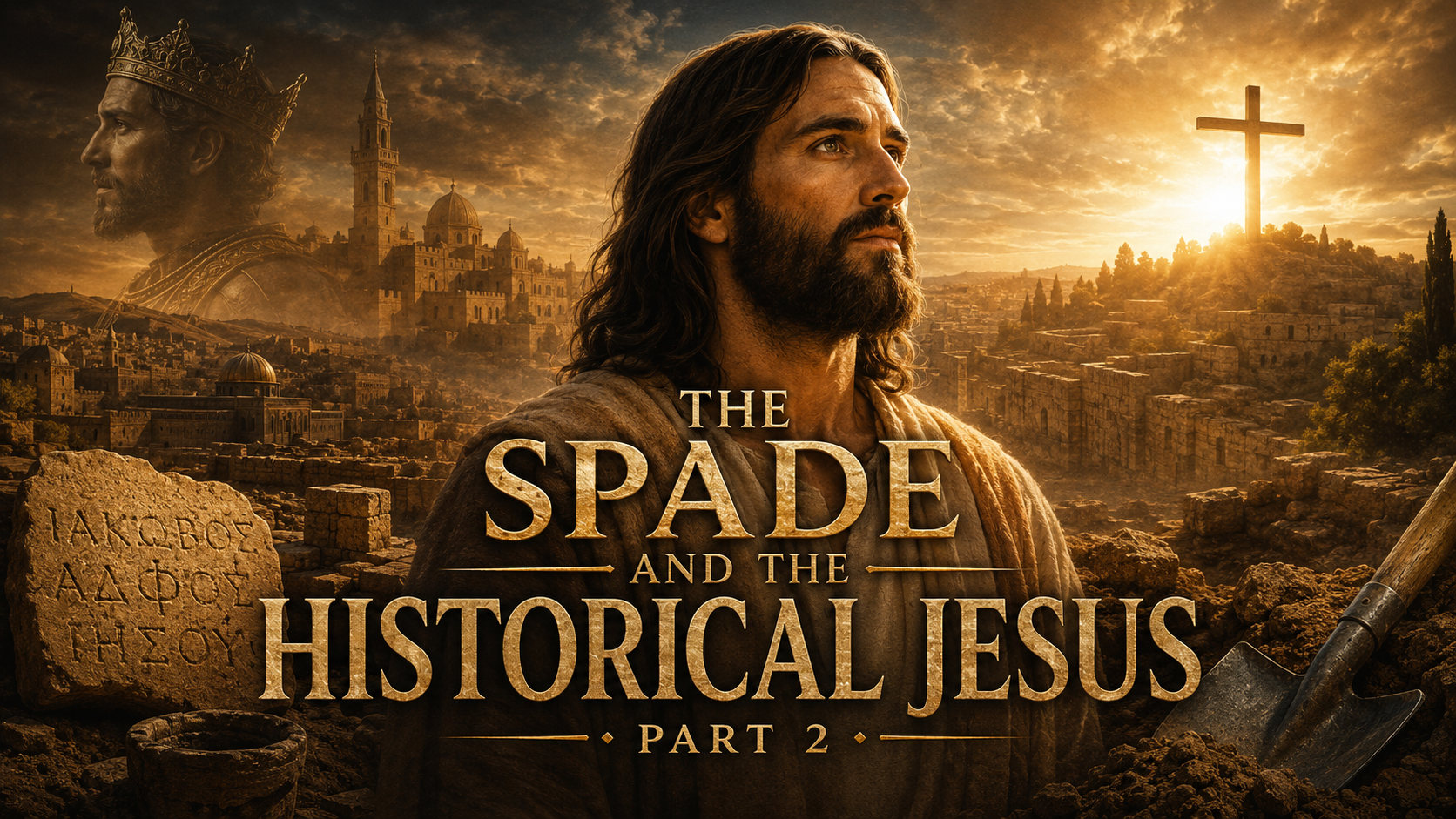
The Spade and the Historical Jesus: Archaeology, Prophecy, and the King Who Gave Everything
Is the story of Jesus only a matter of faith, or is it also rooted in real history?
That question matters deeply. Christianity is not built on vague ideas, private visions, or abstract philosophy. It is built on the claim that God entered human history. The Bible presents real places, real rulers, real cities, real events, and a real Savior who lived, died, and rose again.
In this second part of the seminar, The Spade and the Historical Jesus, Dr. Michael G. Hasel explores how archaeology and prophecy support the historical foundation of the New Testament. The message moves from Herod’s palaces to Pontius Pilate’s inscription, from Caiaphas’ bone box to the Megiddo church mosaic, and finally to the cross of Christ.
The central point is simple but powerful: the Bible is grounded in history, and that history points us to Jesus.
The Bible Is Rooted in Real History
One of the most important points in the presentation is that the Bible is different from every other major religious text. It is not merely a collection of spiritual sayings or moral teachings. It is not simply a book of philosophy. It is a record of God working in time and space.
The Bible begins with history:
“In the beginning God created the heavens and the earth.”
That opening sentence answers some of the biggest questions human beings have ever asked:
- Where did everything come from?
- Who made the world?
- Why does life exist?
- Is history moving toward something?
The Bible does not present history as a meaningless cycle. It presents history as a story with a beginning, a direction, and an ending. God creates. Humanity falls. God promises redemption. The Messiah comes. Jesus dies and rises again. And one day, Christ returns to restore all things.
This is why archaeology matters. If the Bible speaks about real events, real kings, real rulers, and real places, then history can help us see the setting in which God worked.
Why Archaeology Matters for Faith
Archaeology does not replace faith. It does not save anyone. It does not create a relationship with God. But it can help confirm that the Bible is not floating in myth or legend.
When archaeologists uncover inscriptions, cities, tombs, coins, and ancient structures that match the world described in Scripture, it gives us historical context. It helps us see that the people in the Bible lived in the same real world we live in.
This is especially important when it comes to Jesus.
Many skeptics have tried to reduce Jesus to a religious teacher, a moral example, or a legend that developed over time. But the New Testament presents Jesus as the Son of God who came into history. He lived under Roman rule. He was judged by Pontius Pilate. He was rejected by religious leaders. He was crucified outside Jerusalem. He rose again.
If those events happened in history, then Christianity is not just an idea. It is a response to something God actually did.
Herod the Great: The King Obsessed With Power
The presentation spends significant time on Herod the Great, one of the most famous rulers connected to the birth of Jesus.
Herod was a brilliant builder. He expanded the Temple Mount in Jerusalem. He built fortresses, palaces, theaters, ports, and massive public works. His architectural achievements were remarkable.
But Herod was also deeply paranoid.
According to the ancient historian Josephus, Herod was obsessed with protecting his throne. He feared political rivals. He feared the Jewish people rising against him. He feared threats from Egypt. He even feared members of his own family.
His paranoia became so extreme that he had members of his own family executed, including his beloved wife Mariamne and several of his sons. Herod’s life became a tragic picture of what happens when a person clings to power at any cost.
This background gives deeper meaning to the story of Jesus’ birth. When wise men came to Jerusalem asking, “Where is He who has been born King of the Jews?” Herod was troubled. He saw the child in Bethlehem not as the promised Messiah, but as a threat.
Herod had the chance to go to Bethlehem and worship Jesus. Instead, he sent soldiers.
The Discovery of Herod’s Tomb
One of the most fascinating archaeological stories connected to Herod is the discovery of his tomb at Herodium.
Herodium was one of Herod’s great fortress-palaces. It was located near Bethlehem and was named after himself. From the area of Bethlehem, the site would have been visible. This is striking because while Jesus was born humbly in Bethlehem, Herod’s massive fortress stood nearby as a symbol of earthly power.
For decades, archaeologist Ehud Netzer searched for Herod’s tomb. He excavated Herodium for many years but did not find it. Later in life, after decades of work, he returned to the site and continued the search.
Eventually, his team discovered a monumental staircase and the remains of a tomb structure on the slope of the mountain. The tomb had been destroyed in antiquity, likely because Herod was so hated. His sarcophagus had been smashed into pieces.
The discovery was powerful. Herod spent his life building monuments to himself. Yet in the end, his tomb was broken and empty of glory.
That contrast prepares us for the greater contrast between Herod and Jesus.
Herod the Great and Jesus the True King
Herod was called “King of the Jews.” He fought to protect that title. He built, schemed, killed, and controlled in order to keep his kingdom.
Jesus was also called “King of the Jews.” But He did not fight to save Himself. He did not build palaces. He did not use force. He did not kill His enemies. He gave His life for them.
Herod clung to a small earthly kingdom on the edge of the Roman Empire. Jesus gave up the glory of heaven to save the world.
Herod used power to protect himself. Jesus used His power to serve others.
Herod’s legacy was fear. Jesus’ legacy is life.
Pontius Pilate and the Stone That Confirmed His Name
Another important archaeological discovery mentioned in the presentation is the Pontius Pilate inscription found at Caesarea Maritima.
Caesarea was a major Roman city on the Mediterranean coast. It served as the administrative capital of Judea. This is where Roman governors, including Pontius Pilate, would have been based.
For a long time, some skeptics questioned certain details about Pilate. But archaeology gave us direct evidence. A stone inscription was found at Caesarea bearing the name Pontius Pilate and identifying him as prefect of Judea.
This matters because Pilate is one of the key figures in the trial and crucifixion of Jesus. The Gospels present him as the Roman authority who sentenced Jesus to death. The inscription confirms that Pilate was a real historical official with authority in Judea during the time of Christ.
Again, the Bible is not speaking in vague mythological language. It names real people who lived in real places.
The Caiaphas Ossuary: A Link to the Trial of Jesus
The presentation also mentions another major discovery: the ossuary, or bone box, associated with Caiaphas.
In the first century, Jewish burial practices often involved placing the bones of the deceased in stone boxes called ossuaries after the body had decomposed. One ornate ossuary was discovered with an inscription referring to Joseph, son of Caiaphas.
Caiaphas was the high priest involved in the trial of Jesus. In the Gospel accounts, he plays a central role in the religious leadership’s decision to condemn Christ.
This discovery is significant because it connects us to the world of the New Testament in a direct way. Caiaphas was not a symbolic figure. He was a real historical person. He lived in the same world where Jesus was arrested, tried, condemned, and crucified.
Ancient Writers Also Mention Jesus
Archaeology is not the only external witness to the historical Jesus. Ancient non-Christian writers also refer to Him and to the early Christian movement.
Tacitus, a Roman historian, wrote that Christ was executed under Pontius Pilate during the reign of Tiberius. This is important because Tacitus was not writing as a Christian trying to defend the faith. He was a Roman historian, and he was not friendly toward Christians.
Pliny the Younger also wrote about Christians. He described them as gathering on a certain day and singing hymns to Christ as to a god.
These references show that very early on, Christians were known for worshiping Jesus. They did not merely admire Him as a teacher. They honored Him as divine.
C.S. Lewis and the Gospels as History
The presentation also refers to C.S. Lewis, one of the most influential Christian thinkers of the twentieth century.
Lewis was not always a Christian. He was once an atheist. As a scholar of literature and myth, he understood legends deeply. But when he studied the Gospels, he came to believe they were not written like myths.
He recognized that the Gospel accounts had a different quality. They read like eyewitness-based history, not like ancient legend.
That observation is important. The New Testament does not sound like a distant fairy tale. It presents names, places, rulers, dates, conflicts, questions, failures, fears, and eyewitness details.
The Gospels are not trying to create a fantasy world. They are telling us what happened.
Who Do You Say Jesus Is?
One of the most important moments in the life of Jesus took place at Caesarea Philippi. This was a place known for pagan worship. Temples and religious shrines stood there. It was a place filled with competing ideas about gods, power, and worship.
There, Jesus asked His disciples a question:
“Who do men say that I, the Son of Man, am?”
The disciples gave different answers. Some said John the Baptist. Some said Elijah. Others said Jeremiah or one of the prophets.
Then Jesus made it personal:
“But who do you say that I am?”
That is still the question today.
It is good to study history. It is helpful to look at archaeology. It is powerful to see how prophecy points to Christ. But eventually, every person must answer the question personally.
Who is Jesus to you?
Peter answered:
“You are the Christ, the Son of the living God.”
That confession is the heart of Christianity.
The Megiddo Mosaic and the Worship of Jesus
Another powerful discovery discussed in the seminar is the Megiddo Mosaic.
This mosaic was found near Megiddo, in the Jezreel Valley, inside what appears to be one of the earliest known Christian worship spaces. It dates to around AD 220, making it one of the earliest Christian church-related discoveries in the region.
The mosaic includes inscriptions that identify believers and donors connected to the site. One inscription mentions a Roman centurion who helped fund the mosaic. That detail is remarkable because the New Testament also shows Roman soldiers encountering the truth about Jesus.
But the most important inscription is the one that refers to Jesus Christ as God.
This is one of the earliest archaeological witnesses showing that Christians worshiped Jesus as divine. It confirms what the New Testament already teaches: the early church did not slowly invent the divinity of Jesus centuries later. Believers were worshiping Jesus as God very early in Christian history.
The Bible Is Also Filled With Prophecy
The second major reason the Bible is unique is prophecy.
A large portion of Scripture is prophetic. Some prophecies deal with nations, kingdoms, judgment, restoration, and the end of time. Others point specifically to the Messiah.
The Old Testament contains many prophecies that Christians understand as pointing to Jesus. These include details about His birth, ministry, betrayal, suffering, death, and mission.
For example:
- The Messiah would be born in Bethlehem.
- He would enter Jerusalem riding on a donkey.
- He would be betrayed for silver.
- He would suffer and be pierced.
- He would be rejected, yet bring salvation.
These prophecies are not vague motivational sayings. Many of them are specific and historically meaningful.
Daniel 9 and the Timing of the Messiah
One of the most important prophecies mentioned in the presentation is Daniel 9.
Daniel 9 contains the prophecy of the seventy weeks. This prophecy points forward to the coming of the Messiah and the timing of His mission. Christians have long seen this prophecy as one of the clearest Old Testament time prophecies pointing to Jesus.
The New Testament says that Jesus came “when the fullness of time had come.” That means His coming was not random. It was not accidental. It happened according to God’s plan.
God was working through history. He was preparing the world. And when the time was right, He sent His Son.
The Probability of Messianic Prophecy
The presentation also highlights the staggering probability of one person fulfilling even a small number of messianic prophecies by chance.
When we consider specific prophecies such as the birthplace of the Messiah, the betrayal for silver, the entry into Jerusalem, and the manner of His suffering, the odds become overwhelming.
The point is not merely mathematical. The point is theological.
God knows the end from the beginning. He is not guessing. He is not reacting. He is guiding history toward His redemptive purpose.
Prophecy shows that Jesus did not simply appear as one more religious figure. He came as the promised Messiah.
The Cross: The Greatest Evidence of God’s Love
The presentation ends by turning our attention to the cross.
Archaeology can show us Roman nails. It can show us ancient execution practices. It can help us understand crucifixion as a real historical form of punishment. It can show us the world in which Jesus suffered.
But archaeology cannot fully explain the meaning of the cross.
Jesus did not die simply because Rome was cruel. He did not die merely because religious leaders rejected Him. He did not die only because Judas betrayed Him or Pilate condemned Him.
Jesus died for sin.
He carried the weight of the world’s guilt. He took upon Himself the burden that belonged to us. The cross reveals the seriousness of sin, but it also reveals the depth of God’s love.
Herod took life to protect his throne. Jesus gave His life to save His enemies.
That is the difference between the kingdoms of this world and the kingdom of God.
Two Kings, Two Kingdoms, One Choice
The contrast between Herod and Jesus is one of the most powerful themes in the message.
Herod was called King of the Jews. Jesus was called King of the Jews.
Herod lived for power. Jesus lived to serve.
Herod built monuments to himself. Jesus built a kingdom of grace.
Herod killed to keep control. Jesus died to set people free.
Herod’s tomb was shattered. Jesus’ tomb was empty.
Every person must decide which king they will follow.
Why This Message Matters Today
We live in a time when many people question the Bible. Some question whether Jesus truly lived. Others accept that He lived but deny who He claimed to be. Many see Him as a good teacher, but not as Lord.
That is why messages like this matter.
Archaeology reminds us that the Bible is connected to the real world. History reminds us that Jesus lived in a specific time and place. Prophecy reminds us that His coming was part of God’s plan. The cross reminds us that His mission was personal.
This is not just information for the mind. It is an invitation for the heart.
The question is not only, “Is there evidence?”
The deeper question is, “Will I follow Jesus?”
Final Thoughts
The Spade and the Historical Jesus shows that the Christian faith is not disconnected from history. The Bible speaks of real people, real places, and real events. Archaeological discoveries connected to Herod, Pilate, Caiaphas, early Christian worship, and the world of the New Testament help us better understand the setting of Jesus’ life and death.
But the greatest truth is not merely that Jesus existed. The greatest truth is that Jesus is the Christ, the Son of the living God.
He came at the right time. He fulfilled prophecy. He entered history. He died for our sins. And He calls us to follow Him.
Herod had the opportunity to worship the newborn King, but he chose power instead.
Today, we have the opportunity to choose differently.
May we choose Jesus.
Disclaimer: The video shared in this post is produced by a third party. We may not endorse all views, beliefs, or content of the creator, but we share this resource because we believe it can be a blessing to our visitors.
Our church occasionally shares videos and resources created by others. While we value good teaching and helpful content wherever it may be found, sharing a resource does not mean we fully agree with or endorse all the theology, lifestyle, doctrine, or opinions of the content creators or their channels.
Discover more from Fannin County Seventh-day Adventist Church
Subscribe to get the latest posts sent to your email.


