
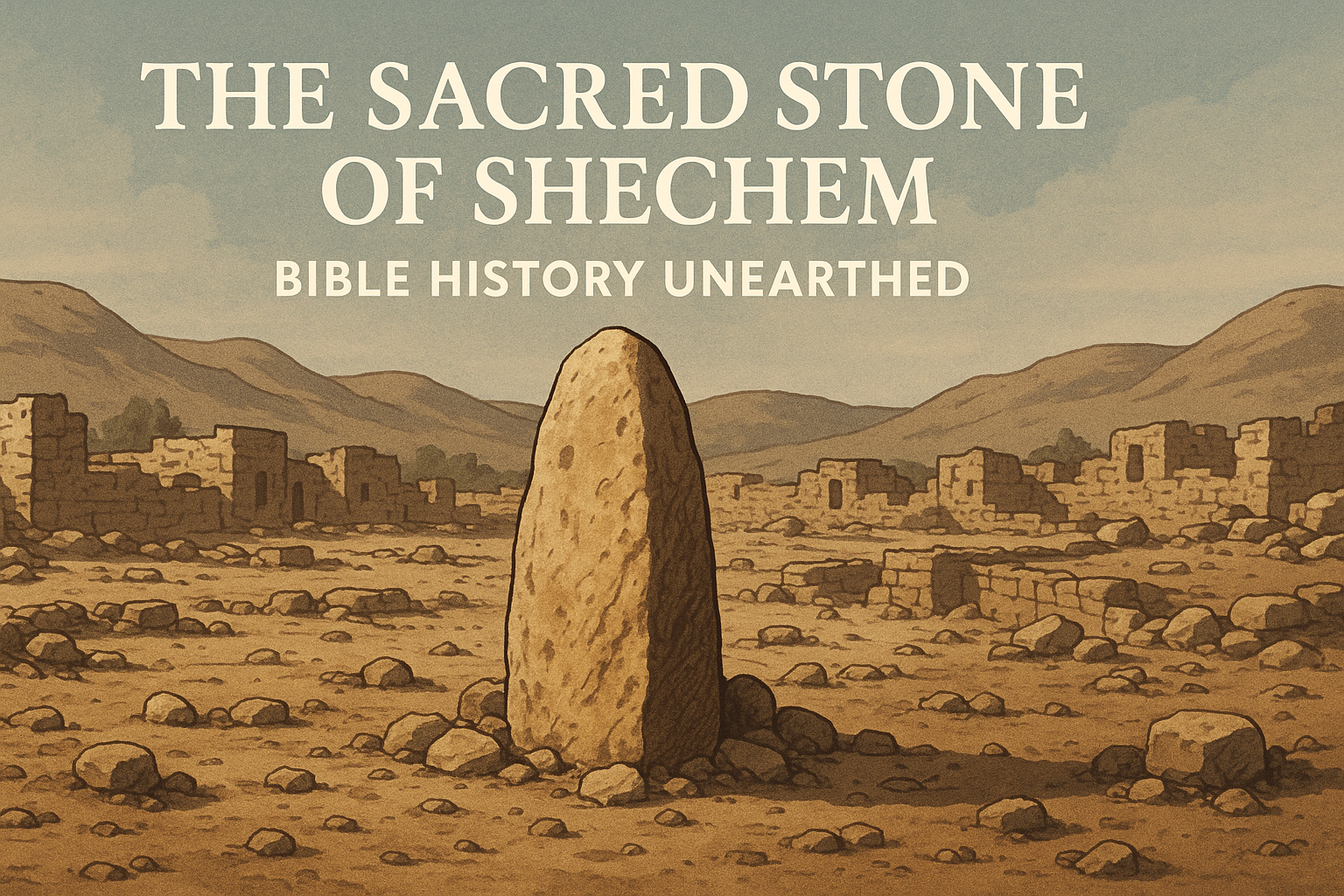
The Sacred Stone of Shechem: Bible History Unearthed
Published on: October 16, 2025
Author: Expedition Bible
Standing in the heart of ancient Shechem, archaeologists have uncovered something remarkable—an artifact described directly in the Bible. This isn’t just another excavation. It’s a discovery that brings the words of Scripture to life in stone.
Mount Gerizim and Mount Ebal: A Covenant Setting
Located about 35 miles north of Jerusalem, Shechem lies nestled between Mount Gerizim and Mount Ebal. This location plays a critical role in Deuteronomy 27, where Moses commands the Israelites to proclaim blessings from one mountain and curses from the other as they enter the Promised Land. Later, in Joshua 24, Shechem becomes the scene of a covenant renewal between God and the people of Israel.
The Sacred Stone Uncovered
In 1926, German archaeologist Ernst Sellin excavated Shechem’s ancient mound (Tel Balata). He unearthed a massive carved standing stone—called a *matzevah* in Hebrew—right beside the ruins of an altar and an enormous temple. This stone, though damaged, matched the biblical description of a covenant stone set up by Joshua as a witness in Joshua 24.
Initially mistaken for a watering trough, the base of the stone was later recognized as a foundation socket designed to hold the monolith upright. Once the stone was placed in its socket, it fit perfectly—revealing its sacred purpose.
A Temple and Its Fire
The structure behind the altar, identified as a temple, had walls over 17 feet thick. This led many to describe it as a fortress or tower-temple, possibly rising four stories. Inside, archaeologists found a destruction layer of intense burning—evidence that aligns perfectly with Judges 9, which tells of the temple being set on fire by Abimelek, killing around a thousand people hiding inside.
Controversy in the Dig
Despite Sellin’s biblical interpretation, his colleague Dr. Gabriel Welter fiercely disagreed. While Sellin was away, Welter had the standing stones removed and thrown down into a pit. Fortunately, in the 1960s, biblical archaeologist G. Ernest Wright salvaged the stone and restored it to its original location—recognizing its enormous significance.
Biblical Correlation Confirmed
Wright and his team supported Sellin’s view: this was the very temple described in Judges 8–9, associated with Baal-Berith (Lord of the Covenant). They even believed the standing stone matched the “great stone” set up by Joshua in Joshua 24, and noted the carved, smoothed surface that may have once held the written covenant itself, just as Deuteronomy 27 described.
The Broken Covenant
The standing stone now found at Shechem is broken, and that in itself is symbolic. Though Joshua established it as a witness to the Israelites’ promise to serve the Lord, by Judges 9, the people had fallen into idolatry, even worshiping the very stone that was meant to point them back to God. It is a broken witness to a broken covenant.
The Importance of Biblical Archaeology
This discovery is a powerful demonstration of how archaeology can affirm Scripture. Without the Bible, such a stone would be little more than a mysterious relic. But with the Bible, it becomes a profound link to the covenant between God and His people—a testament carved in stone.
As the video closes, viewers are reminded that only one Israelite ever lived in perfect covenant with God—Yeshua, the Messiah. He fulfilled the covenant we broke, offering forgiveness through His death, so we could be restored.
📺 Watch the full video here: https://www.youtube.com/watch?v=mnis257Rd3E
Discover more from Fannin County Seventh-day Adventist Church
Subscribe to get the latest posts sent to your email.


