
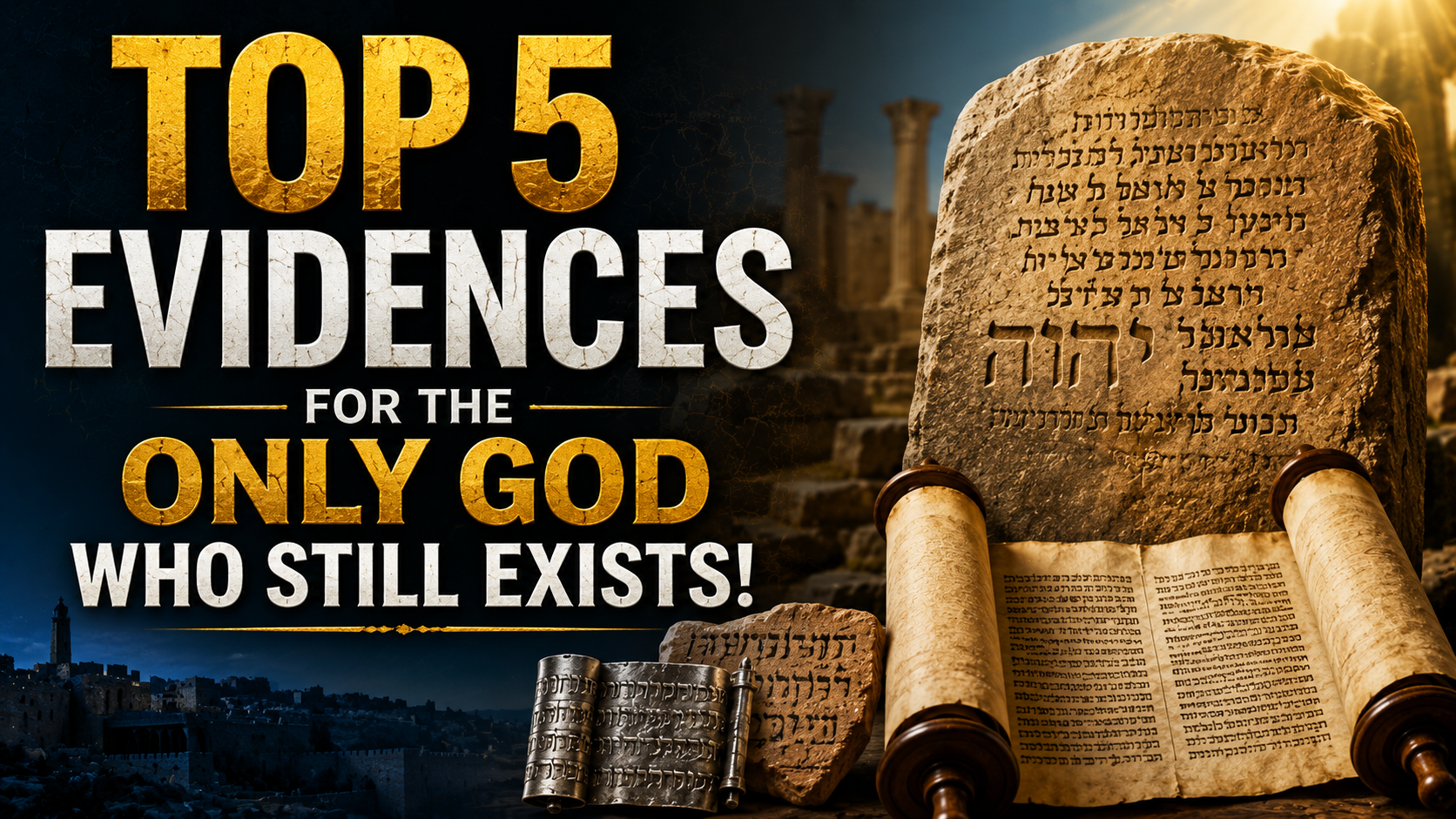
5 Archaeological Evidences for the God of the Bible: How the Name Yahweh Survived Through History
Human civilizations rise and fall.
Kings die. Empires disappear. Languages change. Cities become ruins. Religions that once dominated entire nations can eventually vanish so completely that their gods survive only as names written in archaeology textbooks.
But the God of the Bible presents Himself differently.
When God appeared to Moses at the burning bush, He revealed His personal name and said:
“This is My name forever, and this is My memorial to all generations.”
That statement creates an extraordinary historical question.
If the God of the Bible said His name would be remembered from generation to generation, can we actually find evidence that this happened?
The presentation TOP 5 Evidences for the ONLY God Who STILL Exists! examines archaeology spanning more than three thousand years and argues that the answer is yes.
From an Egyptian temple in Sudan to an ancient Moabite inscription, from tiny silver scrolls found outside Jerusalem to the Dead Sea Scrolls and modern Hebrew Bibles, the personal name of the God of Israel appears repeatedly across history.
Other ancient gods were once worshiped by powerful nations.
Marduk had Babylon.
Chemosh had Moab.
Ashur had Assyria.
Zeus and Jupiter were worshiped across the Greek and Roman worlds.
But their temples fell, their priesthoods disappeared, and their worship largely passed into history.
The name of Yahweh did not.
This article examines five major pieces of archaeological evidence presented in the video and explores what they reveal about the God who told Moses that His name would endure forever.
Does the God of the Bible Have a Personal Name?
Before looking at the archaeological evidence, we first need to understand what name we are looking for.
In Exodus 3, Moses encounters God at the burning bush. God tells Moses that He will deliver the Israelites from slavery in Egypt and commands him to return to Egypt.
Moses immediately recognizes a problem.
The Israelites will want to know who sent him.
They lived in a world filled with gods. Egypt alone had numerous deities, each with its own name, temples, priests, symbols, and stories.
So Moses asks God what he should say when the people ask for the name of the God who sent him.
God reveals His personal name.
In many English Bibles, this name appears as LORD written in capital letters. Behind that English translation are four Hebrew letters often called the Tetragrammaton:
YHWH
These Hebrew letters are commonly represented as Yod, He, Waw, He.
The presentation renders the divine name as Yahweh.
God then tells Moses that this is His name forever and that He will be remembered by this name from generation to generation.
That statement is unusually specific.
It does not merely say that people will continue believing in some form of deity. It identifies a personal name and connects that name with continuity through history.
Archaeology gives us a remarkable opportunity to examine that claim.
Evidence 1: The Soleb Inscription
The first major evidence takes us far from modern Israel to the country of Sudan.
There, at the ancient Egyptian temple of Soleb, archaeologists have found inscriptions dating to the reign of Pharaoh Amenhotep III.
The temple contains columns covered with Egyptian inscriptions celebrating foreign peoples and territories associated with Egyptian campaigns. Some of these inscriptions depict bound prisoners and identify the lands or groups from which they came.
Among these inscriptions is one particularly important phrase.
It refers to:
“The land of the Shasu of Yahweh.”
The Shasu were nomadic peoples known to the Egyptians. What makes this inscription so important is the appearance of the name Yahweh in an Egyptian context.
The Egyptian hieroglyphs in the inscription represent sounds corresponding to the divine name.
This evidence is significant because of its age.
The Soleb temple dates to the late fifteenth century BC. According to the chronology used in the presentation, this places the inscription in roughly the same century in which the biblical account describes God revealing His name to Moses.
Think about the importance of that.
The Bible says God revealed His personal name to Moses during the Exodus period.
An Egyptian inscription from that broad historical period contains a reference to a nomadic people connected with the name Yahweh.
The name was not invented centuries later by Jewish writers.
It was already known in the ancient Near Eastern world.
What Does “The Shasu of Yahweh” Mean?
The Soleb inscription does not give us the entire biblical story of Moses, the Exodus, or Israel.
But it provides something extremely valuable.
It shows that the name Yahweh was associated with a group of nomadic people during a very early period.
Later archaeological evidence helps establish the relationship between Yahweh and Israel more clearly. When the Soleb inscription is viewed alongside those later discoveries, a larger historical picture begins to emerge.
The people who worshiped Yahweh did not suddenly appear late in Israel’s history.
The divine name reaches back deep into the ancient world.
That makes the Soleb inscription one of the most fascinating archaeological discoveries connected with the Old Testament.
Evidence 2: The Moabite Stone
The second major evidence comes from the ancient kingdom of Moab.
East of the Dead Sea, in modern Jordan, lie the ruins of Dhiban, identified with ancient Dibon, an important Moabite city.
In 1868, a missionary named Frederick Klein learned about a large inscribed stone at the site. The object later became famous as the Moabite Stone, also called the Mesha Stele.
The inscription dates to the ninth century BC.
Its opening identifies the author:
Mesha, king of Moab.
This is immediately significant because the Bible also mentions Mesha, king of Moab, in 2 Kings 3.
But the inscription becomes even more important when we look at the names of the gods and nations it contains.
Mesha identifies himself with Moab and repeatedly refers to Chemosh, the chief god of the Moabites.
This reflects a common ancient pattern.
Nations were often strongly identified with their national gods.
- Moab was associated with Chemosh.
- Ammon was associated with Milcom or Molech.
- Assyria was associated with Ashur.
- Babylon was associated with Marduk.
The relationship between a nation and its god could become central to that nation’s identity.
The Moabite Stone then gives us another pair of names:
Israel and Yahweh.
Israel and Yahweh in the Same Ancient Inscription
The Mesha Stele refers to Israel multiple times and also contains the divine name Yahweh.
This makes the inscription especially important.
Here we have a document written by Israel’s enemy, not by a biblical author, identifying Yahweh as the God associated with Israel.
That is powerful independent historical evidence.
Moab had Chemosh.
Israel had Yahweh.
The relationship is clear enough that the inscription helps explain the earlier Soleb reference to the “Shasu of Yahweh.”
If later inscriptions show that Israel was known as the people of Yahweh, then the earlier Egyptian reference to Yahweh-associated nomads becomes even more interesting within the broader biblical context.
The Mesha Stele demonstrates that by the ninth century BC, the relationship between Israel and Yahweh was firmly established and recognized even by neighboring nations.
A Name Preserved Across Centuries
We now have two major points in history.
The Soleb inscription preserves the name Yahweh in the fifteenth century BC.
The Moabite Stone preserves the name Yahweh in the ninth century BC.
Hundreds of years separate these inscriptions.
Yet the name remains recognizable.
This is exactly the type of continuity that Exodus 3 describes when God says His name will endure from generation to generation.
But the archaeological trail does not stop there.
Evidence 3: The Silver Scrolls of Ketef Hinnom
The third major discovery takes us to Jerusalem.
Southwest of the ancient city lies an archaeological site called Ketef Hinnom. The area contains ancient burial caves dating to the period of the kingdom of Judah.
During excavations led by archaeologist Gabriel Barkay, researchers discovered two tiny rolled pieces of silver in one of the burial chambers.
At first glance, they were simply small silver objects.
But when carefully unrolled and examined, they revealed something extraordinary.
They contained ancient Hebrew writing.
Among the inscriptions was the divine name of God.
YHWH.
Yahweh.
The Priestly Blessing in Silver
The inscriptions on the Ketef Hinnom scrolls include language closely related to the priestly blessing found in Numbers 6.
The blessing asks Yahweh to bless and keep His people, shine His face upon them, show them grace, and give them peace.
These silver scrolls date to approximately the seventh century BC.
That makes them extremely important in biblical archaeology.
They demonstrate that biblical language and the personal name of God were being written in Jerusalem centuries before the time of Jesus.
The location is also meaningful.
The Bible repeatedly connects God’s name with Jerusalem.
Now archaeology has literally uncovered the divine name in ancient Jerusalem itself.
The God worshiped in Jerusalem was not anonymous.
His personal name had been preserved in Hebrew writing.
From Soleb to Jerusalem
The evidence now spans an even greater period.
In the fifteenth century BC, Yahweh’s name appears in an Egyptian inscription.
In the ninth century BC, Yahweh appears on the Moabite Stone alongside Israel.
In the seventh century BC, Yahweh’s name appears on silver scrolls in Jerusalem.
Different nations.
Different writing systems.
Different centuries.
The same divine name.
This is precisely what makes the archaeological pattern so striking.
Evidence 4: The Dead Sea Scrolls
The fourth major evidence comes from one of the greatest manuscript discoveries in modern history.
Beginning in 1947, ancient manuscripts were discovered in caves near Qumran, close to the Dead Sea.
These writings became known as the Dead Sea Scrolls.
The collection contains biblical manuscripts, commentaries, community documents, and other Jewish writings dating from several centuries before Christ into the first century AD.
The biblical manuscripts are especially important because they allow us to compare ancient copies of Scripture with later Hebrew manuscripts.
And throughout the Dead Sea Scrolls, the name of God appears repeatedly.
Yahweh was not forgotten.
It was copied again and again by Jewish scribes.
Hundreds of Appearances of the Divine Name
The presentation explains that the divine name appears hundreds of times across the Dead Sea Scroll manuscripts.
The scrolls were copied over several centuries, roughly from the third century BC into the first century AD.
This gives us another long period of continuity.
Generation after generation of Jewish scribes preserved the same name.
Even when Jewish traditions developed regarding how the name should be pronounced or spoken aloud, the written form continued to be preserved within the Hebrew Scriptures.
The four-letter divine name remained part of the biblical text.
The God who spoke to Moses was still identified by the same personal name centuries later.
The Preservation of Scripture
The Dead Sea Scrolls are important for more than the divine name.
They also demonstrate the remarkable preservation of the biblical text.
Before their discovery, some of the oldest complete Hebrew manuscripts available to scholars came from many centuries after the time of Jesus.
The Dead Sea Scrolls pushed the manuscript evidence much farther back in time.
When scholars compared these ancient manuscripts with later Hebrew texts, they found substantial continuity.
This does not mean every manuscript is letter-for-letter identical. Ancient manuscripts naturally contain variations. But the overall preservation of Scripture is remarkable.
The message survived.
The names survived.
The prophecies survived.
And Yahweh’s name survived.
Evidence 5: The Divine Name in the Present Generation
The fifth evidence brings the story into the modern world.
If Exodus 3 says God’s name would endure from generation to generation, then the chain should not end in antiquity.
Does the Jewish community still know the God of Israel by the same divine name?
Yes.
Modern Hebrew Bibles still contain the four Hebrew letters of the divine name.
Whether looking at commonly used Orthodox Jewish editions or modern Hebrew-English Tanakh editions, a reader can turn to Exodus 3 and find YHWH preserved in the Hebrew text.
More than three thousand years after the period associated with Moses, the same name remains.
This is extraordinary continuity.
Ancient Egyptian inscriptions contain the name.
Moabite inscriptions contain the name.
Ancient Hebrew silver scrolls contain the name.
The Dead Sea Scrolls contain the name.
Modern Hebrew Bibles contain the name.
The archaeological and manuscript record provides a continuous witness stretching from the ancient world into the present generation.
What Happened to the Other Ancient Gods?
At this point, the presentation asks an important comparative question.
What happened to the gods worshiped by the other ancient nations?
The ancient Near East was filled with deities.
Entire civilizations centered their identities around them.
The Babylonians honored Marduk.
The Assyrians worshiped Ashur.
The Moabites served Chemosh.
The Canaanite world included Baal and Asherah.
Later, Greek and Roman civilizations worshiped gods such as Zeus and Jupiter.
These gods once had enormous temples.
They had priests.
They had sacrifices.
They had festivals.
Kings credited military victories to them.
People prayed to them for fertility, protection, war, rain, and prosperity.
Today, those systems have largely disappeared.
Their temples are archaeological sites.
Their gods are studied as mythology.
Their ancient worshipers are gone.
Their names survive primarily because historians and archaeologists recovered them.
How Does the Name of a God Become Forgotten?
The video uses the Assyrian invasion of Judah to illustrate how ancient gods disappeared.
In 2 Kings 18, the Assyrian king Sennacherib had already conquered numerous nations. His armies destroyed cities and crushed resistance throughout the ancient Near East.
Then he turned toward Jerusalem.
Sennacherib’s representative mocked the people of Judah and challenged their trust in Yahweh.
His argument was simple.
Where were the gods of the nations Assyria had already destroyed?
Had any of them been able to save their people?
The answer appeared obvious.
No.
The cities were destroyed.
The populations were killed, deported, or absorbed.
The worship systems collapsed.
As those nations disappeared, the gods associated with them were eventually forgotten.
Sennacherib therefore asked why Yahweh should be any different.
Hezekiah’s Prayer
King Hezekiah heard the Assyrian threat and turned to God in prayer.
He acknowledged that Assyria had indeed destroyed other nations and burned their gods.
But Hezekiah identified the crucial difference.
Those gods were not truly gods.
They were objects made of wood and stone by human hands.
Hezekiah then asked Yahweh to deliver Jerusalem so that the kingdoms of the earth would know that He alone was God.
The biblical account says God answered.
Jerusalem was not conquered by Sennacherib.
The Assyrian army withdrew.
Yahweh’s people survived.
Deliverance and the Survival of God’s Name
The presentation argues that the survival of Yahweh’s name is connected with the survival of the people who worshiped Him.
Israel and the Jewish people endured events that destroyed or absorbed many ancient nations.
Egyptian oppression did not eliminate them.
Assyria did not eliminate them.
Babylonian exile did not eliminate them.
Persian-period threats did not eliminate them.
Later persecution and dispersion did not erase their identity.
Through every generation, the Scriptures continued to preserve the name of Yahweh.
This is what makes the comparison with ancient pagan gods so powerful.
Many gods were connected with civilizations that vanished.
The God of Israel continued to be worshiped.
Does Archaeology Prove That God Exists?
Archaeology can establish historical facts.
It can show that certain names were used at certain times.
It can confirm the existence of ancient kings, cities, peoples, religious practices, and inscriptions.
It can demonstrate that Yahweh’s name was known across thousands of years.
But archaeology cannot place God Himself inside a museum display case.
The evidence instead invites a larger conclusion.
The biblical God makes a historical claim about His name.
That claim can be tested.
The evidence shows that His name truly has endured through generation after generation.
The survival of the name does not force faith upon anyone. But it gives believers a remarkable historical foundation for confidence in Scripture.
The God described by the Bible did not disappear with the civilization in which His name was first recorded.
His worship continues.
His Scriptures continue.
His name continues.
From Yahweh to Jesus
The presentation closes by connecting the divine name with Jesus Christ.
Matthew 1:21 says Mary would give birth to a Son and that He would be called Jesus because He would save His people from their sins.
The Hebrew form of Jesus’ name is commonly represented as Yeshua.
The name carries the meaning that Yahweh saves.
This is central to the Christian message.
The God who revealed Himself to Moses as Yahweh is the God Christians worship.
Christianity does not introduce an unrelated deity centuries later.
The New Testament presents Jesus within the continuing story of the God of Abraham, Isaac, Jacob, Moses, David, and the prophets.
The story moves from Exodus to the gospel.
In Exodus, Yahweh delivers His people from slavery.
In the gospel, God delivers humanity from slavery to sin.
Yahweh Saves
The meaning of Jesus’ name beautifully summarizes the gospel.
Humanity’s greatest problem is not simply political oppression, illness, poverty, or mortality.
Our deepest problem is sin.
Sin separates us from God.
It brings guilt.
It produces suffering.
And ultimately, it leads to death.
The Christian gospel declares that God did not abandon humanity to this condition.
Jesus came to save His people from their sins.
He lived among us.
He revealed the character of God.
He died on the cross.
He rose from the dead.
Through Him, forgiveness and eternal life are offered to everyone who believes.
The God whose name survived history is presented in Scripture as the God who saves.
The Difference Between an Idol and the Living God
An idol cannot save its worshiper.
It cannot hear prayer.
It cannot predict history.
It cannot raise the dead.
It cannot forgive sin.
It cannot preserve itself after the civilization that created it disappears.
The biblical prophets repeatedly mocked idols for this reason.
Human hands created them.
A craftsman shaped the wood or stone.
Then people bowed before the thing they had created.
The Bible presents Yahweh as the opposite.
Human beings did not create Him.
He created human beings.
He is not sustained by worshipers.
He sustains them.
He does not exist because His name survived.
His name survives because He is the living God described in Scripture.
Five Evidences Across More Than Three Thousand Years
When the evidence is viewed together, the historical sequence is remarkable:
- The Soleb Inscription: An Egyptian inscription from the late fifteenth century BC refers to the Shasu of Yahweh.
- The Moabite Stone: A ninth-century BC inscription associates Israel with Yahweh.
- The Ketef Hinnom Silver Scrolls: Seventh-century BC Hebrew inscriptions from Jerusalem preserve the divine name within a biblical blessing.
- The Dead Sea Scrolls: Jewish manuscripts copied from the third century BC into the first century AD preserve the divine name hundreds of times.
- Modern Hebrew Scripture: Jewish Bibles today continue to preserve the four Hebrew letters representing Yahweh.
One name.
Many generations.
Many archaeological sites.
Multiple languages and writing systems.
Thousands of years.
The statement in Exodus remains striking:
“This is My name forever.”
Why This Evidence Matters for Christians
Christian faith is not built entirely on archaeology.
Faith comes from hearing the Word of God and responding to the revelation of Jesus Christ.
But Christianity is deeply historical.
The Bible does not begin with “once upon a time.”
It names places.
It names kings.
It identifies nations.
It describes wars, migrations, temples, cities, and rulers.
It places God’s acts within human history.
That means archaeology can interact meaningfully with the biblical story.
When excavations uncover names, places, inscriptions, and texts connected with Scripture, they help us understand the historical world of the Bible more clearly.
The enduring name of Yahweh is one of those remarkable connections.
God Is Not Limited to the Past
There is another important lesson.
It is possible to become fascinated with biblical archaeology while missing the God to whom the archaeology points.
The purpose of studying ancient inscriptions is not merely to collect interesting facts.
The God who spoke to Moses is not only the God of ancient stones.
He is the living God.
The Bible presents Him as active, personal, and involved with humanity.
He called Abraham.
He delivered Israel.
He heard Hezekiah’s prayer.
He spoke through the prophets.
He came near to humanity through Jesus Christ.
And Christians believe He continues calling people today.
The God Who Remembers His People
Human beings forget.
Generations pass.
Names disappear.
Even once-famous people eventually become little more than lines in history books.
But Scripture repeatedly describes God as remembering His covenant.
He remembered Noah.
He remembered Abraham.
He heard Israel in Egypt.
He preserved a remnant through exile.
He fulfilled promises given centuries earlier.
The endurance of His name reflects a larger biblical theme:
God is faithful.
People change.
Empires change.
Cultures change.
God does not.
A Personal Question
The archaeological evidence may lead us to ancient temples, burial caves, scrolls, stones, and museums.
But eventually, the study becomes personal.
If Yahweh is the living God described in Scripture, how will we respond to Him?
It is possible to know the correct Hebrew letters and still not know God.
It is possible to study the Mesha Stele and remain spiritually distant.
It is possible to admire the Dead Sea Scrolls while ignoring the message they preserve.
Jesus said eternal life is to know the only true God and Jesus Christ whom He sent.
The purpose of evidence is not merely to win an argument.
It should lead us toward truth.
Conclusion: The Name That Endured
More than three thousand years ago, the book of Exodus records God telling Moses:
“This is My name forever, the name you shall call Me from generation to generation.”
History provides an extraordinary trail.
The name Yahweh appears in an ancient Egyptian temple.
It appears on the Moabite Stone beside the name Israel.
It appears on tiny silver scrolls found near Jerusalem.
It appears throughout the Dead Sea Scrolls.
It remains written in Hebrew Bibles today.
Meanwhile, many gods that once dominated powerful civilizations have disappeared from living worship.
Their temples became ruins.
Their priesthoods vanished.
Their names became archaeological curiosities.
But the God of the Bible is still worshiped throughout the world.
His Word is still read.
His name is still known.
And the Christian gospel declares that His saving character is revealed fully in Jesus Christ.
Yahweh saves.
The God who delivered His people in the past offers deliverance from sin today.
The archaeological record can take us back through history.
The gospel asks us what we will do in the present.
The ancient evidence points to a name.
Scripture points to a Person.
And the invitation remains open:
Know the God whose name has endured from generation to generation, trust the Savior He has given, and discover for yourself that the God of the Bible is not merely the God of history.
He is the living God.
Discover more from Fannin County Seventh-day Adventist Church
Subscribe to get the latest posts sent to your email.


