
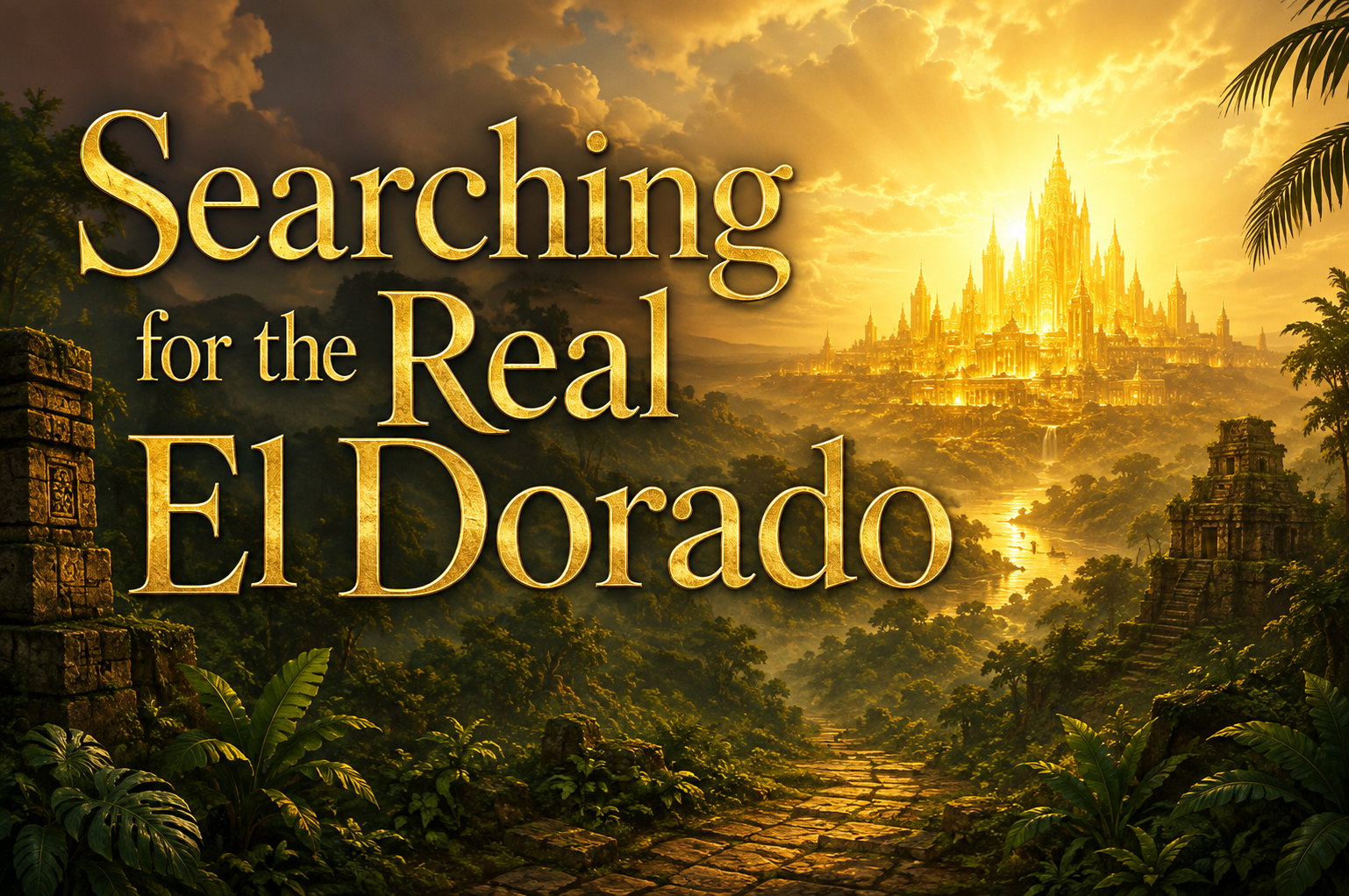
Searching for the Real El Dorado: The City Whose Builder and Maker Is God
For centuries, explorers have searched for places they believed might offer everything humanity desires: wealth, peace, wisdom, security, freedom, and happiness.
One of the most famous of these legends is El Dorado.
The name is often associated with a mysterious golden city hidden somewhere in the Americas. Stories told of a kingdom so wealthy that gold seemed almost ordinary. Explorers crossed mountains, entered jungles, followed rivers, and sometimes died while searching for it.
But the deeper desire behind El Dorado is much older than the legend itself.
Human beings have always searched for a perfect place.
We call it paradise.
Utopia.
Shangri-La.
The promised land.
The city on a hill.
Different cultures have given it different names, but the dream remains the same: somewhere there must be a place where fear is gone, justice prevails, people live in peace, and life is finally secure.
In Searching for the Real El Dorado, Pastor Doug Batchelor uses the history of explorers, lost civilizations, the American experiment, and Bible prophecy to point toward a much greater city.
According to Scripture, humanity’s search for the perfect city is not ultimately hopeless.
There is a city whose builder and maker is God.
There is a kingdom where peace is permanent.
There is a land where death, sorrow, violence, and injustice will finally end.
The real El Dorado is not hidden somewhere beneath the Amazon rainforest.
It is the New Jerusalem.
The Legend of El Dorado
The phrase “El Dorado” originally referred to “the gilded one.” According to the legend, a king would participate in a ritual in which his body was covered in gold dust before entering the water during a ceremonial event.
Over time, the story grew.
El Dorado became more than one golden ruler. It became a golden kingdom, then a golden city, and eventually a symbol of unbelievable wealth hidden somewhere in the Americas.
Stories spread of extraordinary civilizations filled with gold, impressive buildings, canals, wisdom, and prosperity.
European explorers became fascinated with the possibility.
Some believed the stories because incredible wealth had already been discovered in the Americas.
The Aztec and Inca civilizations demonstrated that enormous and highly organized societies had existed long before European arrival. Their cities, roads, temples, engineering, and wealth made stories of another great civilization seem possible.
So the search continued.
Percy Fawcett and the Lost City of Z
One of the most famous men to pursue the dream was British explorer Percy Fawcett.
Fawcett was a surveyor, military officer, and experienced explorer. He traveled extensively through parts of South America and spent years moving through remote areas of the Amazon.
During his journeys, he heard stories from Indigenous peoples about ancient settlements, roads, wealthy civilizations, and forgotten cities hidden within the jungle.
Fawcett eventually became convinced that somewhere in the Amazon stood the remains of a great lost civilization.
He called the city simply “Z.”
In 1925, Fawcett entered the Brazilian wilderness with his son Jack and Jack’s friend Raleigh Rimell.
The group sent a final message indicating that they believed they were approaching their destination.
Then they disappeared.
No confirmed account ever established exactly what happened to them.
Fawcett had spent much of his life pursuing the possibility of a forgotten city.
In the end, he disappeared while searching for it.
His story illustrates something deeply human.
People will sacrifice extraordinary amounts of time, money, comfort, security, and even life itself if they believe something of great value lies ahead.
Why the Search Did Not Seem Foolish
Fawcett’s belief was not based entirely on fantasy.
European explorers had already encountered civilizations in the Americas with impressive cities and enormous wealth.
Hernán Cortés and his forces encountered the Aztec Empire and the great city of Tenochtitlan.
Francisco Pizarro later encountered the Inca Empire in South America, where the Spanish were astonished by the amount of gold and silver present.
The Inca road system stretched across enormous distances. Cities and fortifications demonstrated remarkable organization and engineering skill.
If civilizations like these had existed in Mexico and Peru, explorers naturally wondered what else might remain hidden deeper within South America.
The Amazon seemed almost limitless.
Could another civilization be hidden there?
For generations, many believed the answer might be yes.
Francisco de Orellana and the Amazon River
One expedition connected with the search for wealth and resources eventually led to one of history’s remarkable journeys.
Gonzalo Pizarro led a large expedition eastward from the Andes into the Amazon basin. The group suffered terribly from hunger, disease, difficult terrain, and lack of supplies.
Francisco de Orellana was sent downstream with a smaller group to search for food.
Unable to return against the powerful river current, Orellana and his men continued downstream.
They eventually traveled the entire course of the Amazon River.
During the journey, they reported encountering large settlements and populated areas along the river.
They described communities with food supplies, roads, organized societies, and in some places fierce military resistance.
Later generations often doubted these accounts because when Europeans returned to some of these areas, the dense rainforest appeared to contain only scattered populations.
But modern discoveries have caused historians and archaeologists to reconsider how densely populated parts of the ancient Americas may once have been.
When the Jungle Hides a Civilization
Tropical forests can erase visible evidence of human settlement surprisingly quickly.
Seeds take root between stones.
Trees grow through walls.
Roots push apart buildings.
Roads disappear beneath vegetation.
Within generations, a once-active city can appear to be untouched forest.
Modern technologies such as lidar have allowed researchers to see beneath thick vegetation and examine the shape of the ground below.
The result has revealed evidence of roads, settlements, earthworks, and large population centers in areas once thought to have contained only small scattered communities.
Some ancient civilizations were far more extensive than earlier researchers realized.
This does not prove every legend about El Dorado.
But it does show that stories of substantial lost civilizations were not necessarily as impossible as people once assumed.
The Golden Raft and the Roots of the Legend
The legend of El Dorado also appears to contain elements rooted in real Indigenous traditions.
A famous golden raft discovered in Colombia depicts figures aboard a ceremonial raft, including a central leader surrounded by attendants.
Artifacts like this demonstrate that stories involving gold and ceremonial leaders were not simply inventions created entirely by European imagination.
The legends grew dramatically over time, but they may have started with real ceremonies and real societies.
This helps explain why explorers remained convinced that somewhere beyond the next mountain or river lay a place of unbelievable wealth.
Yet even if every detail of El Dorado had been true, it still would not have solved humanity’s greatest problem.
Gold cannot stop death.
Wealth cannot remove sin.
A beautiful city cannot guarantee peace in the human heart.
Humanity’s Search for Utopia
El Dorado is only one version of the human dream.
Another word is “utopia.”
Today, the word describes an ideal society in which life is peaceful, prosperous, fair, and happy.
We imagine a place without corruption.
Without war.
Without poverty.
Without violence.
Without oppression.
Humanity repeatedly attempts to create such societies.
Political movements promise them.
Revolutions promise them.
New technologies promise them.
Economic systems promise them.
But every human society eventually encounters the same problem.
People bring human nature with them.
A perfect system operated by selfish people will eventually become imperfect.
Shangri-La and the Dream of Paradise
Another famous image is Shangri-La.
The name came from James Hilton’s novel Lost Horizon, which described an isolated place of peace, wisdom, beauty, and unusual longevity.
The word eventually became synonymous with paradise.
Hotels, resorts, and businesses adopted the name because it communicates escape and perfection.
Again, the theme is familiar.
People want somewhere better.
We want a place untouched by the problems surrounding us.
Deep inside, humanity seems to remember that the world was supposed to be different.
The Bible explains why.
Human beings were originally created for Eden.
We were made for a world without death.
We were made for fellowship with God.
Sin destroyed that harmony, but the longing remained.
Israel and the Promised Land
The Bible contains its own history of people searching for a better land.
Israel left slavery in Egypt and journeyed toward Canaan.
God described the promised land as a land flowing with milk and honey.
The Israelites would receive houses they had not built, wells they had not dug, vineyards they had not planted, and cities already established.
But God gave them an important warning.
When prosperity came, they must not forget Him.
This is one of the recurring dangers of human prosperity.
People seek wealth because they believe it will make them secure.
Then wealth arrives, and they begin trusting the blessing instead of the One who gave it.
The promised land could be a blessing only if Israel remained connected to God.
Solomon’s Golden Kingdom
During the reign of Solomon, Israel experienced something resembling the ancient dream of a golden kingdom.
The nation was prosperous.
Jerusalem became famous.
Other rulers traveled to hear Solomon’s wisdom.
Gold flowed into the kingdom.
Scripture describes a period when people lived in relative security and peace.
In some ways, Solomon’s Jerusalem looked like the kind of city humanity had always wanted.
Wealth.
Wisdom.
Peace.
Influence.
But even Solomon’s kingdom did not last.
Human weakness entered the story.
Compromise followed prosperity.
The kingdom eventually divided.
Once again, an earthly golden age proved temporary.
The City on a Hill
When Puritan settlers crossed the Atlantic toward North America, some imagined that they had an opportunity to build a different kind of society.
John Winthrop famously spoke about a “city upon a hill,” drawing from Jesus’ words in Matthew 5.
The idea was that the new community would be watched by others and should therefore demonstrate faithfulness, morality, justice, and responsibility.
Once again, the image of the city appears.
Human beings want to build a society that becomes a light to others.
That aspiration can be good.
Christians should want communities that value justice, freedom, honesty, compassion, and human dignity.
But no earthly country can become the kingdom of God.
No constitution can remove sin from the heart.
No government can create heaven on earth.
A More Perfect Union, Not a Perfect One
The sermon makes an important distinction regarding the American experiment.
The Constitution speaks of forming “a more perfect union.”
Not a perfect union.
Human governments can improve.
Laws can protect freedom.
Institutions can encourage justice.
People can build societies that are safer, freer, and more prosperous than others.
But perfection remains beyond human government.
Every political system is administered by imperfect human beings.
Republics have problems.
Monarchies have problems.
Dictatorships have problems.
Theocracies administered by sinful people have problems.
The central problem is deeper than political structure.
The human heart needs transformation.
Freedom Requires Character
One theme emphasized in the message is the connection between freedom and morality.
A free society depends heavily on people exercising freedom responsibly.
If people become dishonest, violent, selfish, corrupt, or indifferent to the lives of others, more laws alone cannot repair the deepest problem.
External rules can restrain behavior.
They cannot create love.
They cannot manufacture integrity.
They cannot transform selfishness into compassion.
That is why the gospel begins with the heart.
Jesus did not simply come to create better regulations.
He came to make new people.
God promises to write His law within the heart.
True freedom requires internal transformation.
America in the Sermon’s Prophetic Framework
The presentation connects the United States with the second beast described in Revelation 13, a familiar interpretation within Seventh-day Adventist prophecy.
The beast is described as rising from the earth with two horns like a lamb before eventually speaking like a dragon.
Within this interpretation, the lamb-like beginning represents principles of civil and religious liberty.
The message emphasizes that believers should not act as though every final prophetic event has already happened.
Religious liberty still exists.
The gospel can still be preached openly.
Christian ministries can still publish, broadcast, organize, evangelize, and send missionaries.
Therefore, the sermon’s counsel is not panic.
It is faithfulness.
Use the freedom that exists while it exists.
Preach.
Teach.
Serve.
Share Scripture.
Do not waste the opportunity God has provided.
Do Not Cry Wolf Too Early
Pastor Batchelor warns against repeatedly declaring that the final crisis has arrived every time a troubling event appears.
History provides many examples of believers who thought a major war, political crisis, or technological development must immediately mark the end.
World War I created enormous prophetic expectations.
World War II and the development of nuclear weapons did the same.
Yet generations continued.
This does not mean prophecy is unimportant.
It means Christians should be careful, thoughtful, and biblical.
If believers repeatedly announce events before they occur, eventually people stop listening.
Jesus called His followers to watch.
Watching is different from panic.
Watching means staying spiritually awake while continuing the work God has given us.
The Gospel and the Opportunity of Freedom
One of the greatest blessings of religious freedom is the ability to share the gospel openly.
Mission organizations have used printing presses, radio, television, satellites, the internet, and modern technology to carry Scripture around the world.
Bible societies and mission movements have translated and distributed Scripture into countless languages.
Christian missionaries have crossed oceans and borders to establish churches, schools, hospitals, and ministries.
Technology can be used for evil.
But it can also be used for the gospel.
Printing can distribute corruption or Scripture.
Television can spread entertainment or biblical teaching.
The internet can spread deception or truth.
Artificial intelligence can be used irresponsibly or become a tool for helping people access biblical resources.
The tool itself is not the final issue.
The question is how we use the opportunity God has placed in our hands.
No Earthly Nation Is El Dorado
Patriotism can become dangerous when a nation is confused with the kingdom of God.
The sermon expresses gratitude for American freedoms while also recognizing the country’s failures and imperfections.
This balance matters.
Christians can appreciate civil liberties without pretending their country is perfect.
They can be thankful for blessings while still acknowledging injustice.
They can serve their communities while remembering that their highest allegiance belongs to Christ.
America is not El Dorado.
No country is.
No human nation will become the New Jerusalem.
Earthly citizenship is temporary.
Christian citizenship is eternal.
Our Citizenship Is in Heaven
Paul writes in Philippians 3:
“For our citizenship is in heaven, from which we also eagerly wait for the Savior, the Lord Jesus Christ.”
This verse radically changes the Christian perspective.
We may have passports and national identities here.
We may love the places where we were born.
We may be grateful for freedoms, culture, family, and community.
But this world is not our final home.
The Christian is a citizen of a kingdom that has not yet fully appeared.
We are waiting for a King.
We are waiting for a city.
We are waiting for restoration.
Abraham Was Looking for a City
Hebrews 11 describes Abraham as a pilgrim.
God called him to leave his homeland and journey toward a land he did not yet fully possess.
But Abraham’s faith eventually reached beyond earthly Canaan.
Hebrews says:
“He waited for the city which has foundations, whose builder and maker is God.”
This is the real El Dorado.
Not a city built by explorers.
Not a city discovered through lidar.
Not a civilization hidden beneath jungle vegetation.
A city built by God.
Abraham understood that no earthly settlement could fully satisfy the promises of God.
He was looking beyond this world.
Strangers and Pilgrims on the Earth
Hebrews continues by describing the faithful as strangers and pilgrims.
They were searching for a homeland.
They could have returned to the countries they left behind.
But they desired something better.
A heavenly country.
That phrase captures the Christian life.
We live here.
We work here.
We raise families here.
We help our neighbors here.
We participate in society here.
But our deepest hope is somewhere else.
We are looking for the country God has prepared.
The New Jerusalem
Revelation 21 finally reveals the city humanity has been searching for.
John writes:
“Then I, John, saw the holy city, New Jerusalem, coming down out of heaven from God.”
The description contains imagery more extraordinary than any earthly legend of El Dorado.
The city shines with the glory of God.
Its gates are described as pearls.
Its foundations are decorated with precious stones.
Its streets are associated with pure gold.
A river of life flows from the throne of God.
The tree of life appears again.
But the greatest treasure of the city is not gold.
It is God’s presence.
Why the New Jerusalem Is Different
Every earthly utopia eventually fails because sin remains.
The New Jerusalem is different because sin is gone.
Revelation says there will be no more death.
No more sorrow.
No more crying.
No more pain.
The former things will pass away.
Humanity has tried to create societies without suffering.
Only God can remove the cause of suffering.
Humanity has built hospitals to fight disease.
God will remove disease.
Humanity builds prisons to restrain violence.
God will remove sin.
Humanity builds cemeteries because death is unavoidable.
In God’s kingdom, death itself will end.
This is not simply a better government.
It is a new creation.
The City Is Prepared for a People
Hebrews says God has prepared a city for His people.
Revelation describes the New Jerusalem as a bride prepared for her husband.
This means the biblical story is not simply about architecture.
God is preparing both a place and a people.
The character of heaven must begin in the heart now.
If heaven is a place of love, God is teaching us to love now.
If heaven is a place of truth, God calls us to live truthfully now.
If heaven is a place of holiness, God calls us away from sin now.
If heaven is a place where Christ rules, Christ must begin ruling the heart now.
We do not earn the city through good works.
We receive salvation through Jesus.
But those who are saved are transformed by the King whose city they will enter.
What Are You Searching For?
Percy Fawcett spent years searching for a city he believed existed somewhere in the Amazon.
Others crossed oceans looking for gold.
Some built nations hoping to create ideal societies.
People today continue the same search in different ways.
Some search for El Dorado in money.
If they can just earn enough, they believe life will finally feel secure.
Others search for it in politics.
If the right leaders win, perhaps the world will finally become safe.
Others search through technology.
Perhaps artificial intelligence, medicine, or scientific advancement will solve every problem.
Others search for paradise through travel, relationships, possessions, career success, or entertainment.
None of these things are necessarily wrong.
But none of them can become heaven.
Do Not Die Searching for the Wrong City
There is something tragic about explorers giving their lives while searching for a city they never found.
But there is an even greater tragedy.
A person can spend an entire lifetime chasing wealth, status, comfort, political power, or earthly success and never prepare for the city that actually exists.
Jesus asked:
“What will it profit a man if he gains the whole world, and loses his own soul?”
Even if El Dorado had been exactly what the legends described, its gold could not purchase eternal life.
The greatest treasure cannot be mined.
It is given.
Jesus offers eternal life freely to those who trust Him.
The King of the Real Golden City
Every kingdom has a ruler.
The New Jerusalem has a King.
Jesus Christ.
Unlike earthly rulers, He cannot be corrupted.
He cannot be bribed.
He does not abuse power.
He does not lie.
He does not age.
He does not die.
His kingdom is righteous because its King is righteous.
The world has repeatedly searched for perfect political systems.
The Bible ultimately points to a perfect King.
When the King is perfectly good, the kingdom can finally be perfectly secure.
Preparing for the Real El Dorado
The biblical call is not to search jungles for the New Jerusalem.
We prepare through faith.
We receive Christ.
We repent of sin.
We learn to love God and others.
We store God’s Word in our hearts.
We use the freedoms and opportunities we have to share the gospel.
We remain faithful even when earthly societies change.
And we remember where our citizenship truly belongs.
The Christian does not need to panic when earthly kingdoms rise or fall.
Our hope is not built upon them.
We are waiting for the kingdom that cannot be shaken.
Conclusion: The City We Have Been Looking For
Human history is filled with people looking for the perfect place.
El Dorado promised gold.
Utopia promised perfect society.
Shangri-La promised peace and long life.
Political movements promised justice.
Explorers searched continents.
Nations attempted to build cities on hills.
But every earthly version remained incomplete.
The Bible explains why the longing persists.
We were created for something better than this fallen world.
Abraham understood it.
He looked for a city with foundations whose builder and maker is God.
The patriarchs understood it.
They confessed that they were strangers and pilgrims seeking a better country.
Paul understood it.
He said our citizenship is in heaven.
John saw it.
The holy city, the New Jerusalem, coming down from God.
This is the real El Dorado.
A city of peace.
A city of wisdom.
A city of life.
A city connected with streets of gold, but where gold is not the greatest treasure.
The greatest treasure is the presence of God.
No explorer can discover this city through human strength.
No army can conquer it.
No fortune can purchase citizenship.
Jesus has already paid the price.
He invites us to belong to His kingdom.
So while the world continues searching for its next utopia, Christians can lift their eyes higher.
Our home is not hidden beneath a jungle canopy.
Our city is prepared by God.
Our King is Jesus.
And one day, the search will finally be over.
Discover more from Fannin County Seventh-day Adventist Church
Subscribe to get the latest posts sent to your email.


