
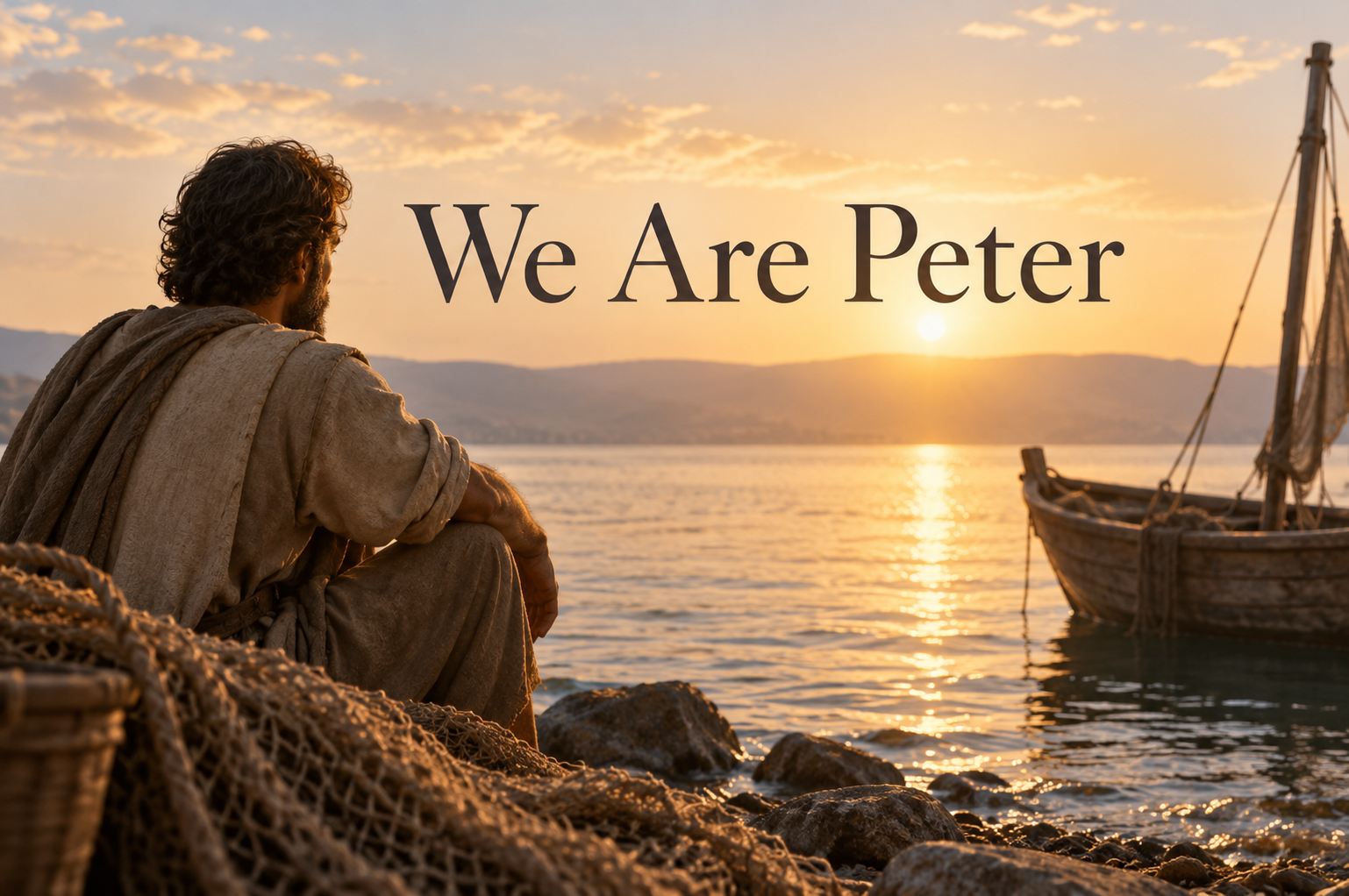
We Are Peter: From Failure and Fear to Forgiveness, Faith, and Transformation
Few people in the New Testament are as memorable as Peter.
He speaks when everyone else is silent.
He acts before thinking.
He makes bold promises and then struggles to keep them.
He steps out of the boat in faith and then begins to sink.
He declares that Jesus is the Christ and shortly afterward tries to correct Jesus about God’s plan.
He promises he will never abandon Christ, then denies knowing Him three times.
And yet this same Peter becomes one of the boldest leaders of the early Christian church.
That is what makes his story so encouraging.
Peter was not transformed because he began as a flawless disciple. He was transformed because Jesus refused to give up on him.
In We Are Peter, Pastor Doug Batchelor follows Peter through the Gospels and Acts to show how closely his spiritual experience resembles our own.
Peter believed.
Peter doubted.
Peter succeeded.
Peter failed.
Peter spoke for God.
Peter sometimes spoke foolishly.
Peter fell terribly.
Peter repented deeply.
And through the grace of Christ, Peter became a different man.
The message is simple:
If Jesus could transform Peter, there is hope for us.
Peter Is Everywhere in the New Testament
Peter appears again and again throughout the ministry of Jesus.
He is present at miracles, sermons, arguments, private conversations, the Transfiguration, the Last Supper, Gethsemane, the trial of Christ, the empty tomb, the Sea of Galilee, Pentecost, and the beginning of the Christian church.
He is sometimes called Simon.
Sometimes Simon Peter.
Sometimes Cephas.
And Jesus gives him the name Peter, connected with the idea of a stone or rock.
But Peter does not begin as a spiritual giant.
He begins as a fisherman.
He is practical, outspoken, rough around the edges, emotional, courageous, and impulsive.
Jesus sees all of that.
And Jesus calls him anyway.
From Fisherman to Disciple
Peter originally worked as a fisherman around the Sea of Galilee.
His brother Andrew was instrumental in bringing him to Jesus.
Andrew does not receive the same attention Peter receives in Scripture, but his simple act of bringing his brother to Christ changed history.
That is an important lesson by itself.
You may never preach to thousands.
You may never become well known.
But bringing one person to Jesus can have consequences you will never fully see.
Andrew brought Peter.
And Peter would eventually preach at Pentecost.
The Miraculous Catch
One of the defining moments in Peter’s calling takes place after a frustrating night of fishing.
Peter and the others had worked through the night and caught nothing.
Jesus told them to launch out again and let down the nets.
From Peter’s perspective, the instruction did not make much sense.
He was the fisherman.
Jesus was known as a teacher and carpenter.
Peter understood the lake, the timing, the nets, and the habits of fish.
But he finally responded in faith:
“At Your word, I will let down the net.”
The result was overwhelming.
The catch was so large that the nets began to break and the boats were filled.
Peter suddenly realized that he was standing in the presence of Someone far greater than an ordinary teacher.
He fell before Jesus and said:
“Depart from me, for I am a sinful man, O Lord.”
This is one of the most important moments in Peter’s life.
His discipleship begins with recognition of his own sinfulness.
Jesus does not respond by saying, “You are right, Peter. You are too sinful for Me.”
Instead, He tells him not to be afraid.
Then He gives him a new mission:
“Follow Me, and I will make you a fisher of men.”
Jesus Calls Imperfect People
Many people imagine they need to become good enough before they can seriously follow Christ.
Peter’s story destroys that idea.
Jesus knew exactly what Peter was like when He called him.
He knew Peter would speak too quickly.
He knew Peter would misunderstand Him.
He knew Peter would lose faith.
He knew Peter would deny Him.
And still Jesus said:
“Follow Me.”
Christ does not call us because the work is already finished.
He calls us so He can begin the work.
Be Prepared to Be Remodeled
Peter was bold, impulsive, stubborn, brave, and sometimes proud.
Jesus did not erase his personality.
He transformed it.
The courage that once caused Peter to act recklessly would eventually allow him to stand before religious authorities and refuse to stop preaching Christ.
The strong personality that once created problems would eventually become useful in leading the early church.
Following Jesus means allowing Him to reshape what is broken in us.
The sermon compares this process to a sculptor working on a damaged piece of stone.
A great artist can see possibilities where everyone else sees flaws.
God sees us in the same way.
He sees the cracks.
He sees the weaknesses.
He sees the habits we wish were different.
But He also sees what His grace can produce.
The hammer and chisel may not always feel comfortable.
But Christ is shaping character.
Peter Steps Out of the Boat
Peter’s impulsiveness was not always a weakness.
Sometimes it made him willing to attempt what no one else would try.
During a storm on the Sea of Galilee, the disciples saw Jesus walking on the water.
They were terrified.
But when Jesus identified Himself, Peter said:
“Lord, if it is You, command me to come to You on the water.”
Jesus answered:
“Come.”
Peter stepped out.
For a moment, the impossible became possible.
A fisherman walked on water.
But then Peter looked away from Jesus.
He saw the wind.
He saw the waves.
He remembered the danger.
His faith began to sink, and then his body followed.
Peter cried out:
“Lord, save me!”
Immediately, Jesus reached down and took hold of him.
Keep Your Eyes on Jesus
The lesson is larger than walking on water.
The Christian life itself is impossible without Christ.
Living faithfully in a sinful world cannot be accomplished simply through determination.
We must remain connected to Jesus.
When Peter focused on Christ, he walked.
When he focused on the storm, he sank.
We do the same thing.
When we focus entirely on temptation, fear, circumstances, criticism, politics, money, illness, pressure, or ourselves, faith weakens.
But when we keep looking toward Christ, we remember who called us out of the boat.
Peter deserves criticism for doubting.
But he also deserves credit for something the others did not do.
He got out of the boat.
Peter Confesses Christ
Peter was frequently the first disciple to speak.
Sometimes that caused trouble.
But sometimes he said exactly what needed to be said.
When many disciples stopped following Jesus because His teaching had become difficult, Jesus asked the Twelve whether they would also leave.
Peter answered:
“Lord, to whom shall we go? You have the words of eternal life.”
Later, near Caesarea Philippi, Jesus asked the disciples:
“Who do you say that I am?”
Again Peter answered:
“You are the Christ, the Son of the living God.”
Jesus told him that this truth had been revealed by the Father.
This was one of Peter’s finest moments.
But what happens next shows how unstable human beings can be.
From Speaking for God to Resisting God
After Peter’s confession, Jesus began explaining that He would go to Jerusalem, suffer, be killed, and rise again.
Peter did not like the plan.
His understanding of the Messiah was still shaped by expectations of an earthly kingdom.
He could imagine Christ ruling.
He could imagine victory.
He could imagine power.
But he could not accept the cross.
So Peter took Jesus aside and began correcting Him.
Think about the contradiction.
Peter had just confessed that Jesus was the Son of God.
Then he tried to tell the Son of God that His plan was wrong.
Jesus strongly rebuked him.
Within a very short period, Peter had spoken a truth revealed by God and then expressed an idea completely contrary to God’s plan.
We can do the same.
One moment we may say something wise, loving, or spiritual.
Shortly afterward, pride, anger, fear, or selfishness can take control.
This is why we must remain dependent on God continually.
Peter Always Had Something to Say
The Mount of Transfiguration gives another example.
Peter, James, and John saw Jesus glorified while Moses and Elijah appeared with Him.
It was an overwhelming experience.
Peter immediately suggested building three tabernacles.
One for Jesus.
One for Moses.
One for Elijah.
The Gospel account points out that Peter did not really know what he was saying.
That may be one of the most relatable descriptions of Peter.
Have you ever spoken and then immediately wished you could pull the words back?
Peter knew that experience well.
But Jesus continued teaching him.
Peter’s Dangerous Confidence
Peter sincerely loved Jesus.
His greatest problem was not lack of love.
It was excessive confidence in himself.
When Jesus warned the disciples that they would stumble, Peter compared himself with the others.
Even if everyone else failed, Peter insisted, he would remain faithful.
He believed it.
He thought he understood himself.
Jesus knew him better.
Christ told Peter that before the rooster crowed, he would deny Him three times.
Peter could not imagine it.
Only hours later, everything changed.
The Sword in Gethsemane
When the mob arrived to arrest Jesus, Peter did not initially behave like a coward.
He pulled a sword and attacked.
Peter was apparently ready to fight.
But he was fighting the wrong battle.
He still believed Christ’s kingdom could be defended by force.
Jesus stopped him and healed the man Peter had wounded.
The Savior did not need Peter’s sword.
He could have called heavenly armies if He wanted to escape.
The cross was not happening because Jesus had lost control.
It was happening because He had chosen to surrender Himself.
Peter did not yet understand that kind of victory.
Following Jesus From a Distance
After Jesus was arrested, the disciples scattered.
Peter eventually followed.
But Scripture records an important detail:
Peter followed at a distance.
That phrase becomes a powerful spiritual warning.
There are Christians who follow Jesus from a distance.
Close enough to identify as believers.
Close enough to attend church.
Close enough to know the language.
But far enough away that their faith is nearly invisible when following Jesus becomes uncomfortable.
Peter loved Christ.
But that night, Jesus was unpopular.
Association with Him was dangerous.
Peter wanted to know what happened without being identified with the Man on trial.
Distance made the next compromise easier.
One Step Away Makes the Next Step Easier
Compromise often happens gradually.
People rarely wake up one morning and decide to abandon everything they believe.
They take a small step.
Then another.
The conscience becomes quieter.
The next compromise feels easier.
Peter first followed at a distance.
Then he stood among the people who opposed Jesus.
Then he denied being one of the disciples.
Then he denied knowing Jesus at all.
Finally, he began swearing and cursing to convince them.
The man who had declared, “You are the Christ,” now claimed, “I do not know Him.”
The Look That Broke Peter
Then the rooster crowed.
Peter remembered the words of Jesus.
And Scripture says Jesus looked at him.
Peter saw the One he loved being abused and beaten.
He realized exactly what he had done.
He had promised loyalty.
He had boasted of his courage.
He had compared himself favorably with the other disciples.
And when the test came, he failed.
Peter went out and wept bitterly.
This was one of the darkest moments of his life.
But it was also the beginning of the end of Peter’s self-confidence.
His pride had to break before God could fully use him.
Failure Can Become a Turning Point
Failure does not automatically transform someone.
Two disciples failed Jesus terribly.
Judas betrayed Him.
Peter denied Him.
Both experienced regret.
But their responses were different.
Judas fell into despair.
Peter returned in repentance.
There is an enormous difference between believing your sin is terrible and believing your sin is greater than God’s mercy.
Peter had to learn that grace was greater than his failure.
“Go Tell the Disciples and Peter”
After the resurrection, the message given at the empty tomb contained a beautiful detail.
The disciples were to be told that Jesus had risen.
But Peter was singled out.
“Tell His disciples, and Peter.”
Why Peter?
Because Peter needed to know that his failure had not removed him from the love of Christ.
He had denied Jesus.
But Jesus had not rejected Peter.
The risen Christ even appeared personally to him.
We are not told everything that was said during that private meeting.
Perhaps that is appropriate.
Some moments of forgiveness belong between Christ and the person He restores.
Breakfast by the Sea
Later, several disciples returned to the Sea of Galilee and went fishing.
Once again, they caught nothing through the night.
Once again, Jesus appeared and told them where to cast their net.
Once again, the catch became enormous.
It echoed Peter’s original calling.
The story had come full circle.
When Peter realized the Man on shore was Jesus, he did not wait for the boat.
He jumped into the water and went toward Christ.
This is the same impulsive Peter.
But now his impulsiveness is driven by love and longing to be near Jesus.
“Peter, Do You Love Me?”
After breakfast, Jesus asked Peter a painful question:
“Do you love Me?”
Three times Peter had denied Jesus.
Three times Jesus gave him the opportunity to affirm his love.
Each time, Christ followed Peter’s answer with a responsibility:
“Feed My sheep.”
Love for Christ must become care for people.
Christianity cannot remain only private emotion.
If we love Jesus, that love will eventually appear in how we treat His people, serve others, teach truth, encourage the weak, and care for those God places around us.
Peter was forgiven.
But he was also recommissioned.
Peter the Transformed Leader
The Peter we meet in Acts is still recognizable.
He remains bold.
He remains direct.
He remains willing to act.
But something has changed.
Before the crucifixion, Peter boasted that he would never deny Jesus and then collapsed under pressure.
After Pentecost, Peter stood before authorities who commanded him to stop preaching Christ.
This time he answered:
“We ought to obey God rather than men.”
The man who once denied Jesus before servants now proclaimed Jesus before rulers.
What changed?
Peter had been broken.
Peter had been forgiven.
Peter had seen the risen Christ.
Peter had received the Holy Spirit.
God Can Transform Weakness Into Strength
Peter demonstrates what God can do with surrendered personality.
His courage remained.
But it became courage for the gospel.
His willingness to speak remained.
But now he preached Christ.
His leadership remained.
But now he understood that leadership meant feeding the flock rather than proving he was better than everyone else.
Grace does not necessarily destroy the personality God gave us.
It sanctifies it.
Peter Opens the Door to the Gentiles
Peter also played an important role in bringing the gospel beyond the Jewish community.
While praying in Joppa, he received the vision of the sheet filled with animals.
Peter initially resisted because he had never eaten anything common or unclean.
But soon Gentile visitors arrived from the home of Cornelius.
Peter came to understand the meaning of the vision:
God had shown him not to call any person common or unclean.
Peter entered Cornelius’ home and preached Christ.
The gospel was for Gentiles too.
The fisherman from Galilee was now helping open the mission of the church to the nations.
Peter in Prison
Peter’s faithfulness eventually brought persecution.
He was arrested and placed in prison under threat of death.
But God sent an angel.
Peter’s chains fell away.
The prison doors opened.
He followed the angel and walked free.
The story becomes another picture of salvation.
Sin places us in bondage.
Habits become chains.
Addictions feel impossible to break.
Fear imprisons.
Guilt traps us in the past.
But Christ can break chains.
The command remains the same:
Get up and follow.
Peter Ultimately Gives His Life for Christ
Jesus had told Peter that when he grew older, others would lead him where he did not want to go, indicating the kind of death through which Peter would glorify God.
The sermon notes the long-standing Christian tradition that Peter was eventually crucified during Roman persecution and that he requested to be crucified upside down because he did not consider himself worthy to die in the same manner as Jesus.
Whether every traditional detail can be established with certainty is secondary to the larger transformation recorded in Peter’s life.
The man who once feared being identified with Jesus eventually became willing to die for Him.
That is transformation.
Stop Comparing Your Journey With Someone Else’s
When Jesus spoke to Peter about his future, Peter immediately looked at John and asked what would happen to him.
Jesus essentially told Peter:
That is not your concern. You follow Me.
We often do exactly what Peter did.
Why is their life easier?
Why did they receive that opportunity?
Why was their prayer answered differently?
Why does God seem to be leading them another way?
Jesus does not ask us to live someone else’s calling.
He says:
“You follow Me.”
From “Depart From Me” to the New Jerusalem
Peter’s story begins with him falling before Jesus and saying:
“Depart from me, for I am a sinful man.”
Yet Jesus sees much farther ahead.
The New Testament describes the apostles sharing in the work of Christ’s kingdom, and Revelation pictures their names associated with the foundations of the New Jerusalem.
Think about that transformation.
The sinful fisherman.
The impulsive disciple.
The man who sank.
The man who argued with Jesus.
The man who slept instead of praying.
The man who attacked with a sword.
The man who denied Christ three times.
Forgiven.
Restored.
Spirit-filled.
Useful.
Faithful.
That is grace.
We Are Peter
Peter appears so often in Scripture because his experience looks familiar.
We make promises we fail to keep.
We speak when we should listen.
We act confidently and then discover how weak we really are.
We have moments of strong faith followed by moments of fear.
We sometimes think our plan is better than God’s.
We take our eyes off Jesus.
We follow from a distance.
We fail.
And afterward we wonder:
Can God still use me?
Peter’s story answers:
Yes.
Do Not Let Failure Become Your Identity
Peter failed dramatically.
But the Bible does not call him Peter the Denier.
His worst moment did not become his permanent identity.
Christ restored him.
This is important for anyone carrying shame from the past.
You may have made terrible decisions.
You may have failed God after promising you would do better.
You may look back at words or actions and wonder how you could have done them.
Repentance does not pretend sin was acceptable.
Peter wept bitterly.
He understood the seriousness of what he had done.
But repentance also believes that the mercy of Christ is real.
Stay Close to Jesus
Peter’s greatest failures occurred when self-confidence replaced dependence on Christ.
His sinking began when his eyes left Jesus.
His denial followed his decision to follow from a distance.
His strength came when he finally recognized his weakness.
The Christian life therefore cannot survive on occasional contact with God.
We need prayer.
We need Scripture.
We need daily dependence.
We need the Holy Spirit.
We need to keep our eyes on Jesus.
Jesus Is Still Making Fishers of Men
Peter’s calling did not end with Peter.
Christ still calls ordinary people.
He calls people who do not feel qualified.
He calls people with imperfect histories.
He calls outspoken people.
Quiet people.
Educated people.
Working people.
Young people.
Older people.
People who have failed.
People who are still being remodeled.
The qualification is not perfection.
The qualification is willingness to follow.
Conclusion: If Peter Could Make It, There Is Hope for Us
Peter’s life is one of the clearest pictures of grace in the New Testament.
He began as a fisherman who knew he was sinful.
Jesus called him.
Peter followed.
He made mistakes.
He spoke too quickly.
He stepped out in faith.
He sank.
He confessed Christ.
He resisted Christ’s plan.
He promised loyalty.
He denied Jesus.
He wept.
He repented.
Jesus sought him out.
Jesus forgave him.
Jesus restored him.
Jesus told him to feed the flock.
The Holy Spirit transformed him.
And the man who once denied Jesus became a fearless witness for Him.
That is why Peter’s story matters.
His life tells us that Christianity is not the story of naturally perfect people.
It is the story of imperfect people transformed by a perfect Savior.
When you fall, call out like Peter:
“Lord, save me.”
When you fail, return to Christ.
When you are forgiven, do not spend the rest of your life staring backward.
Get up.
Follow Him.
Feed His sheep.
Tell others about Jesus.
And keep your eyes fixed on the One who reached down and saved Peter from the waves.
We are Peter.
And what Christ did for him, He can do in us.
Discover more from Fannin County Seventh-day Adventist Church
Subscribe to get the latest posts sent to your email.


