
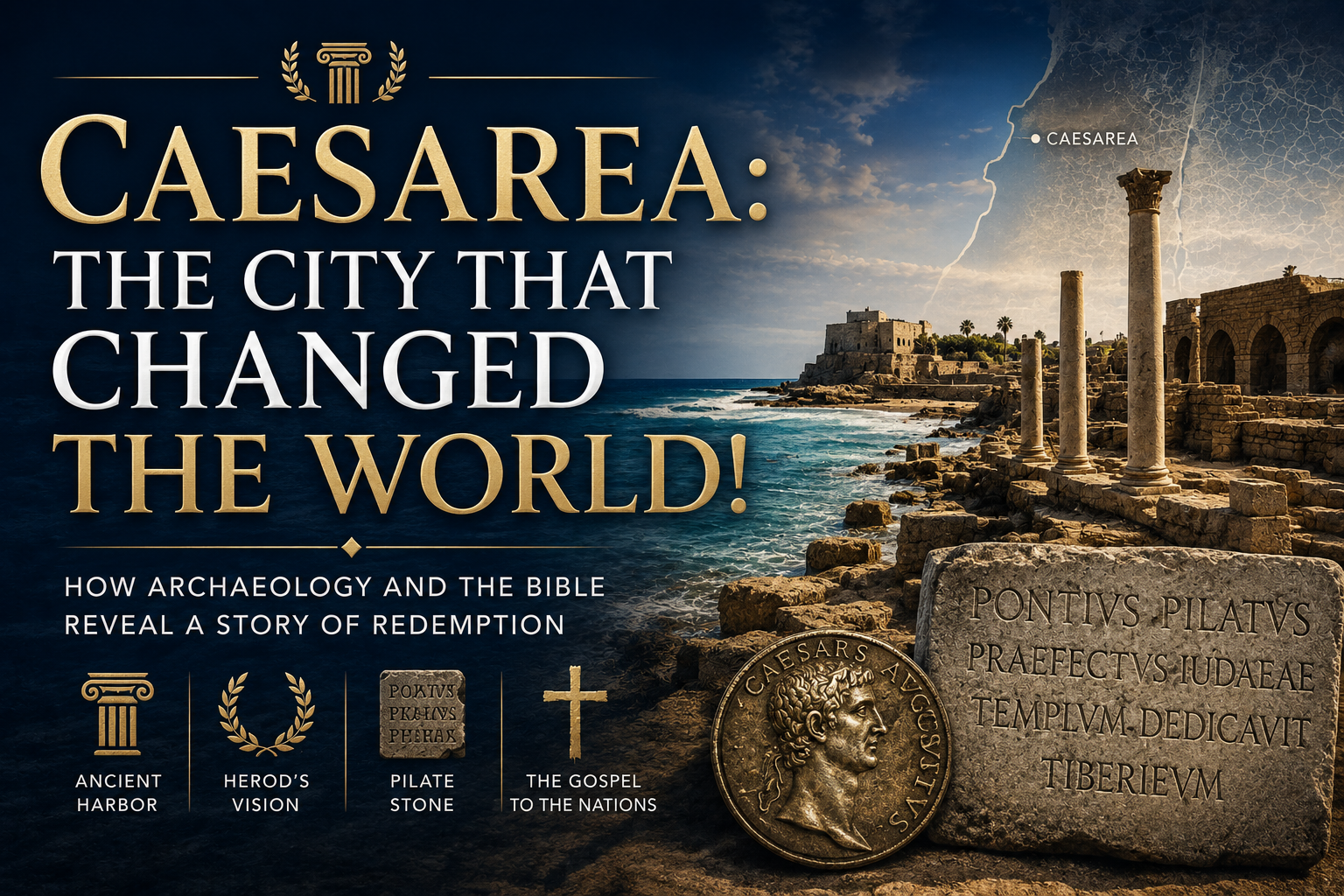
Caesarea: The City That Changed the World
On the Mediterranean coast of Israel stand the ruins of Caesarea, one of the most important cities in the history of the early church.
At first, Caesarea was a Roman city built to display power. It had a massive artificial harbor, a palace, a theater, a hippodrome, temples, and a strong connection to the Roman Empire. Herod the Great built it as a city of honor for Caesar. It was meant to bring Rome into Judea.
But God had another plan.
Over time, Caesarea became a place where the gospel crossed major boundaries. It became the city where Gentiles received the Holy Spirit. It became the city where Paul gave his testimony before rulers. It became a city where Christians suffered, remained faithful, and eventually saw the worship of Jesus replace the worship of emperors.
The story of Caesarea is not only a story about archaeology. It is a story about transformation.
It shows how God can take a city built for human pride and use it to spread the message of Christ to the world.
Herod’s City on the Sea
The Mediterranean coastline of Judea had a problem. It had very little natural protection from the wind and waves. There were not many good harbors along that stretch of coast. For a region connected to Rome and the wider Mediterranean world, this was a serious limitation.
Herod the Great decided to solve that problem.
Starting around 22 BC, Herod began building an artificial harbor at Caesarea. This was an enormous engineering project. Massive stones were used to create underwater foundations that supported the harbor walls. Even today, the outline of the harbor can still be seen beneath the Mediterranean Sea.
This harbor changed everything.
It created a direct maritime connection between Rome, the capital of the empire, and Caesarea, the new Roman capital of Judea. In a very real sense, Caesarea brought Rome to Judea.
That is why the city mattered so much.
It was not just a coastal town. It was a symbol of Roman influence, Roman authority, Roman religion, and Roman culture in the land of the Bible.
The Rome of Judea
Herod built Caesarea as a glorious Roman city. Around the harbor, he constructed buildings that reflected the power and culture of the empire.
Caesarea included:
- A royal palace on a promontory overlooking the sea
- A theater for public events and performances
- A hippodrome for races and large gatherings
- Temples connected to Roman worship
- A massive harbor connecting Judea to the Mediterranean world
Herod named the city Caesarea in honor of Augustus Caesar, the reigning Roman emperor at the time.
This was not accidental. The city itself was a statement. Herod was saying that this place belonged to the world of Rome. It carried Roman power, Roman architecture, Roman politics, and Roman worship.
That is what makes the biblical story of Caesarea so powerful.
The city that was built to honor Caesar would become a city where Christ was proclaimed.
The Temple to Augustus Caesar
One of the most important structures in Caesarea was the temple Herod built for Augustus Caesar.
This temple stood near the harbor on a raised platform. Ancient historian Josephus described it as an impressive temple dedicated to Caesar. Inside would have stood a large statue of Augustus.
This means that Caesarea was not simply a political center. It was also a center of emperor worship.
In the Roman world, emperors were often treated as divine. People offered worship and honor to them in ways that belonged only to God. Caesarea became one of the places where that false worship was promoted in Judea.
This matters because the New Testament repeatedly confronts the question of true worship.
Who is Lord?
Is Caesar lord?
Or is Jesus Lord?
Caesarea becomes one of the places where that question comes into sharp focus.
The Pilate Stone and the Worship of Tiberius
Another major discovery from Caesarea is the Pilate Stone.
In 1961, an Italian archaeological team found an inscription connected to Pontius Pilate, the Roman prefect of Judea. This inscription is important because it confirms Pilate’s historical role and connects him to Caesarea.
The inscription also appears to refer to a building dedicated to Tiberius Caesar, the Roman emperor during the crucifixion of Jesus.
This is significant for several reasons.
Augustus was emperor when Jesus was born in Bethlehem. Tiberius was emperor when Jesus was crucified. At Caesarea, the Roman rulers connected to both the birth and death of Christ were honored through imperial worship.
Yet the gospel would soon be preached in that very city.
The contrast is striking.
Rome honored emperors as divine. The gospel proclaimed that the true Son of God had come in humility, died on the cross, and risen from the dead.
Caesarea in the Book of Acts
The name Caesarea appears many times in the book of Acts. That alone tells us how important this city became in the story of the early church.
In Acts, Caesarea is connected to several major events:
- The conversion of Cornelius and his household
- The pouring out of the Holy Spirit on Gentiles
- The judgment of Herod Agrippa I
- The imprisonment and trials of Paul
- Paul’s testimony before rulers
- The spread of the gospel toward Rome
These events show that Caesarea was not just a Roman center. It became a gospel center.
God took the city that Rome built for power and used it as a stage for the message of Jesus.
Cornelius and the Birth of the Gentile Church
One of the most important events in Caesarea is found in Acts 10.
There was a man named Cornelius living in Caesarea. He was a Roman centurion in the Italian Regiment. The Bible describes him as devout and God-fearing. He prayed, gave generously, and feared God with his household.
Cornelius was a Gentile.
That is important because the early Christian movement began among Jews. Jesus was Jewish. The apostles were Jewish. The first believers at Pentecost were connected to the Jewish world. But God’s plan was always bigger than one nation.
Through Cornelius, God made it clear that the gospel was for Gentiles too.
God sent an angel to Cornelius and told him to send for Peter. At the same time, God gave Peter a vision. In that vision, Peter saw unclean animals, and God told him not to call unclean what God had made clean.
This vision was not mainly about food. It was about people.
God was preparing Peter to enter the house of a Gentile and preach Christ there.
Peter Goes to Caesarea
For Peter, going to Caesarea would not have been easy.
Caesarea was a Gentile stronghold. It was filled with Roman power, pagan worship, and imperial culture. For a Jewish follower of Jesus, this was not the place he would naturally choose to go.
But God was leading him.
Peter entered the house of Cornelius and preached the good news of peace through Jesus Christ. He declared that Jesus is Lord of all. While Peter was still speaking, the Holy Spirit came upon those who heard the message.
The Jewish believers who came with Peter were amazed. The gift of the Holy Spirit had been poured out even on Gentiles.
This was one of the great turning points in the New Testament.
The unclean were made clean through Christ.
The gospel crossed a boundary that many people thought could not be crossed.
Caesarea became the place where the Gentile mission received a powerful confirmation from God Himself.
A Temple Built by God
The video makes a powerful contrast between the temples of Caesarea.
Herod built a temple for Augustus.
Pontius Pilate dedicated a structure connected to Tiberius.
But in Acts 10, God built a different kind of temple.
Not a temple made of stone.
A living temple.
When Cornelius and his household believed the gospel and received the Holy Spirit, God was building His church among the Gentiles.
Peter later writes in 1 Peter 2:5:
“You also, like living stones, are being built into a spiritual house.”
That is what happened in Caesarea.
In a city filled with temples to men, God began building a spiritual house made of living believers.
Where Was the House of Cornelius?
The exact location of Cornelius’s house is not known with certainty. But the video points to an interesting archaeological possibility.
Jerome, an early Christian writer, said that a pilgrim named Paula visited Caesarea and saw the house of Cornelius, which had been turned into a Christian church.
This gives archaeologists an important clue. If the house of Cornelius was later remembered and honored, then we might expect to find an early church built over or near that location.
In 1994, archaeologists uncovered a Byzantine church near Herod’s palace. This location is interesting because Cornelius was a Roman centurion. It would make sense for a centurion connected with Roman authority to live near the governor’s palace.
We cannot say with absolute certainty that this was the house of Cornelius. But the location, tradition, and archaeology make it a serious possibility.
If this church does mark the place, then it stands near the site where Peter preached to Gentiles and the Holy Spirit was poured out on them.
That would make it one of the most meaningful locations in the history of the church.
Herod Agrippa and the Judgment of God
Caesarea also appears in Acts 12 in the story of Herod Agrippa I.
Herod Agrippa was the grandson of Herod the Great, the builder of Caesarea. According to Acts, he came to Caesarea and gave a public address while wearing royal robes. The people shouted, “The voice of a god, and not of a man!”
Herod accepted the praise.
Because he did not give glory to God, he was struck down and died.
This is a sobering story. In the very city built for emperor worship and human glory, God judged a ruler who received worship that belonged only to Him.
Josephus, the Jewish historian, also describes the death of Agrippa. His account confirms important details of the biblical event, including Agrippa’s appearance in Caesarea and the sudden suffering that led to his death.
This is another example where archaeology and ancient history help us see the world of the Bible more clearly.
But the Word of God Continued
Acts 12 does not end with Herod’s death only. It says:
“But the word of God continued to spread and flourish.”
That is the real message.
Human rulers come and go. Some exalt themselves. Some persecute the church. Some demand loyalty that belongs only to God.
But the Word of God continues.
Herod died.
The gospel spread.
This pattern appears throughout history. Empires rise. Rulers boast. Persecutors threaten. But the message of Christ cannot be stopped.
Paul Imprisoned in Caesarea
The next major biblical event at Caesarea involves the Apostle Paul.
In Acts 23 through 26, Paul is taken to Caesarea and held under guard in Herod’s palace. The ruins of that palace are still visible today. Archaeologists have identified areas that may connect to where Paul was held.
One underground structure beneath the palace courtyard was later used as a prison. Some scholars believe this may have been the place where Paul was imprisoned.
Whether or not we can identify the exact room, the larger setting is clear. Paul was held in Caesarea, in the seat of Roman authority, waiting for his case to be heard.
But even in chains, Paul was not powerless.
His imprisonment became a platform for testimony.
Paul’s Testimony Before Agrippa II
Paul eventually stood before Festus, the Roman governor, and Herod Agrippa II.
Agrippa II was the son of Herod Agrippa I, the ruler who died after accepting praise as a god. He was also the great-grandson of Herod the Great, who built Caesarea and its temple to Augustus.
This means Paul was speaking in a deeply hostile setting.
He was standing before Roman and Herodian power. He was speaking in a city built for Caesar. He was addressing rulers connected to a family that had opposed God’s work many times.
And what did Paul do?
He gave his testimony.
He told the story of how he met the risen Jesus on the road to Damascus. He spoke of the prophets. He spoke of Christ. He called his listeners to faith.
At the end, Paul said he wished that Agrippa and all who heard him would become like him, except for his chains.
That is courage.
Paul did not waste his opportunity. He used it to proclaim Jesus.
The Power of a Personal Testimony
Paul’s message before Agrippa reminds us that testimony matters.
He did not only give an argument. He told what Christ had done in his life.
He had once opposed the church. He had persecuted believers. He had been on his way to Damascus when the risen Christ appeared to him. His life was changed forever.
That kind of testimony is powerful because it shows transformation.
Caesarea itself has a similar story.
It was once a pagan stronghold. It was a city of emperor worship. It was a place of Roman pride. But over time, the gospel transformed it into one of the most influential Christian cities in the world.
That is what Christ does.
He transforms people.
He transforms families.
He transforms cities.
He transforms history.
Persecution in Caesarea
The spread of Christianity in Caesarea did not happen without suffering.
Early Christian historian Eusebius lived in Caesarea and wrote about believers who were persecuted there. Some were killed for refusing to worship the emperor. Others suffered because they would not deny Christ.
In the Roman world, Christians could often escape punishment by offering worship to the emperor and cursing Christ. But faithful believers refused.
This created a direct conflict.
Rome demanded worship.
Christians worshiped Jesus.
Rome honored Caesar as lord.
Christians confessed Jesus as Lord.
This confession was not merely private. It challenged the religious and political order of the empire.
That is why persecution came.
The Gospel Cannot Be Stopped
One of the great lessons from Caesarea is that persecution did not stop the gospel.
In fact, the more Rome tried to crush the church, the more the message spread. The courage of Christian witnesses made the truth of the gospel visible. Their faithfulness showed that Jesus was worth more than life itself.
This is one of the great mysteries of church history.
The empire had armies, prisons, theaters, courts, governors, and executioners.
The church had the gospel.
And the gospel prevailed.
Not by violence.
Not by political control.
Not by worldly power.
But by the witness of believers and the power of the Holy Spirit.
The Temple Replaced by a Church
The archaeology of Caesarea gives a powerful picture of transformation.
The temple to Augustus Caesar was eventually destroyed. Later, a large octagonal church was built over the area where the pagan temple once stood.
That image says so much.
A place once used for the worship of a man became a place for the worship of Christ.
The false divine king was replaced by the true divine King.
The city that honored Caesar became a city where Jesus was honored.
This does not mean the transformation was easy or instant. It came through preaching, witness, suffering, persecution, courage, and time.
But it happened.
Caesarea changed.
From Rome to the World
Herod built the harbor to connect Caesarea to Rome. The purpose was political, economic, and cultural. It brought Roman influence into Judea.
But God turned that connection around.
The same city that helped bring Rome to Judea became part of the story of sending the gospel from Judea toward Rome and beyond.
This is one of the most beautiful reversals in the story.
Human rulers built Caesarea for their glory.
God used Caesarea for His gospel.
Men claimed to be divine.
God revealed that the true Divine Son had become a man.
Rome exalted power.
Jesus showed humility.
Caesar demanded worship.
Christ gave His life to save sinners.
The True King
The message of Caesarea ultimately points us to Jesus.
The emperors wanted to be worshiped as gods. But they were only men. Their kingdoms faded. Their temples fell. Their statues broke. Their cities became ruins.
Jesus, however, is the true King.
He did not come demanding worship through force. He humbled Himself. He became a man. He died on the cross so that sinners could be forgiven. He rose again in victory.
This is the message Peter preached in the house of Cornelius.
This is the message Paul proclaimed before Agrippa.
This is the message Christians died for in Caesarea.
And this is the message that continues to spread around the world today.
What Caesarea Teaches Us Today
The story of Caesarea teaches several lessons that still matter for believers.
1. God can transform any place
Caesarea was a pagan Roman stronghold, yet God used it as a major place for the spread of the gospel. No place is too dark for God to work.
2. The gospel is for all people
Cornelius and his household remind us that the good news of Jesus is not limited to one nation, culture, or background. Christ came to save all who believe.
3. True worship belongs only to God
Caesarea was filled with emperor worship, but the Bible shows that worship belongs to God alone. No ruler, system, or human power can take His place.
4. Testimony matters
Paul used his opportunity before rulers to tell what Jesus had done in his life. Our own testimony can also point others to Christ.
5. The gospel cannot be stopped
Persecution came to Caesarea, but the message of Jesus continued to spread. The power of the gospel is greater than the power of empires.
A City Transformed by Christ
Caesarea began as a city built for Caesar.
It became a city where Christ was proclaimed.
It began with a harbor meant to bring Rome into Judea.
It became part of the story of sending the gospel from Judea to the world.
It began with temples to human rulers.
It became a place where living stones were built into a spiritual house for God.
This is the redemptive story of Caesarea.
And it is also a picture of what Jesus does in every life surrendered to Him.
He takes what was unclean and makes it clean.
He takes what was proud and brings it low.
He takes what was broken and makes it new.
He takes what was built for human glory and turns it toward the glory of God.
The Message Still Goes Out
The ruins of Caesarea still stand by the Mediterranean Sea. The stones of the harbor remain beneath the waves. The palace, theater, hippodrome, churches, and temple platform still remind visitors of the city’s long history.
But the greatest legacy of Caesarea is not Roman architecture.
It is the gospel.
There, Peter preached to Cornelius.
There, Gentiles received the Holy Spirit.
There, Herod Agrippa learned that glory belongs to God.
There, Paul gave his testimony before rulers.
There, Christians suffered for the name of Jesus.
And there, a city once shaped by emperor worship became a witness to the true King.
Caesarea reminds us that God is always able to turn human plans into part of His greater purpose.
Herod built a harbor for Rome.
God used it for the gospel.
Caesar claimed glory.
Christ received worship.
Rome tried to rule the world.
Jesus changed it.
And the message that went out from places like Caesarea continues today:
Jesus Christ is Lord of all.
Discover more from Fannin County Seventh-day Adventist Church
Subscribe to get the latest posts sent to your email.


