
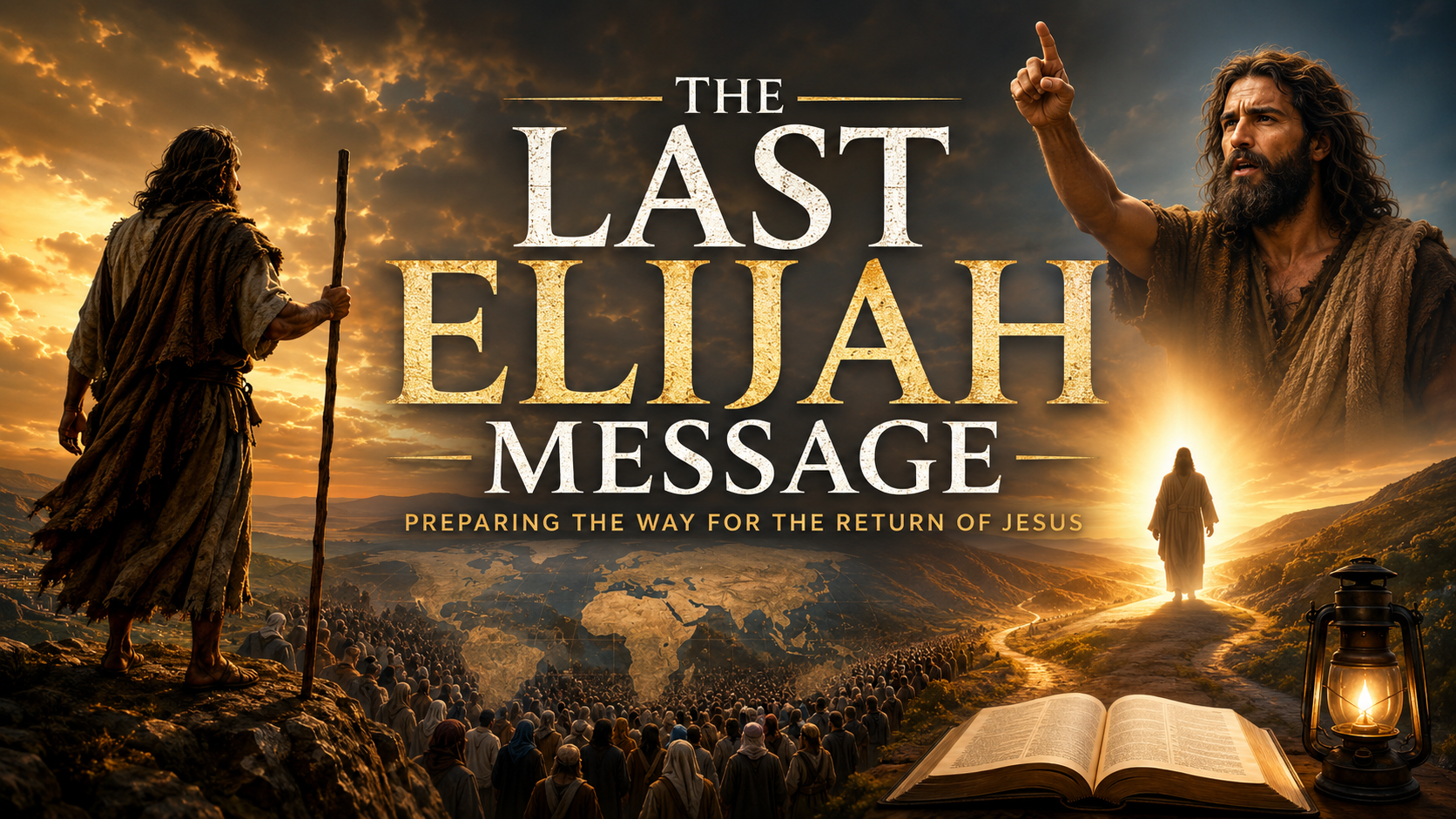
The Last Elijah Message: Preparing the Way for the Return of Jesus
We are living later than we have ever lived before.
The world seems to be moving faster every year. Wars continue. Technology advances at a pace that would have seemed impossible only a generation ago. Artificial intelligence is changing how people work, communicate, and understand reality. Knowledge is increasing, confusion is spreading, and many people are asking whether we are approaching the final events of Bible prophecy.
Jesus warned that the closing days of earth’s history would be intense. He said that unless those days were shortened, no flesh would be saved. Yet He also promised that the gospel would go to the world before the end.
That raises an important question:
What message must be proclaimed before Jesus returns?
In The Last Elijah Message, Pastor Doug Batchelor examines the final prophecy of the Old Testament and its meaning for believers today. Malachi foretold that Elijah would come before the great and dreadful day of the Lord. This does not mean the literal prophet Elijah will be reincarnated. Instead, God will raise up a people who carry the same spirit, courage, faithfulness, and reforming message seen in Elijah and John the Baptist.
Elijah prepared Israel to return to God.
John the Baptist prepared people for the first coming of Jesus.
God’s last-day people are called to prepare the world for His second coming.
The Final Prophecy of the Old Testament
The final verses of Malachi contain a powerful promise:
“Behold, I will send you Elijah the prophet before the coming of the great and dreadful day of the Lord.”
The prophecy continues by saying that he will turn the hearts of the fathers to the children and the hearts of the children to their fathers.
For centuries, Jewish families have remembered this promise during Passover. An empty chair is traditionally prepared for Elijah because he is expected to come before the Messiah.
But the New Testament helps us understand the prophecy more clearly.
When the angel Gabriel announced the birth of John the Baptist, he said John would go before the Lord “in the spirit and power of Elijah.”
John was not Elijah reincarnated. He carried the same kind of spiritual mission.
Like Elijah, he called people to repentance.
Like Elijah, he confronted kings.
Like Elijah, he lived simply.
Like Elijah, he preached in the wilderness.
Like Elijah, he prepared people to return to the true worship of God.
Was John the Baptist Elijah?
Jesus said that John the Baptist was the Elijah who was to come. Yet when religious leaders directly asked John whether he was Elijah, he answered no.
At first, this may sound like a contradiction.
But the leaders were asking whether John was literally Elijah returned from heaven. John correctly answered that he was not. He was not Elijah reincarnated or physically returned.
Jesus was speaking about John’s mission.
John came in Elijah’s spirit and power. He carried a similar message and performed a similar work. His ministry fulfilled the Elijah prophecy in preparation for Christ’s first coming.
But Jesus also spoke of another fulfillment.
After John had already been killed, Jesus said that Elijah “is coming first and will restore all things.” This future language points beyond John the Baptist to another Elijah movement before the second coming.
The first Elijah prepared Israel for reform.
John prepared Judea for the Messiah.
The final Elijah message prepares the world for the return of Christ.
Not One Person, but a Worldwide Movement
In the Old Testament, Elijah worked mainly within the nation of Israel.
John the Baptist also ministered primarily within Judea.
But the final message must go to every nation, tribe, language, and people. Because the work is global, it cannot be limited to one preacher or one location.
The last Elijah message is a worldwide movement.
It is carried by believers who are filled with the Holy Spirit, grounded in Scripture, faithful to God’s commandments, and willing to point others to Jesus.
Revelation describes a final message called the everlasting gospel. It calls the world to worship the Creator, recognize the hour of God’s judgment, come out of spiritual confusion, and remain faithful to Jesus.
This is an Elijah message because it calls people to decision.
Elijah asked Israel:
“How long will you falter between two opinions? If the Lord is God, follow Him.”
The final generation faces the same question.
1. The Wilderness Experience
Elijah spent significant time in the wilderness. God sent him away from the corruption of Ahab’s court and preserved him near the Brook Cherith.
John the Baptist also preached in the wilderness of Judea. Crowds left the cities to hear a message that was simple, direct, and uncompromised.
The wilderness represents separation from corruption and quiet time with God.
This does not necessarily mean every believer must immediately leave the city. It does mean we need to separate ourselves spiritually from the values of the world.
We need time away from constant noise.
We need time in prayer.
We need time in Scripture.
We need moments when earthly support is removed and we learn to depend completely on God.
Some of the greatest servants of God were prepared in the wilderness. Moses spent years in the desert before leading Israel. David learned to trust God while caring for sheep. Jesus fasted in the wilderness before beginning His public ministry.
The wilderness strips away distractions and exposes what is truly in the heart.
2. Preparing the Highway for the King
Isaiah described a voice crying in the wilderness:
“Prepare the way of the Lord; make straight in the desert a highway for our God.”
In ancient times, roads were prepared before a king traveled through his territory. Workers filled holes, removed obstacles, lowered rough places, and straightened crooked paths.
John the Baptist fulfilled this prophecy spiritually. He prepared human hearts for the coming of Jesus.
The valleys represented discouraged and broken people who needed to be lifted up.
The mountains represented pride that needed to be brought low.
The crooked paths represented dishonest lives that needed to be made straight.
The rough places represented sin, bitterness, rebellion, and habits that stood between people and God.
The same work is needed today.
Preparing for Jesus is not mainly about watching headlines or constructing prophetic timelines. It is about allowing God to prepare the road into our hearts.
Is there pride that needs to be humbled?
Is there dishonesty that needs to be corrected?
Is there a relationship that needs reconciliation?
Is there a secret sin that must be confessed?
The King is coming, and the road must be prepared.
3. A Simple and Disciplined Lifestyle
Elijah and John the Baptist were both known for simplicity.
Elijah was fed with simple food and water. John avoided wine and strong drink. His lifestyle stood in sharp contrast with the luxury, excess, and self-indulgence of the religious and political leaders of his day.
The message is not that every believer must copy their exact diet or clothing. The principle is temperance.
God’s people should not be controlled by appetite.
They should not be intoxicated by alcohol or drugs.
They should not live only for pleasure.
They should treat their bodies as temples of the Holy Spirit.
The Bible says:
“Whether you eat or drink, or whatever you do, do all to the glory of God.”
Preparation for the last days includes physical, mental, and spiritual discipline. The Holy Spirit wants clear minds through which He can work.
4. Modesty and Simplicity
Elijah wore the simple clothing associated with a prophet. John the Baptist wore camel’s hair and a leather belt.
Their appearance was not designed to attract admiration. It reflected humility and separation from the extravagance of their age.
Modern culture often encourages people to build their identity around outward appearance. Clothing, jewelry, cosmetic procedures, tattoos, and constant self-presentation can become forms of self-glorification.
The Bible does not teach that plain clothing saves anyone. Salvation comes through Christ alone. But it does teach modesty, moderation, and a focus on inward character.
Peter wrote that our beauty should not be centered on outward decoration, but on the hidden person of the heart.
God’s last-day people should be recognizable not by expensive appearance, but by humility, purity, kindness, and the character of Jesus.
5. Courage to Confront Sin
Elijah was not afraid to confront King Ahab.
When Ahab accused Elijah of troubling Israel, Elijah answered that the real trouble came from the king’s rejection of God’s commandments and acceptance of Baal worship.
John the Baptist showed the same courage when he confronted Herod for taking his brother’s wife. He plainly told the king:
“It is not lawful for you to have her.”
Neither man adjusted the message to protect himself.
They spoke respectfully, but they spoke truthfully.
The last Elijah message must also confront sin. It cannot be reduced to motivational speeches, entertainment, or comforting words that never call anyone to repentance.
Paul warned that a time would come when people would not endure sound doctrine. They would gather teachers who told them what they wanted to hear and would turn away from truth toward fables.
The church must speak with courage, even when truth is unpopular.
That does not give believers permission to be rude, arrogant, or cruel. Elijah’s boldness must be combined with Christ’s love. But love does not remain silent while people are moving toward destruction.
6. A Call Back to God’s Commandments
Immediately before Malachi announces Elijah’s coming, God says:
“Remember the Law of Moses, My servant.”
The Elijah message is connected with a return to God’s law.
Elijah accused Israel of forsaking the commandments of the Lord. John the Baptist called people to repent of breaking God’s law. Revelation identifies God’s last-day people as those who keep the commandments of God and have the faith of Jesus.
This is not salvation by works.
We are saved by grace through faith.
But saving faith produces obedience.
Faith that never changes the life is not genuine biblical faith. Jesus said that those who love Him will keep His commandments.
The final message calls people away from human tradition and back to the complete Word of God.
It does not offer God’s law with certain commandments removed.
It calls people to love God with all their hearts and to allow Him to write His law within them.
7. Repentance and Reformation
Elijah’s question on Mount Carmel demanded a decision:
“If the Lord is God, follow Him; but if Baal, follow him.”
Israel had attempted to combine the worship of God with pagan religion. Many had not completely abandoned the Lord, but they were mixing truth with error.
Elijah exposed the compromise.
John the Baptist gave the same call:
“Repent, for the kingdom of heaven is at hand.”
People came to the Jordan confessing their sins and were baptized as a sign of a changed life.
The last Elijah message must also call for revival and reformation.
Revival is the renewing of spiritual life.
Reformation is the change that follows.
Revival without reformation becomes temporary emotion. Reformation without revival becomes cold legalism. God desires both the heart and the life.
We are called to repent, receive forgiveness, and walk in newness of life.
8. Humility and Pointing People to Christ
Elijah performed extraordinary miracles, yet his focus was the glory of God.
John the Baptist drew enormous crowds, yet he said of Jesus:
“He must increase, but I must decrease.”
John did not use his influence to build a personal kingdom. He pointed people away from himself and toward Christ.
When he saw Jesus, he declared:
“Behold! The Lamb of God who takes away the sin of the world!”
This must remain the center of the final message.
Prophecy is important.
God’s commandments are important.
Health, worship, and Christian lifestyle are important.
But without Jesus, they cannot save us.
The purpose of the Elijah message is not to make people admire the messenger. It is to help them see Christ.
9. Opposition From Religious and Political Power
Elijah was persecuted by Queen Jezebel, who was married to King Ahab. Her religious influence joined with the power of the state to threaten the prophet’s life.
John the Baptist was persecuted through Herodias, who used her influence over Herod to have him killed.
In both cases, religious corruption joined political power against God’s messenger.
Revelation warns that a similar union will exist before the return of Jesus. Religious systems will influence civil authority, and those who remain faithful to God may face economic pressure, imprisonment, and even a death decree.
This is not intended to create panic. Jesus told His followers in advance so they would not be surprised.
Some servants of God may be protected and translated like Elijah.
Others may die and later be resurrected like John the Baptist.
Our responsibility is not to control the outcome. It is to remain faithful.
10. Living for the Glory of God
Elijah declared:
“I have been very zealous for the Lord God of hosts.”
John the Baptist said:
“He must increase, but I must decrease.”
Their lives were centered on God’s glory rather than personal recognition.
This is one of the greatest struggles in the Christian life. Human beings naturally seek praise, comfort, control, and self-preservation.
Jesus prayed in Gethsemane:
“Not My will, but Yours, be done.”
Paul said:
“I die daily.”
Every day, self must be surrendered again. Every day, believers must choose whether Christ or self will sit on the throne of the heart.
True revival never glorifies the preacher, ministry, church, or personality. It directs attention toward Jesus.
11. Training and Discipling Others
Elijah did not work alone. He trained Elisha and strengthened the sons of the prophets.
Before being taken to heaven, Elijah visited the schools of the prophets and prepared others to continue the work.
John the Baptist also had disciples. He taught them, baptized them, and eventually directed them toward Jesus.
Christ followed the same pattern. He invested deeply in His disciples, opened the Scriptures to them, and commissioned them to teach others.
The final Elijah movement cannot depend on a few well-known speakers.
Every believer is called to participate.
Parents must disciple their children.
Churches must train new believers.
Experienced Christians must mentor younger Christians.
The gospel must be passed from one person to another.
A movement that does not train others will disappear when its leaders are gone. The Elijah message prepares a generation to continue the work until Jesus comes.
12. Preparing People for the Holy Spirit
Elisha asked for a double portion of Elijah’s spirit.
John the Baptist said Jesus would baptize people with the Holy Spirit and fire.
After Christ’s earthly ministry, the Holy Spirit was poured out at Pentecost, giving ordinary believers extraordinary courage and power.
The Bible promises another great outpouring of the Spirit before the final harvest.
This is often called the latter rain.
God’s people cannot finish the work through human talent, technology, money, or organization alone. The gospel must go forward through the power of the Holy Spirit.
But preparation is necessary.
The disciples were deeply flawed before Pentecost. They argued over who was greatest. They misunderstood Jesus. They fled when He was arrested.
Yet through repentance, prayer, reconciliation, and surrender, they were prepared to receive the Spirit.
Elijah was also a human being with fears and weaknesses. James reminds us that he was a man with a nature like ours. Yet when he prayed in faith, God answered.
This gives hope to ordinary believers.
God does not need perfect people before He begins working with them.
He needs surrendered people.
13. Restoring True Worship
On Mount Carmel, Elijah repaired the broken altar of the Lord.
The prophets of Baal had spent the day shouting, dancing, and cutting themselves. Their worship was loud and emotional, but no fire came from heaven.
Elijah calmly restored the altar with twelve stones, placed the sacrifice upon it, and prayed a simple prayer.
Then the fire of God fell.
The people cried out:
“The Lord, He is God! The Lord, He is God!”
The final Elijah message also calls for the restoration of true biblical worship.
Worship must not be built merely on tradition, entertainment, emotion, or popular culture. It must be rooted in Scripture.
God is seeking people who worship Him in spirit and in truth.
The altar must be restored.
Prayer must be restored.
Reverence must be restored.
God’s commandments must be restored.
Christ must once again become the center.
14. A Worldwide Revival
Elijah gathered all Israel to Mount Carmel.
John the Baptist drew people from Jerusalem, Judea, and the entire region around the Jordan.
Their ministries produced national attention and called the people to a public decision.
The final Elijah message must go much farther.
Jesus said:
“Go into all the world and preach the gospel to every creature.”
Revelation describes a message that reaches every nation, tribe, language, and people.
The message will receive both positive and negative attention. Believers may be brought before rulers to explain their faith. The truth will become widely known, and every person will face a decision.
Pastor Batchelor suggests that persecution may become one of the forces that awakens the church. Trials often reveal whether faith is genuine. When following Christ becomes costly, those who remain will be those who truly believe.
God can use difficult events to separate the wheat from the chaff and produce a worldwide revival.
The Pattern of Three and a Half Years
The sermon also points to a recurring three-and-a-half-year pattern in Scripture.
Elijah’s ministry took place during a famine lasting three and a half years.
Jesus ministered for approximately three and a half years after being introduced by John the Baptist.
Revelation describes a prophetic period of 1,260 days, or three and a half prophetic years, during which God’s people faced persecution.
The pattern connects famine, persecution, wilderness, prophetic witness, and eventual deliverance.
We should be careful not to set dates where Scripture does not clearly set them. But the pattern reminds us that history often repeats and that God remains faithful during periods of intense trial.
Elijah was sustained during famine.
God’s people were preserved during persecution.
The church will also be sustained during the final crisis.
Turning the Hearts of Families
Malachi says the Elijah message will turn the hearts of fathers to children and children to fathers.
This is more than a theological debate. It is a message of reconciliation.
Sin divides families.
Pride creates distance.
Unforgiveness hardens hearts.
Neglect separates parents and children.
The gospel restores what sin has broken.
A true last-day revival will affect the home. Fathers will become spiritually present. Parents will teach their children. Children will honor their parents. Families will pray together, study Scripture together, and forgive one another.
The Elijah message does not only prepare church members for Christ’s return.
It prepares families.
Discouragement Does Not Disqualify You
Elijah experienced deep discouragement. After the victory on Mount Carmel, he fled into the wilderness and asked God to take his life.
John the Baptist also struggled. While imprisoned, he sent messengers to Jesus asking whether He was truly the One who was to come.
Even faithful prophets experienced doubt, loneliness, exhaustion, and fear.
This should encourage believers who sometimes feel overwhelmed.
Discouragement does not mean God has abandoned you.
Doubt does not mean your faith has disappeared.
The clouds may temporarily block your view of the sun, but the sun is still shining.
God met Elijah in the wilderness. He gave him food, rest, direction, and encouragement. Jesus answered John’s questions by pointing to the evidence of His ministry.
God is patient with struggling servants.
The Mantle of Christ’s Righteousness
When Elijah was taken to heaven, his mantle fell to Elisha. Elisha tore his own clothing and took up Elijah’s mantle.
This provides a beautiful picture of the gospel.
Our own righteousness is insufficient. We must surrender our self-righteousness and receive the righteousness of Christ.
Isaiah says our righteousness is like filthy rags. Revelation describes God’s people wearing clean garments given by Christ.
The power of the Elijah message does not come from human goodness.
It comes from being covered by Jesus.
We do not call others to repentance because we are better than they are. We call them because we have also needed mercy.
We do not restore the altar in our own strength. We depend upon the sacrifice of Christ.
Do You Know Who You Are?
Near the end of the sermon, Pastor Batchelor tells the story of royal children who were hidden among ordinary families during times of political danger.
Some of the children grew up without knowing their true identity. Then one day, they discovered they belonged to the royal family and were heirs to a kingdom.
The Bible says believers are children of God.
Romans says that if we are children, then we are heirs of God and joint heirs with Christ.
This identity changes how we live.
We are not spiritual orphans.
We are not meaningless people moving randomly through history.
We are children of the King, called to represent His kingdom.
God has given His people a holy calling and an important message.
The Last Elijah Message Today
The final Elijah message is not centered on one personality.
It is not a secret teaching for a select few.
It is a call to the whole church.
It calls believers to:
- Spend meaningful time with God
- Prepare the way for Jesus
- Live simply and temperately
- Practice modesty and humility
- Speak courageously against sin
- Return to all of God’s commandments
- Call people to repentance and baptism
- Point every person toward Christ
- Remain faithful during persecution
- Train and disciple others
- Prepare for the outpouring of the Holy Spirit
- Restore true biblical worship
- Carry the gospel to the whole world
This is not a work reserved for pastors.
God can use parents, teachers, students, workers, retirees, young people, and ordinary church members.
Elijah was a human being with weaknesses like ours.
John was a man sent by God.
The disciples were ordinary people filled with an extraordinary Spirit.
God is able to use us too.
Conclusion: Prepare the Way of the Lord
The world is moving quickly toward the final events of history.
But God has not left humanity without a message.
Before Jesus came the first time, John the Baptist prepared the way.
Before Jesus comes again, a worldwide Elijah message will call people back to Scripture, repentance, true worship, God’s commandments, and faith in Christ.
The message is urgent, but it is also full of hope.
Jesus is the Lamb of God who takes away the sin of the world.
He offers forgiveness.
He offers a new heart.
He offers the Holy Spirit.
He offers strength for the wilderness.
He offers courage for the conflict ahead.
He offers His righteousness in place of our own.
The King is coming.
The road must be prepared.
The altar must be restored.
The world must hear the everlasting gospel.
And God is still asking:
“Whom shall I send, and who will go for Us?”
May our answer be:
“Here am I. Send me.”