
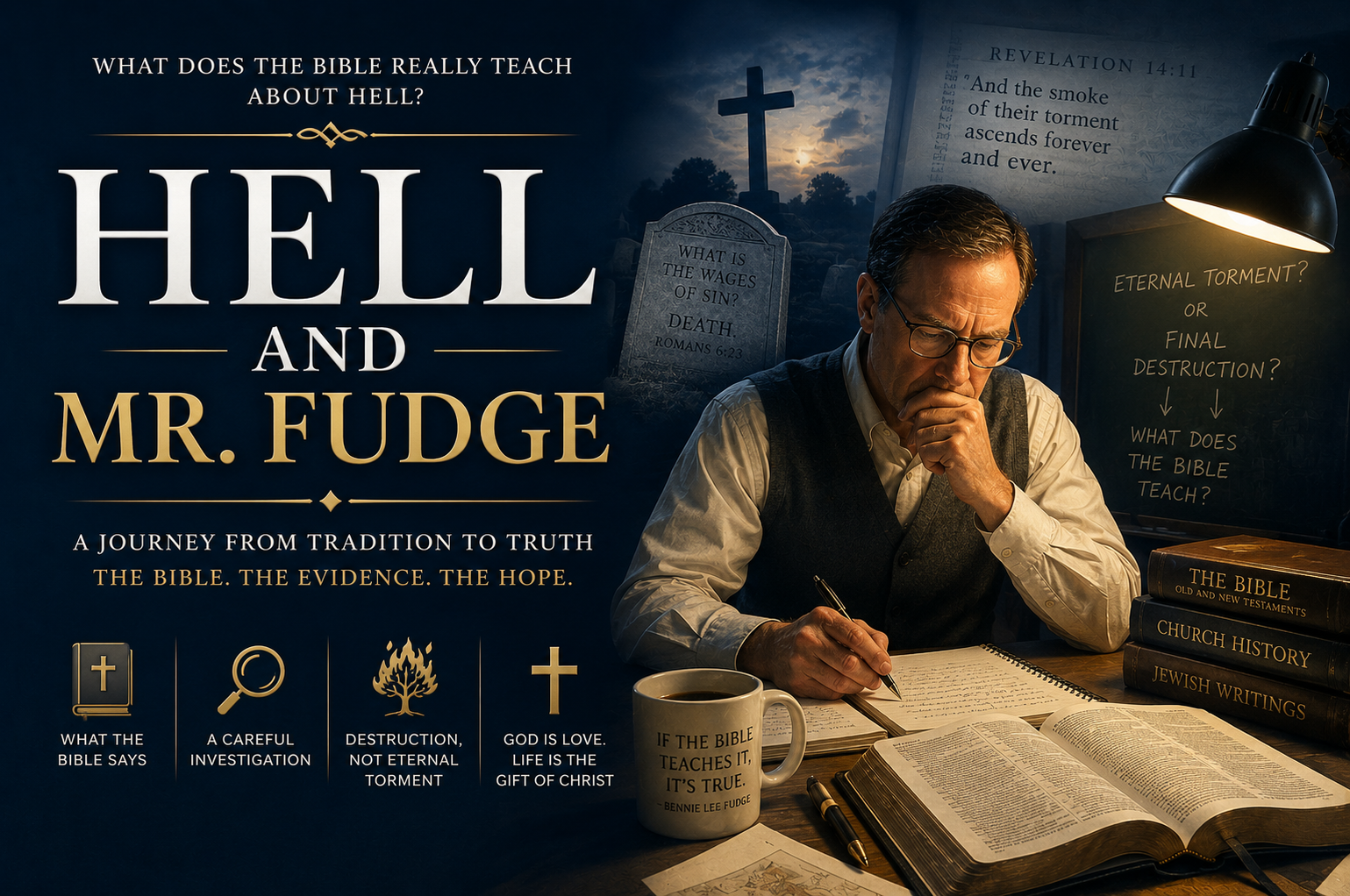
Hell and Mr. Fudge: What the Bible Teaches About Love, Judgment, and the End of Sin
Few subjects have troubled Christians more deeply than the subject of hell.
For many people, the word hell immediately brings to mind the idea of never-ending torment. They have been taught that the lost will suffer conscious pain forever and ever, without relief and without end. For some, this teaching has created fear. For others, it has raised painful questions about the character of God.
Can the God who is love keep sinners alive forever only to punish them without end?
Can the God who gave His Son for the world become the author of eternal torture?
Or has something been misunderstood?
The movie Hell and Mr. Fudge tells the story of Edward Fudge, a Christian scholar who was asked to research what the Bible actually teaches about the final punishment of the wicked. At first, Fudge expected to defend the traditional view of eternal conscious torment. But as he studied Scripture, history, Jewish writings, early Christian theology, and the influence of Greek philosophy, he came to a different conclusion.
He became convinced that the Bible does not teach that the lost will burn forever in conscious agony. Instead, it teaches that sin leads to death, destruction, and final perishing.
This view is often called conditional immortality. It is also connected to what many call annihilationism. The basic idea is simple: eternal life is a gift given only through Christ. Human beings do not possess natural immortality apart from God. Those who reject life in Christ do not live forever in pain. They finally perish.
This is not a small subject. It touches the gospel, the judgment, the meaning of death, the nature of the soul, and most of all, the character of God.
The Question That Started the Journey
In the movie, Edward Fudge’s journey is not presented as a cold academic exercise. It is personal.
As a young boy, Edward had a friend named Davy. Davy was full of energy and dreams. He wanted to see the world. But his life ended suddenly in a tragic accident. That loss left Edward with a painful question.
Where was Davy now?
Was he burning forever in hell?
For a young mind trying to understand God, that question was heavy. Edward had been taught that those who died outside of Christ entered endless torment. Yet something about that idea felt deeply wrong. How could a loving God keep someone alive forever in order to punish them forever?
This question stayed with him for years.
Later, when Edward was commissioned to research the topic of hell, the issue was no longer only emotional. It became biblical. He had to ask what Scripture actually said. Not what tradition said. Not what fear said. Not what church culture had repeated. But what the Bible itself taught.
Two Views of Hell
The movie presents two main views that Edward Fudge had to examine.
The first is the traditional view of eternal conscious torment. This view teaches that the wicked will remain alive forever in hell, experiencing conscious punishment without end.
The second is the conditionalist view. This view teaches that the wicked are punished by God, but the final result of that punishment is destruction. The lost are not given eternal life in misery. They perish.
These two views ask different questions about immortality.
- Does every human being naturally possess an immortal soul?
- Is eternal life something all people automatically have?
- Or is eternal life a gift given only to those who belong to Christ?
- Does the Bible describe the final punishment as endless torment or final destruction?
Edward Fudge began his study carefully. He compared arguments. He looked at the Old Testament. He studied Jewish writings between the Old and New Testaments. He examined the words of Jesus. He looked at the apostles. He also studied church history to see how Christian teaching developed over time.
What he found surprised him.
The Old Testament and the Fate of the Wicked
One of the first major discoveries in the movie is that the Old Testament says far more about the fate of the wicked than many people realize.
Edward finds that the Old Testament repeatedly uses words and images connected to final destruction. The wicked are described as being cut off, destroyed, consumed, coming to nothing, disappearing, and perishing.
These words do not naturally suggest endless conscious torment. They suggest an end.
Psalm 37, for example, says the wicked will fade away. Malachi 4 describes the wicked as being burned up like stubble. Other passages describe the enemies of God as being consumed, destroyed, or brought to nothing.
This pattern matters.
If the Bible wanted to teach that the wicked would live forever in torment, we might expect the Old Testament to clearly say so. But again and again, the language points toward death and destruction.
Even images like unquenchable fire do not necessarily mean fire that burns forever without consuming anything. In Scripture, an unquenchable fire is a fire that cannot be stopped until it has completed its work.
The point is not endless burning.
The point is complete judgment.
Sodom, Gomorrah, and Eternal Fire
One of the strongest examples in the movie comes from Sodom and Gomorrah.
The book of Jude describes Sodom and Gomorrah as suffering the punishment of eternal fire. At first glance, someone might read that and assume the cities are still burning somewhere today.
But they are not.
The fire was eternal in its result, not endless in its process.
The cities were destroyed. The judgment was final. The destruction could not be reversed.
This is important because it helps us understand how the Bible sometimes uses the word eternal. Eternal punishment does not always mean an eternal act of punishing. It can mean a punishment with eternal consequences.
In the case of Sodom and Gomorrah, the fire did not burn forever. But what it did was forever.
The destruction was permanent.
This gives us a helpful way to read other judgment passages. The Bible may be teaching that the final punishment of the wicked is eternal in result, not eternal in conscious experience.
What Did Jesus Teach?
For Edward Fudge, the most important question was not what philosophers taught or what later traditions said. The central question was this:
What did Jesus teach?
Jesus spoke seriously about judgment. He warned about hell. He warned about destruction. He warned about the danger of rejecting God. No faithful Christian should ignore those warnings.
But when Jesus speaks about the final fate of the lost, His language often points to destruction, death, and perishing.
John 3:16 is central:
“For God so loved the world, that he gave his only begotten Son, that whosoever believeth in him should not perish, but have everlasting life.”
The contrast is not between everlasting life in heaven and everlasting life in torment.
The contrast is between perishing and everlasting life.
That matters.
Jesus could have said that those who reject Him would live forever in agony. But the verse says they perish. Eternal life belongs to believers. It is not presented as something all people naturally possess.
Jesus also says in Matthew 10:28 that God can destroy both soul and body in hell. That statement is difficult to reconcile with the idea that the soul cannot be destroyed.
If Jesus says God can destroy both soul and body, then we should allow His words to speak plainly.
The Wages of Sin Is Death
Romans 6:23 says:
“For the wages of sin is death; but the gift of God is eternal life through Jesus Christ our Lord.”
This verse gives us a simple contrast.
The wages of sin is death.
The gift of God is eternal life.
Again, the contrast is not eternal life in joy versus eternal life in torment. The contrast is death versus eternal life.
This is one of the clearest biblical arguments for conditional immortality. Eternal life is not something every person already has by nature. It is the gift of God through Christ.
If eternal life is a gift, then those who reject the gift do not receive eternal life in another form. They receive the wages of sin, which is death.
This does not make judgment less serious. It makes it deeply serious.
To lose eternal life is not a small thing. To perish outside of Christ is tragic. To be finally destroyed by judgment is terrifying. But it is not the same as being kept alive forever in conscious torment.
The Immortal Soul Question
The turning point in Edward Fudge’s research comes when he examines the idea of the immortal soul.
Many Christians have been taught that every person has an immortal soul that cannot die. According to that idea, the body may die, but the soul must live forever somewhere. If the righteous live forever with God, then the wicked must also live forever somewhere else.
But Edward realizes something important:
The Bible does not teach natural immortality of the soul.
Immortality belongs to God. Eternal life is given through Christ. Human beings are dependent creatures. We do not have life in ourselves apart from the Creator.
The idea of the naturally immortal soul owes much to Greek philosophy, especially the influence of Plato. Over time, this idea entered Christian thinking and affected how many interpreted passages about death, judgment, heaven, and hell.
Once the immortal soul is assumed, eternal torment begins to seem necessary. If the soul cannot die, then the wicked must exist forever. If they are judged, then that judgment must continue forever.
But if the soul is not naturally immortal, then the biblical language of death, destruction, and perishing can mean what it says.
The lost are not immortal sinners.
Only God gives immortality.
Greek Philosophy and Christian Tradition
The movie shows Edward tracing how the idea of the immortal soul entered Christian tradition.
Greek thinkers such as Plato taught ideas about the soul that were different from the Hebrew view of human life. In Greek thought, the soul was often seen as an immortal part of the person trapped inside the body. Death released the soul.
But the biblical picture is different.
The Bible presents human beings as whole persons created by God. Life comes from God. Death is an enemy. Resurrection is the hope of the believer.
The Christian hope is not that an immortal soul escapes the body forever. The Christian hope is resurrection through Jesus Christ.
This distinction matters.
If Christian theology absorbs Greek assumptions about the soul, then Bible passages can be read through the wrong lens. Words like death and destruction may be softened or reinterpreted because the reader assumes the soul cannot really die.
Edward Fudge’s research challenged that assumption.
He did not simply ask, “What has the church often taught?”
He asked, “What does the Bible actually say?”
Judgment Still Matters
Some people may assume that rejecting eternal torment means making judgment less serious. But that is not true.
The Bible teaches judgment. It teaches accountability. It teaches that sin has consequences. It teaches that those who reject God face final punishment.
Conditional immortality does not remove judgment. It defines the final result of judgment as death and destruction rather than endless conscious torment.
This view still takes sin seriously.
It still takes hell seriously.
It still takes the warnings of Jesus seriously.
But it also takes seriously the Bible’s repeated language of perishing, consuming, destroying, and death.
Hell is not ignored. Hell is understood as the final destruction of evil.
In this view, God does not preserve sin forever in a corner of the universe. He brings sin to an end.
That is good news.
The Character of God
At the heart of this whole issue is the character of God.
The Bible says God is love. It also says God is just. These two truths do not fight each other. God’s justice is loving, and His love is just.
The traditional view of eternal conscious torment has caused many people to struggle with God’s character. They wonder how finite sins committed in a short human life could result in infinite conscious torment. They wonder how God could command us to love our enemies while He keeps His enemies alive forever in pain.
These are not small questions.
Edward Fudge’s conclusion presents a different picture. God judges sin. God punishes evil. God destroys the wicked. But He does not torture forever.
He is not cruel.
He is not unjust.
He is not less merciful than the best human parent.
He is holy love.
The final judgment reveals that God will not allow evil to last forever. But it also reveals that He does not delight in endless suffering.
Choosing the Side of Love
The movie’s message can be understood as a call to choose the side of love.
God offers life through Jesus Christ. He does not force people to receive it. He invites. He calls. He gives His Son. He opens the door of mercy.
Those who choose Christ receive eternal life.
Those who reject life remain under the power of sin and death.
This makes the gospel simple and serious.
God is not asking people to choose between heaven and eternal torture. He is calling people to choose life over death, light over darkness, love over rebellion, and Christ over sin.
The final destruction of the wicked is not God losing control. It is God ending evil.
It is the universe being cleansed.
It is the final answer to sin.
Love wins, not by keeping hatred alive forever, but by bringing evil to an end.
The Cost of Telling the Truth
Another major theme in the movie is the cost of standing for what Scripture teaches.
Edward Fudge’s conclusions were not easy for him. He knew they would upset people. He knew many would accuse him of attacking the faith. He knew some would say he was rejecting the Bible, even though his whole point was to return to the Bible.
That is one of the hardest things about truth.
Sometimes people are more loyal to inherited ideas than to Scripture itself.
Edward’s father had taught him a principle that shaped his life: if the Bible teaches it, it is true, even if the whole world is against it.
That principle sounds simple until obeying it costs something.
For Edward, it cost relationships, reputation, comfort, and acceptance in certain circles. But he could not ignore what he had found.
When Scripture challenged tradition, he chose Scripture.
Faith, Humility, and Careful Study
The story of Hell and Mr. Fudge also reminds us that difficult doctrines require humility.
It is easy to repeat what we have always heard. It is harder to open the Bible and test our assumptions.
Edward Fudge did not reach his conclusion lightly. He studied deeply. He compared passages. He wrestled with history. He considered opposing arguments. He did not begin with the answer he wanted. He followed the evidence where he believed Scripture led.
That is a good example for all believers.
We should not be careless with doctrine. We should not build our beliefs on emotion alone. But we also should not defend tradition simply because it is familiar.
Every teaching must be brought back to the Word of God.
The question is not, “What have I always believed?”
The question is, “What has God revealed?”
What This Means for the Gospel
The doctrine of conditional immortality brings the focus back to the promise of eternal life in Christ.
The gospel is not merely an escape from pain. It is the gift of life.
Jesus came so that sinners would not perish. He came so that we might live. He came to destroy the works of the devil. He came to defeat death itself.
If the traditional view is true, then death is never really the final wage of sin. The wicked live forever too, only in misery. But if the conditionalist view is true, then the Bible’s language becomes clear:
- Sin leads to death.
- Christ gives eternal life.
- The wicked finally perish.
- God destroys both soul and body in hell.
- Only the redeemed receive immortality.
This makes the gospel shine with hope.
Eternal life is not automatic. It is a gift. It is found in Jesus Christ alone.
The End of Sin
One of the most beautiful implications of this view is that sin will truly end.
If hell is eternal conscious torment, then sin and suffering continue forever somewhere in God’s universe. Evil is never fully gone. Pain never fully ends. Rebellion remains alive, even if contained.
But the Bible points to a future where God makes all things new.
Revelation speaks of a time when there will be no more death, sorrow, crying, or pain. The former things will pass away.
That vision is hard to reconcile with a universe where countless people are suffering forever.
Conditional immortality offers a clearer picture. God judges evil. God destroys sin. God removes rebellion. God wipes away tears. God restores His creation.
The final fire consumes.
Then it is finished.
A Message for Believers Today
The story of Edward Fudge is not only about hell. It is about how we read the Bible.
It challenges believers to ask hard questions with faith and courage. It reminds us that Scripture must be our final authority. It invites us to examine whether some beliefs we inherited may have come more from tradition than from the Bible.
It also reminds us to speak truth with love.
This subject can be emotional. Many sincere Christians believe in eternal conscious torment. Many sincere Christians believe in conditional immortality. This should lead us to study carefully, not attack carelessly.
The goal is not to win an argument.
The goal is to know God truly.
The goal is to honor Scripture.
The goal is to proclaim the gospel clearly.
The God Revealed in Jesus
In the end, every doctrine must be tested by the God revealed in Jesus Christ.
Jesus is full of grace and truth. He warns about judgment, but He also weeps over the lost. He speaks of destruction, but He also gives His life to save sinners. He hates evil, but He loves the world.
The cross shows us the heart of God.
God does not enjoy the death of the wicked. He takes no pleasure in anyone being lost. He gave His Son so that sinners might live.
That is why this subject matters.
Hell is not about portraying God as cruel. It is about showing the terrible end of sin and the urgent beauty of salvation.
God offers life.
God offers mercy.
God offers resurrection.
God offers Himself.
Conclusion: Hell, Love, and the Hope of Life
Hell and Mr. Fudge tells the story of a man who was willing to follow Scripture even when it challenged what he had always believed.
Edward Fudge began with questions. He studied the Bible. He examined tradition. He wrestled with grief, fear, opposition, and truth. In the end, he became convinced that the Bible does not teach the natural immortality of the soul or the eternal conscious torment of the wicked.
Instead, he saw a biblical message centered on life and death.
The wages of sin is death.
The gift of God is eternal life.
Those who believe in Christ will not perish.
Those who reject life will finally be destroyed.
This view does not weaken the seriousness of judgment. It makes judgment final. It does not deny hell. It says hell consumes. It does not deny God’s justice. It shows justice in harmony with love.
Above all, it points us back to the God revealed in Jesus.
God is not a torturer.
God is love.
He will judge sin. He will end evil. He will destroy death. And He will give eternal life to all who trust in His Son.
The question for every person is not whether God delights in punishment. He does not.
The question is whether we will receive the life He offers.
Christ stands before the world with mercy, truth, and love.
May we choose life.
Discover more from Fannin County Seventh-day Adventist Church
Subscribe to get the latest posts sent to your email.


