
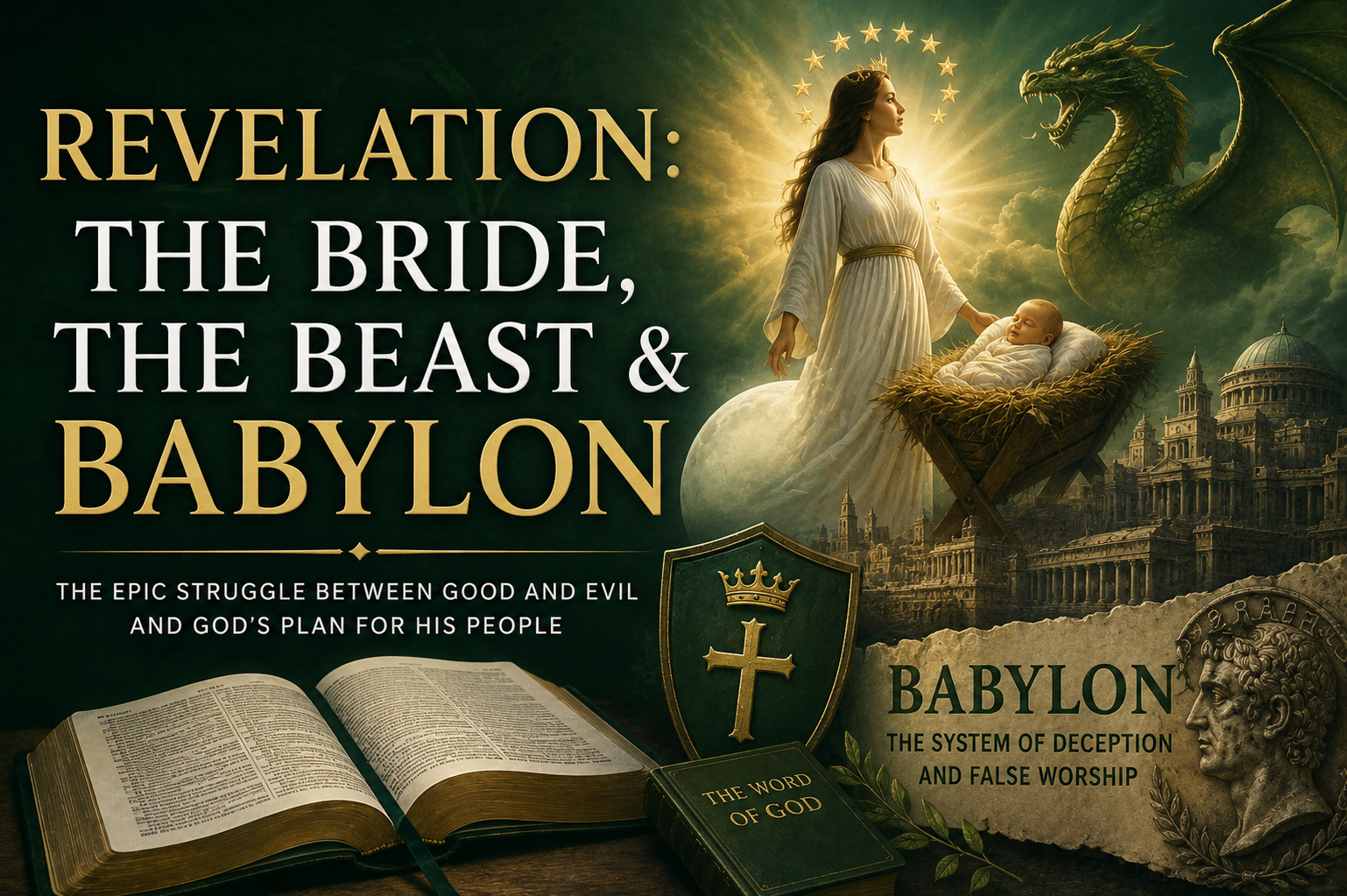
Revelation: The Bride, the Beast, and Babylon
The book of Revelation is not just a book about symbols, beasts, kingdoms, and future events. It is a book about worship, loyalty, truth, deception, and the final victory of Jesus Christ.
In Revelation, the Apostle John is shown a great spiritual conflict. This conflict is not limited to one generation or one empire. It reaches back to the beginning of human history and continues until the return of Christ. It is the conflict between Christ and Satan, between truth and error, between the bride of Christ and the powers of Babylon.
At first glance, Revelation can feel difficult to understand. It speaks of a woman, a child, a dragon, a beast, Babylon, persecution, commandments, testimony, and final judgment. But when we allow the Bible to explain its own symbols, a clear picture begins to form.
This is not a prophecy meant to create fear. It is a prophecy meant to call God’s people back to faithfulness.
Revelation shows us that Jesus has a people. It also warns us that Satan has always worked to corrupt, persecute, and deceive. Yet through every age, God has preserved His Word and raised up faithful men and women to stand for the truth.
The Woman, the Child, and the Dragon
Revelation 12 begins with a powerful scene:
“Now a great sign appeared in heaven: a woman clothed with the sun, with the moon under her feet, and on her head a garland of twelve stars.”
The prophecy then shows this woman about to give birth. Before the child is born, a great dragon stands before her, ready to devour the child as soon as He is born.
This scene may sound strange at first, but the Bible gives us the key to understanding it.
In Scripture, a pure woman often represents God’s faithful people. The church is described as the bride of Christ. Paul writes in Ephesians 5 that Christ loved the church and gave Himself for her. This image helps us understand the woman in Revelation 12 as a symbol of God’s people, first through faithful Israel and then through the church that Christ established.
The child is easier to identify. Revelation says He will rule the nations with a rod of iron and that He is caught up to God and His throne. These details point directly to Jesus Christ.
The dragon is also clearly identified. Revelation 12 says the dragon is “that serpent of old, called the Devil and Satan.”
So the picture becomes clear:
- The woman represents God’s faithful people.
- The child represents Jesus Christ.
- The dragon represents Satan.
This prophecy shows the long war between Christ and Satan. It also shows that Satan’s hatred for Jesus did not begin at the cross. From the very beginning, the enemy tried to stop the plan of salvation.
The Attack on Christ
Revelation 12 points us back to the birth of Jesus and the attempt to destroy Him.
In the Gospel of Matthew, wise men came from the east looking for the newborn King of the Jews. This troubled Herod because “King of the Jews” was his own title under Roman authority. Herod saw Jesus as a threat to his throne.
He asked where the Messiah was to be born and learned that the prophecy pointed to Bethlehem. Then, in rage and fear, Herod ordered the killing of young children in Bethlehem in an attempt to destroy Christ.
But Revelation shows us that this was not only the jealousy of a cruel earthly king. Behind Herod’s actions was the dragon. Satan was working through human power to try to destroy the Savior.
This is one of the central lessons of Revelation:
Behind visible events, there is an invisible spiritual conflict.
Earthly rulers may act for political reasons. Religious leaders may act out of fear. Nations may act out of pride. But behind the scenes, there is a larger battle over the salvation of humanity.
Satan tried to destroy Christ at His birth. He tried to tempt Him in the wilderness. He tried to silence Him during His ministry. He worked through opposition, accusation, rejection, and finally crucifixion.
But the enemy failed.
Jesus died for our sins, rose from the dead, and ascended to the throne of God.
The Victory of Jesus
Revelation 12 says the child was “caught up to God and His throne.”
This points to the resurrection and ascension of Christ. Satan could not defeat Jesus. The cross, which looked like the enemy’s greatest victory, became the place where Christ won the victory over sin and death.
Isaiah 53 says:
“He was wounded for our transgressions, He was bruised for our iniquities.”
Jesus took upon Himself the guilt of humanity. He carried our sins. He died in our place. Then He rose again, proving that sin, death, and Satan do not have the final word.
Because Christ is now beyond Satan’s reach, the enemy turns his anger toward the followers of Jesus.
That is why Revelation says the dragon persecuted the woman who gave birth to the male child.
The Persecution of the Early Church
After Christ’s ascension, the church grew rapidly. But that growth came with opposition.
The Roman Empire viewed Christianity with suspicion. Christians refused to worship the Roman gods. They refused to offer worship to the emperor. They confessed that Jesus, not Caesar, was Lord.
To Rome, this looked dangerous. Roman religion was tied to the well-being of the state. If people refused to honor the gods, many believed the empire could suffer divine anger. Christians became easy scapegoats when problems came.
As a result, believers were stripped of rights, accused falsely, and persecuted for their faith. Yet their courage became a testimony.
The early Christians did not have political power. They did not have armies. They did not control the empire. But they had the gospel.
And the gospel could not be stopped.
Even under pressure, Christians continued to worship, pray, serve, and witness. Their faithfulness showed the world that Jesus was worth more than comfort, safety, or even life itself.
The Catacombs and the Hope of Resurrection
During periods of persecution, many Christians in Rome used underground burial places known as catacombs.
These were not simply natural caves. They were carefully excavated underground spaces. Christians used them to bury their dead and, at times, to gather near the tombs of believers who had died in faith.
The catacombs remind us of an important Christian belief: the resurrection of the body.
Christians buried their dead because they believed death was not the end. They believed that Christ would return and raise His people. Their burial practices were a testimony of hope.
Even in the face of persecution, the early church held fast to the promise of Jesus.
This is a powerful reminder for believers today. The Christian faith is not built on earthly comfort. It is built on Christ, His resurrection, and His soon return.
Constantine and a Turning Point in Church History
In the early fourth century, a major change took place.
Constantine rose to power in the Roman Empire. After a series of conflicts, he claimed to have received a vision connected to the Christian symbol of the cross. He went on to favor Christianity and changed the position of Christians in the empire.
Under Constantine, Christianity went from being persecuted to being protected and promoted.
This may sound like a complete victory. In some ways, it brought relief to believers who had suffered. But it also created a new danger.
When Christianity became popular and politically useful, many people entered the church without true conversion. Pagan customs, worldly ambition, and imperial thinking began to mix with Christian worship.
The church was no longer only facing danger from outside persecution. Now it faced danger from inside compromise.
When the Church Joined the Empire
By the late fourth century, Christianity became the official religion of the Roman Empire. Pagan temples were closed or converted. Christian leaders gained social and political influence. Many elites joined the church.
But the question became:
Was the church converting the empire, or was the empire changing the church?
Over time, many practices began to enter Christianity that were not rooted in Scripture. Ceremonies became more elaborate. Religious authority became more centralized. Traditions began to stand above the plain teaching of the Bible.
The simplicity of New Testament faith was increasingly covered by layers of human tradition.
This is one of the great warnings of Revelation. The enemy does not only attack God’s people through violence. He also attacks through compromise.
Persecution can test the church.
But popularity can corrupt it.
The Danger of Tradition Above Scripture
One of the major themes in the video is how biblical truth was gradually replaced or distorted by tradition.
This did not happen overnight. It happened over centuries. Small compromises became accepted practices. Accepted practices became traditions. Traditions became doctrines. Eventually, many people no longer knew the difference between what the Bible taught and what human religious systems had added.
Some of the issues discussed include:
- The use of images and statues in worship
- The elevation of Mary beyond what Scripture teaches
- Changes in the practice and meaning of baptism
- Changes in the Lord’s Supper
- The shift from the seventh-day Sabbath to Sunday observance
- Teachings about hell and purgatory
- Confession through priests instead of direct access to Christ
- Repetitive prayers and works-based religion
- Restricting Scripture from the common people
These issues matter because the Christian life must be built on the Word of God.
Jesus said, “You shall know the truth, and the truth shall make you free.”
If truth brings freedom, then error brings bondage.
The Sabbath and the Question of Authority
One of the clearest examples discussed is the Sabbath.
The fourth commandment says:
“Remember the Sabbath day, to keep it holy.”
The Bible identifies the seventh day as the Sabbath of the Lord. Yet over time, many Christians began to honor Sunday instead. This shift was influenced by several historical factors, including separation from Judaism, the celebration of Christ’s resurrection, and the influence of Roman sun worship.
Constantine’s Sunday law in AD 321 referred to the “venerable day of the sun.” This shows that the law was connected to Roman culture and sun worship, not a clear biblical command.
The issue is not simply about a day. It is about authority.
Who has the authority to define worship?
God?
Or human tradition?
Revelation calls God’s end-time people those who keep the commandments of God and have the testimony of Jesus. That makes the Sabbath question deeply significant.
The False Picture of God
The video also discusses how some teachings distorted the character of God.
One example is the idea of endless conscious torment in hell. The Bible teaches that sin leads to death and that the lost will ultimately perish. Jesus warned that God can destroy both soul and body in hell. The book of Revelation speaks of final judgment, but it does not present God as cruel or unjust.
When people are taught that God tortures sinners forever without end, many come to fear or even hate Him. This gives a false picture of His character.
Another example is purgatory, the idea that people suffer after death to be purified before heaven. This doctrine became tied to money, masses, and fear. Many were taught that they could help shorten the suffering of loved ones by paying for religious services.
But Scripture points us to Christ alone.
Jesus is our Savior.
Jesus is our Mediator.
Jesus is our righteousness.
Forgiveness is not purchased with money. Salvation is not earned through suffering. Eternal life is the gift of God through Jesus Christ our Lord.
The Bible Taken from the People
As traditions grew, the Bible became less accessible to ordinary people.
Many were told that only religious leaders could interpret Scripture. The Bible was often kept in languages the common people could not understand. This created spiritual darkness.
When people do not have access to God’s Word, they become dependent on human authorities. They cannot test teachings for themselves. They cannot easily see when tradition has replaced truth.
That is why the recovery of Scripture was one of the greatest blessings of the Reformation.
The Bible had to be brought back to the people.
The Rise of the Reformers
Even in times of darkness, God did not leave Himself without witnesses.
Throughout history, He raised up men and women who loved Scripture and called the church back to truth.
One of these was Peter Waldo. He believed the Bible should be made available in the language of the people. He gave up wealth, preached simply, and encouraged others to follow Scripture.
The Waldensians became known for their devotion to the Bible. They memorized large portions of Scripture. They copied biblical passages by hand. Some carried portions of Scripture hidden in their clothing and shared them carefully with people who were open to truth.
Their courage reminds us that the Word of God is worth sacrifice.
John Wycliffe and the English Bible
Another major figure was John Wycliffe, an English theologian and teacher at Oxford.
Wycliffe saw the difference between the teachings of Scripture and the corruption around him. He believed the Bible was the supreme authority and that common people should have access to it.
His work helped bring the Bible into English and inspired later reformers. His followers, known as Lollards, spread Scripture and preached a simpler, Bible-centered faith.
Wycliffe’s influence reached far beyond his own lifetime. His writings helped prepare the way for the Reformation.
He reminds us that one person committed to Scripture can help change history.
John Hus and the Cost of Truth
John Hus was deeply influenced by Wycliffe’s writings. He preached in the language of the people and called for reform in the church.
Hus contrasted the humility of Jesus with the pride and wealth of religious power. He called attention to the difference between Christ’s simple life and the luxury of corrupt religious leaders.
Because he stood for truth, Hus was arrested, tried, and condemned. Even when facing death, he refused to turn away from what he believed Scripture taught.
His courage became a testimony to future generations.
Before his death, Hus spoke of another reformer who would arise later and whose voice could not be silenced.
Martin Luther and the Return to Scripture
Martin Luther became one of the best-known reformers in Christian history.
As a monk, Luther longed for assurance of salvation. He fasted, prayed, confessed, and worked hard to find peace with God. But peace did not come through human effort.
Eventually, through Scripture, Luther began to understand the truth:
“The just shall live by faith.”
This changed everything.
Luther saw that salvation was not earned through pilgrimages, penance, indulgences, or human works. It was received by faith in Jesus Christ.
When indulgences were being sold in Germany, Luther objected. On October 31, 1517, he posted his 95 Theses, calling for debate and reform. He did not expect to start a movement that would shake Europe. But the truth of Scripture could not be contained.
At the Diet of Worms, Luther was commanded to recant. His answer became one of the most famous statements in Christian history:
“My conscience is captive to the Word of God.”
That is the heart of the Reformation.
The Printing Press and the Spread of Truth
God used the printing press at a crucial moment in history.
Before printing, Bible copies were slow and expensive to produce. But with the printing press, Scripture and reform writings spread rapidly across Europe.
People began reading the Bible for themselves. They saw the difference between the teachings of Jesus and the traditions that had been added over time.
The light of Scripture began to break through centuries of darkness.
Reformers such as Luther, Tyndale, Calvin, Knox, and others helped bring the Bible back to the center of faith.
The message was simple:
Scripture must be above tradition. Christ must be above every human mediator. Grace must be above works. Truth must be above error.
The Bride and Babylon
Revelation contrasts two women.
In Revelation 12, there is a pure woman, representing God’s faithful people.
In Revelation 17, there is another woman, described as Babylon. She is connected with worldly power, false worship, persecution, and spiritual compromise.
This contrast is not meant to attack sincere individuals. Many sincere people have lived within systems that contain error. God alone knows the heart.
But Revelation does call us to examine systems, teachings, and traditions in the light of Scripture.
The issue is not whether people are kind, sincere, or religious.
The issue is truth.
Does a teaching come from the Word of God?
Does it point people directly to Christ?
Does it honor the commandments of God?
Does it reflect the character of Jesus?
The Final Conflict
Revelation warns that the final conflict will involve worship and obedience.
The dragon is angry with the remnant of the woman’s seed. Revelation identifies them as those who keep the commandments of God and have the testimony of Jesus Christ.
This means the final issue is not merely political. It is spiritual.
The world will be faced with a choice between the commandments of God and the traditions of men, between the worship of the Creator and the worship of human power, between the bride of Christ and Babylon.
Jesus warned that deception would be strong in the last days. False teachings would be convincing. Religious systems would appear powerful. Many would be led away from simple biblical truth.
That is why we must know Scripture for ourselves.
Where Will You Stand?
The message of Revelation is not only about history. It is personal.
Every person must choose whom they will serve.
Will we follow tradition when it conflicts with Scripture?
Will we trust human authority above the Word of God?
Will we accept a comfortable religion, or will we follow Christ wherever He leads?
The Reformers were not perfect people. But they understood something deeply important: God’s Word must stand above every human institution.
That same truth matters today.
We are not saved by belonging to a system. We are not saved by religious tradition. We are not saved by ceremonies, payments, penance, or human merit.
We are saved by Jesus Christ.
He is the Lamb of God.
He is our High Priest.
He is our Mediator.
He is our righteousness.
He is the true Head of the church.
A Call Back to the Word of God
The prophecy of the bride, the beast, and Babylon is a call back to Scripture.
It calls us to test every teaching by the Bible.
It calls us to worship God alone.
It calls us to reject false traditions that hide the beauty of Christ.
It calls us to stand with the faithful people of God, even when truth is unpopular.
Most of all, it calls us to Jesus.
The dragon has fought against Christ from the beginning. He tried to destroy the Savior. He persecuted the church. He worked through compromise. He used tradition to cover truth. He tried to keep Scripture from the people.
But he has not won.
Jesus has overcome.
The Word of God still stands.
The gospel still saves.
The truth still makes people free.
And Christ is coming again for a faithful people who love Him, trust Him, and follow His Word.
The question remains:
Where will you stand?
Discover more from Fannin County Seventh-day Adventist Church
Subscribe to get the latest posts sent to your email.


