
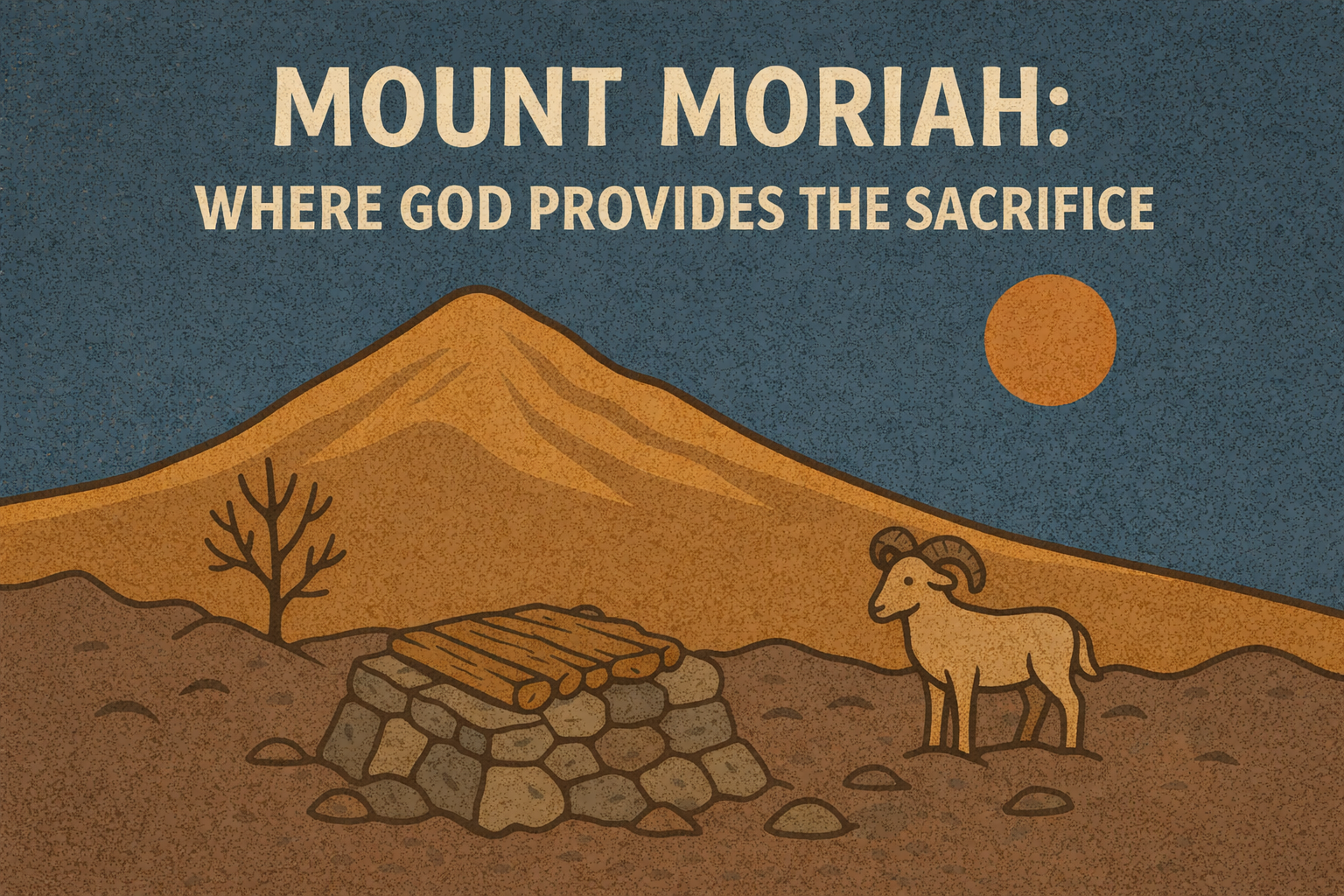
Mount Moriah: Where God Provides the Sacrifice
From Abraham and Isaac to the Temple, its destruction, and the cross of Christ, Mount Moriah tells one united story of sacrifice and atonement.
Watch: Archaeology and the Story of Mount Moriah
The video below walks through the biblical, historical, and archaeological evidence for the true location of Mount Moriah, the Temple Mount in Jerusalem, and how it all connects to the sacrifice of Jesus.
What Makes Mount Moriah So Unique?
The hill known as Mount Moriah in Jerusalem has carried some of the most important events in biblical history. Over roughly 4,000 years, this one location has held:
- The altar of Abraham and Isaac
- The altar of King David
- Solomon’s Temple (the First Temple)
- The Second Temple rebuilt by Zerubbabel
- The expansion of the Temple Mount by Herod the Great
- A Roman shrine under Emperor Hadrian
- The Islamic shrine known as the Dome of the Rock
Today, the Temple Mount is one of the most sensitive and contested religious sites on earth, which is why archaeologists have never been allowed to excavate directly on top of it. Yet even without digging into the platform itself, there is still a large amount of archaeological evidence around it that confirms what the Bible says about this sacred hill.
Abraham and Isaac: The First Altar on Moriah
The story of Mount Moriah begins with Abraham. In Genesis 22:2, God tests Abraham and says:
“Take your son, your only son, whom you love, Isaac, and go to the region of Moriah. Sacrifice him there as a burnt offering on a mountain I will show you.”
Abraham and Isaac climb the mountain together. Isaac notices that they have fire and a knife, but no lamb for the offering. He asks his father where the lamb is. Abraham answers in faith:
“God himself will provide the lamb.”
At the top of the mountain, Abraham builds an altar. He binds Isaac and lays him on the wood. As he raises the knife, the angel of the Lord calls from heaven, telling him not to harm the boy. Abraham looks up and sees a ram caught by its horns in a thicket. He sacrifices the ram instead of his son.
This is the first clear picture of substitutionary sacrifice on Mount Moriah:
- The ram dies so that Isaac can live.
- A life is given in the place of another.
From this moment on, Mount Moriah becomes a place where God provides a sacrifice so that His people might live.
David’s Altar: A Plague Stopped by Sacrifice
Centuries later, another altar is built on this same hill. In 2 Samuel 24, King David sins, and the Lord sends a plague on Israel. As David sees the angel striking down the people, he cries out that the fault is his.
God then commands David to build an altar on the threshing floor of Araunah (Ornan) the Jebusite. David buys the threshing floor and the oxen, builds an altar, and offers burnt offerings.
“David built an altar to the Lord there and sacrificed burnt offerings and fellowship offerings. Then the Lord answered his prayer in behalf of the land, and the plague on Israel was stopped.” (2 Samuel 24:25)
Again we see the same pattern:
- The oxen die so that Israel can live.
- A sacrifice is offered, and judgment stops.
Scripture later ties this threshing floor directly to Mount Moriah and to the site of the future temple.
Solomon’s Temple on Mount Moriah
The key verse that connects all these events is 2 Chronicles 3:1:
“Then Solomon began to build the temple of the Lord in Jerusalem on Mount Moriah, where the Lord had appeared to his father David. It was on the threshing floor of Araunah the Jebusite…”
This one verse ties three locations together as the same place:
- The mountain where Abraham built his altar in the region of Moriah.
- The threshing floor of Araunah the Jebusite where David built his altar.
- The site where Solomon built the Temple of the Lord.
So Mount Moriah is:
- The place of Abraham’s altar.
- The place of David’s altar.
- The place of Solomon’s temple and its sacrificial altar.
In 2 Chronicles 2:6, Solomon explains the purpose of the temple as a place to burn sacrifices before God. The theme that holds the whole hill together is sacrifice and atonement.
The Meaning of Sacrifice: A Rabbi’s Perspective
In the video, the presenter interviews Rabbi Ken Spiro about the meaning of sacrifice in the Old Testament. They discuss Leviticus 17:11:
“For the life of a creature is in the blood, and I have given it to you to make atonement for yourselves on the altar; it is the blood that makes atonement for one’s life.”
The rabbi explains that the Hebrew word for sacrifice, korban, comes from a root that means “to draw near.” Sacrifice is not about “feeding God” but about recognizing the seriousness of sin and drawing near to Him through atonement.
When the blood of the animal is applied to your sin, the barrier between you and God is removed, and relationship is restored. The temple is a tool for atonement and reconciliation.
Destruction, Exile, and the Longing to Rebuild
Because the temple was the one place where Israel could offer atoning sacrifices, its destruction was devastating. In 2 Kings 25:9, the Babylonians burn the temple and break down the walls of Jerusalem. The people are exiled, and the sacrificial system is interrupted.
When the exiles return under the decree of Cyrus, their first desire is to rebuild the temple on the same site. In Ezra 6, Cyrus orders that the house of God be rebuilt in Jerusalem as a place to present sacrifices and that the governor of the Jews should repair its ruins.
The second temple is not built somewhere new. It is built on the same spot, repairing the ruins of the first temple. Later, the historian Josephus tells us that Herod the Great did not move the temple either. He enlarged and glorified the existing Temple on the same Mount Moriah.
Did the Temple Really Stand on Today’s Temple Mount?
In recent years, some have claimed that the temple did not stand on the traditional Temple Mount, but somewhere else, such as over the City of David. These claims usually appeal to Jesus’ prophecy that “not one stone will be left on another.”
To answer this, we need to understand what the Temple Mount platform is and what Jesus was referring to.
The Temple Mount is a flat platform built on a natural hill. Massive retaining walls were constructed around the hill, and the area between those walls and the slope was filled in to create a large, level surface. On top of that platform stood the buildings, including the temple and the royal stoa.
In Mark 13, the disciples admire the “massive stones” and “magnificent buildings.” Jesus responds:
“Do you see all these great buildings? Not one stone here will be left on another; every one will be thrown down.”
He is speaking about the buildings, not the retaining walls of the platform. In AD 70, the Romans destroyed the temple and the other structures on top of the mount. Those stones were thrown down off the platform and crashed onto the street below.
Archaeological Evidence for the Destruction Jesus Described
Today, at the base of the western wall of the Temple Mount, you can still see a huge pile of ancient stones. These are stones from the buildings that once stood on top of the platform. They were pushed over the edge when the Romans destroyed Jerusalem.
The Roman street beneath them is cracked and buckled from the impact. The stones once rested on top of each other in the temple and other structures, but now they lie broken and scattered.
Israeli archaeologist Gabby Barkai, who is not a Christian, points to these stones and plainly says this is archaeological evidence that Jesus’ prophecy came true: the buildings on the Temple Mount were completely thrown down.
The platform itself remains, but the temple and the royal stoa do not.
Hadrian’s Shrine and the Dome of the Rock
After the temple’s destruction, the site did not simply vanish from history.
- In the early second century, Emperor Hadrian built a shrine on the Temple Mount with statues of himself and the god Jupiter. Early Christian writer Jerome saw this with his own eyes.
- During the Byzantine Christian period, the Temple Mount remained mostly bare. The Christians did not build a church there, in part because of Jesus’ prophecy that not one stone would be left on another.
- In AD 638, the Muslim caliph Umar asked the bishop of Jerusalem for a place to build a sanctuary. The bishop pointed him to the rock where the temple had stood.
- In AD 692, the caliph Abd al-Malik built the Dome of the Rock over that rock.
The Dome of the Rock does not erase the history of the site. It actually marks the same location that Jews, Christians, and Muslims all recognize as the ancient temple area on Mount Moriah.
Archaeological Layers around Mount Moriah
Even though the platform itself has not been excavated, the areas around it have been. These excavations give us a timeline of history linked to the Temple Mount:
- Islamic period: The Dome of the Rock (AD 692) sits on the rock peak of Mount Moriah.
- Roman period: Large arches north of the Western Wall were built by Hadrian to access his shrine on top of the mount.
- Destruction of AD 70: Piles of fallen stones at the base of the walls and the damaged pavement below them.
- Herodian masonry: Distinctive stones in the western and southern walls show where Herod expanded the platform.
- Zerubbabel’s period: North of a visible “seam” in the wall, some stones from the earlier Second Temple period still remain.
- Solomonic period: Towers and walls between the City of David and the Temple Mount, built by Solomon, have been uncovered, showing how he extended the city north to include Mount Moriah.
- Earlier layers: Beneath the City of David are remains from the time when the city was called Salem, the era of Abraham.
All of these layers point to the same conclusion: the Temple Mount is the authentic Mount Moriah. The stones around it tell the story of Abraham, David, Solomon, the exiles, Herod, Rome, Islam, and most importantly, the story of God’s plan of atonement.
From Abraham’s Ram to the Lamb of God
The video draws a powerful connection between two nearby places in Jerusalem:
- Mount Moriah, marked today by the Dome of the Rock, where Abraham offered Isaac and where the temple once stood.
- The area of the Church of the Holy Sepulchre, just to the west, which marks the traditional site of Jesus’ crucifixion.
On Mount Moriah, God provided a ram so that Isaac might live. At Calvary, God provided His own Son as the Lamb of God so that we might live.
In John 2, in the temple courts on Mount Moriah, Jesus says:
“Destroy this temple, and I will raise it again in three days.”
The crowd misunderstands, thinking He is speaking about the stones of Herod’s temple. But John explains:
“The temple he had spoken of was his body.”
Jesus claims that His body is the true and greater temple, the place where God and humanity meet. His death and resurrection would provide a better atonement than the blood of animals.
Isaiah 53 and the Lamb of God
The idea of a suffering, substitutionary sacrifice is not new in the New Testament. It is rooted in the Old Testament, especially in Isaiah 53. There, the prophet speaks of a “suffering servant”:
- “The Lord has laid on him the iniquity of us all.”
- “He was led like a lamb to the slaughter.”
- “He was cut off from the land of the living.”
- “The Lord makes his life an offering for sin.”
Isaiah describes someone who will bear the sins of others, who will die in their place, and whose life will be offered as a sacrifice. The New Testament identifies this person as Jesus.
In John 1:29, John the Baptist sees Jesus and says:
“Look, the Lamb of God, who takes away the sin of the world!”
Just as the ram died instead of Isaac, and the oxen died instead of Israel’s judgment in David’s day, so Jesus dies instead of us. His sacrifice is the final and complete korban, bringing us near to God.
The Curtain Torn and the Way Opened
Jesus did not die on top of Mount Moriah. Hebrews 13:12 reminds us that He suffered “outside the city gate.” He was crucified outside the walls of Jerusalem. Yet the moment He died had a powerful effect inside the city, in the heart of the temple itself.
Matthew 27 tells us that when Jesus gave up His spirit:
“At that moment the curtain of the temple was torn in two from top to bottom.”
That curtain separated the Holy of Holies from the rest of the temple. It symbolized the barrier between a holy God and sinful people. When it tore from top to bottom, God was declaring that the way into His presence was now open through the blood of Jesus.
The sacrifice of Christ is the ultimate korban. Through His blood, those who trust in Him can draw near to God, forgiven and cleansed, and enter into a relationship with Him both now and forever.
What Mount Moriah Says to Us Today
When we look at Mount Moriah and the Temple Mount, we see more than ancient stones and layers of history. We see a story that runs from Abraham to David, from Solomon to Jesus:
- God provides a sacrifice so that His people might live.
- Sin is serious, and atonement is costly.
- Animal sacrifices pointed forward to a greater sacrifice yet to come.
- In Jesus, the Lamb of God, that greater sacrifice has been made.
The archaeology around Mount Moriah confirms that the Bible is rooted in real places and real events. But more importantly, it points us to a real Savior. The hill where Abraham said, “God himself will provide the lamb,” is not far from the hill where God did just that in Christ.
The curtain is torn. The way is open. The only question left is how we will respond.
If you would like to pray, study, or talk more about what it means to know Jesus as Savior and Lord, we at Fannin SDA Church would be honored to walk alongside you. The God who provided on Mount Moriah is the same God who offers grace to you today.
Discover more from Fannin County Seventh-day Adventist Church
Subscribe to get the latest posts sent to your email.


