
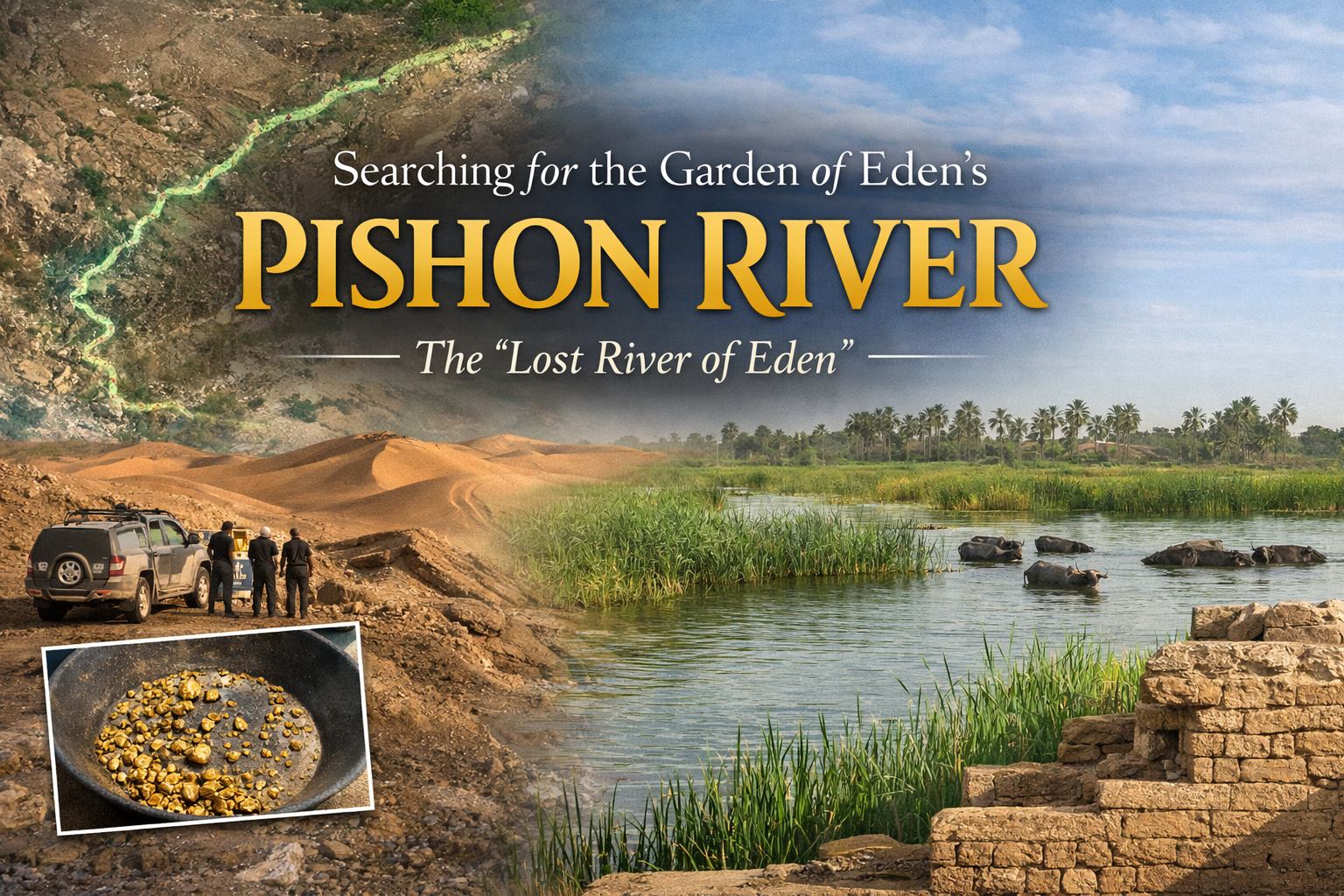
Searching for the Garden of Eden’s Pishon River (The “Lost River of Eden”)
In Genesis 2, the Bible describes Eden in relation to four rivers. Three are identifiable, but one has long been a mystery: the Pishon. In this field-style video, the case is made that the best candidate for Pishon is an ancient river system in Arabia that once flowed across the peninsula and toward Mesopotamia.
Genesis 2 and the “mystery river”
Genesis 2 describes a river that watered the garden, and from there it became four “riverheads.” Two of the rivers are widely recognized as the Tigris and the Euphrates. Another river (Gihon) is debated, and the fourth, Pishon, is the big question.
The key clue highlighted in the video is Genesis 2:11: Pishon “winds through the whole land of Havilah.” So the whole search depends on identifying where Havilah was understood to be located.
Why look south, not north?
Many Bible maps show two broad proposals for Eden’s region: a northern one (near Turkey/Armenia) and a southern one (near the lower Tigris-Euphrates region). The argument made here leans strongly toward the southern proposal for a few reasons:
- Geography: the south is lower, warmer, and more “garden-like.”
- Hydrology: if these rivers relate to each other, you need a region where major rivers can connect.
- Biblical direction clues: the land connected to Pishon is described in a way that points east of Egypt toward the direction of Assyria.
The “confluence” idea: four rivers that merge
One of the most interesting parts of the video is how it handles Genesis 2:10. At first glance, the verse sounds like one river splits into four branches, which feels backwards to how we normally think about rivers.
The speaker leans on Hebrew scholarship (including E. A. Speiser) to argue the wording can be understood the other way around: that the “heads” are branches that merge together in the Eden region. That matters because it pushes the search toward a place where multiple rivers come together.
The southern setting: where Tigris and Euphrates meet
The video visits the area in Iraq where the Tigris and Euphrates converge and become one river system flowing toward the Persian Gulf. From there, it brings in a third river candidate (linked to the Iran-Iraq border area) as part of the “connected rivers” picture.
Then the focus shifts back to the missing piece: Where is Pishon?
Havilah: “opposite Egypt” toward Assyria
The main directional clue used is that Havilah is described as being opposite Egypt in the direction of Assyria. The argument presented is that the region that fits that description best is the Arabian Peninsula (especially what is now Saudi Arabia), on the route toward Mesopotamia.
Gold, resin, and onyx: a “commodity match”
Genesis 2 doesn’t only name rivers. It also describes Havilah as a land known for resources:
- Gold (and the text says the gold is “good”)
- Aromatic resins
- Onyx stone
The video argues this lines up well with Arabia’s historic reputation for gold mining and incense-route trade (frankincense and myrrh), along with precious stones. This is presented as another “fit” between the Genesis description and the Arabian setting.
The leading Pishon candidate: an ancient riverbed across Arabia
Here’s the central claim: although there is no major river crossing Arabia today, satellite studies identified a massive ancient river system that once did.
The video points to an ancient riverbed known locally as Wadi ar-Rumah as the leading candidate for Pishon. The case is built using:
- Satellite identification of a continuous ancient drainage path across Arabia
- Physical scale (a huge riverbed, often far wider than expected)
- Geologic “pebble trail” logic: stones and rock types found far downrange match sources in the Hijaz mountains, implying long-distance water transport
- Route logic: the riverbed aligns with movement corridors toward Mesopotamia
But wasn’t it dry “until around 200,000 BC”?
The transcript mentions estimates that the river flowed continuously until around 200,000 BC before climate shifts dried it up. If that’s correct, it raises big timeline questions depending on how someone reads Genesis (literal chronology, archetypal reading, or other frameworks).
The video’s main goal isn’t to settle every timeline debate. It’s to argue that Genesis 2 points to a real-world geography, and that Arabia has a plausible “lost river” candidate that matches the description better than distant proposals.
The marshes of southern Iraq: a “garden-like” landscape
Near the end, the video describes the vast marshlands of southern Iraq near the region where major rivers converge. The point is simple: regardless of what the land looked like “before the Flood,” the area today still shows why a low, warm, well-watered region could reasonably be described as garden land.
From Paradise Lost to Paradise Regained
The closing section moves from geography to the bigger biblical story: Eden represents paradise lost through sin, and the hope of paradise regained is tied to God’s plan of redemption and the promise of a renewed creation.
In other words, the search for Eden’s rivers isn’t only about maps. It’s also about longing for what was lost, and the promise of restoration.
Quick takeaway
- Genesis 2 ties Eden to four rivers, and Pishon is the hardest to identify.
- The video argues “Havilah” points us toward Arabia.
- A huge ancient riverbed (Wadi ar-Rumah) is presented as the strongest Pishon candidate.
- Southern Iraq is presented as the most “connected rivers” region and a realistic garden setting.
Note: This article summarizes and discusses claims made in the video and its transcript. Interpretations vary, and some points (especially chronology and identifications) are debated among scholars.


